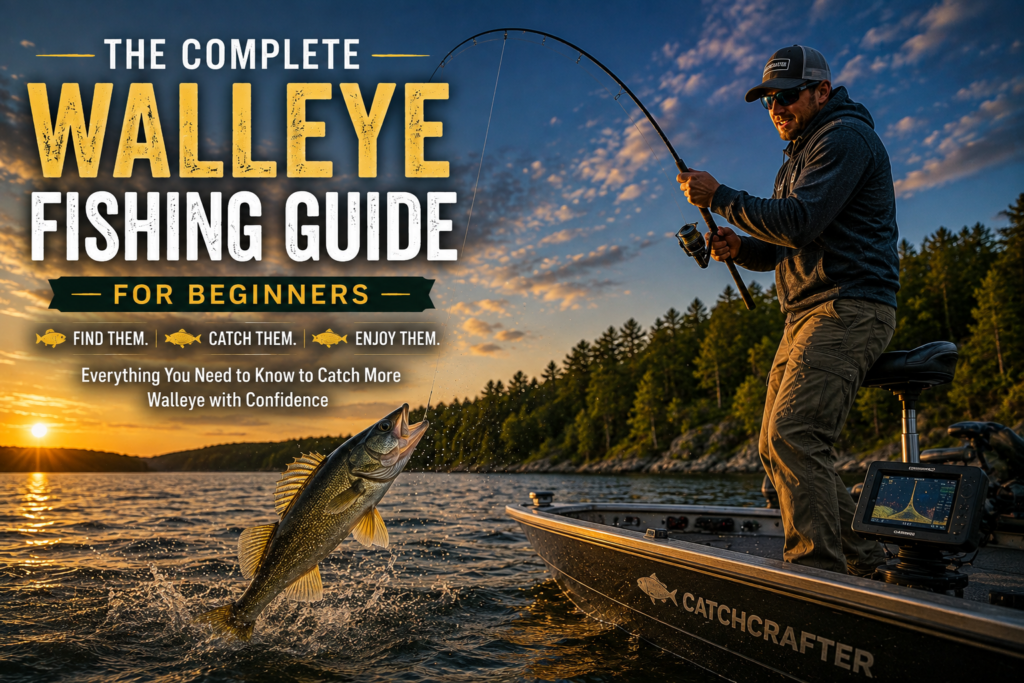
Walleye are one of the most sought-after freshwater game fish in North America, prized for their sharp eyesight, challenging behavior, and outstanding table fare. Whether you’re casting from shore, drifting a river, jigging deep structure, or trolling open water, learning to understand walleye behavior is the key to catching more fish.
Unlike bass, walleye are often most active during low-light periods and can be surprisingly sensitive to changes in light, water temperature, and seasonal conditions. That’s why successful walleye anglers focus not only on choosing the right lure, but also on knowing where fish are likely to be and how their behavior changes throughout the year.
This guide is designed for beginners who want to build confidence on the water without feeling overwhelmed. We’ll cover everything from understanding walleye behavior and choosing the right equipment to selecting productive lures, using live bait, finding fish in every season, and avoiding common beginner mistakes.
Whether you’re hoping to catch your very first walleye or improve your success on your local lakes and rivers, this guide will provide the practical knowledge and proven techniques to help you become a more confident and successful angler.
🎣 Partner’s Tip
Don’t worry if walleye seem difficult to catch at first. Every experienced walleye angler has had days when the fish simply refused to cooperate. The secret isn’t luck—it’s learning how walleye behave and adapting your presentation to match the conditions. As your confidence grows, so will your success.
🐟 Understanding Walleye
Walleye are one of North America’s most recognizable freshwater game fish, known for their excellent eyesight, cautious nature, and outstanding table fare. Their large, reflective eyes allow them to see exceptionally well in low-light conditions, which is why they are often most active at dawn, dusk, on cloudy days, or after dark.
Unlike bass, which often strike aggressively out of instinct or territorial behavior, walleye are generally more deliberate feeders. They prefer to conserve energy and frequently position themselves near structure or along natural travel routes where baitfish pass by. Instead of chasing prey over long distances, walleye often wait patiently before making a quick, decisive attack.
Walleye inhabit a wide variety of waters, including natural lakes, reservoirs, rivers, and large impoundments. They are commonly found near points, drop-offs, rock piles, weed edges, current breaks, and submerged humps. As water temperatures and seasonal conditions change, walleye move between shallow and deep water in search of food, comfortable temperatures, and suitable spawning habitat.
One of the biggest keys to consistent success is learning these seasonal movements. Anglers who understand where walleye are likely to be during each season spend less time searching and more time catching fish.
🎣 Walleye Facts at a Glance
| Feature | Description |
|---|---|
| Scientific Name | Sander vitreus |
| Average Size | 15–25 inches |
| Trophy Size | 28 inches and larger |
| Preferred Water | Cool, clear lakes, rivers, and reservoirs |
| Best Feeding Times | Dawn, dusk, overcast days, and night |
| Favorite Foods | Minnows, perch, shad, crayfish, leeches, and nightcrawlers |
| Typical Habitat | Points, drop-offs, rocks, weed edges, current breaks |
| Difficulty | ⭐⭐⭐ Moderate |
Why Walleye Are Called the “Fish with Glass Eyes”
One of the first things anglers notice about a walleye is its large, reflective eyes. A special layer behind the retina, called the tapetum lucidum, reflects available light back through the eye, allowing walleye to see exceptionally well in dim conditions. This adaptation gives them a major advantage when hunting at dawn, dusk, or in stained water while many prey species struggle to see approaching predators.
This exceptional vision is one reason walleye often avoid bright sunlight and move deeper during the middle of the day, especially in clear lakes. Understanding this behavior helps explain why many successful anglers focus their efforts during low-light periods or target deeper structure when the sun is high.
🎣 Partner’s Tip
If you’re struggling to catch walleye during the middle of a bright, sunny day, don’t assume the fish aren’t there. More often than not, they’ve simply moved deeper or tucked closer to structure. Adjust your presentation instead of changing lakes—you’ll often find the fish were there all along.
📍 Where to Find Walleye
One of the biggest secrets to catching more walleye has very little to do with choosing the perfect lure. Successful anglers consistently catch more fish because they understand where walleye spend their time throughout the day and during each season.
Walleye rarely wander aimlessly. Instead, they relate to structure, depth changes, current, and available food. Learning to recognize these areas will dramatically increase your chances of finding active fish before you ever make your first cast.
Whether you’re fishing a natural lake, reservoir, or river, walleye are usually found near locations that provide easy access to food while offering security from predators and bright sunlight.
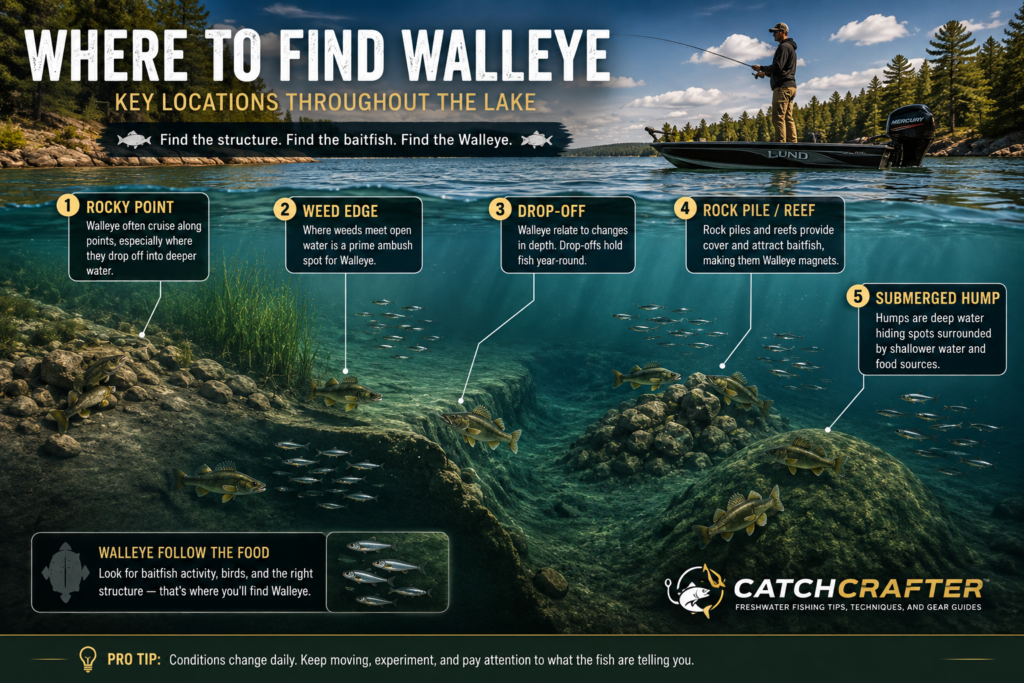
🎣 Prime Walleye Locations
Rocky Points
Rocky points extending into deeper water are classic walleye locations. These areas often attract baitfish and provide excellent feeding opportunities, especially during low-light periods.
Drop-Offs
Walleye frequently position themselves along underwater drop-offs where shallow flats transition into deeper water. These edges act like underwater highways that fish use when moving between feeding and resting areas.
Weed Edges
Healthy weed lines provide cover for baitfish and create excellent ambush points for hungry walleye. Focus on the outside edge where vegetation meets deeper water. Fishing around vegetation can require a different approach. Read our Strategies for Weedy Areas guide for more tips on working productive weed cover.
Rock Piles and Reefs
Submerged rocks attract crayfish, minnows, and other forage species. Walleye often hold along these structures during the day before moving shallower to feed.
River Current Breaks
In rivers, walleye conserve energy by holding behind rocks, wing dams, bridge pilings, and other structures that reduce current while allowing food to drift toward them.
Humps and Underwater Islands
Offshore humps rising from deeper water can hold schools of walleye throughout much of the year. These isolated structures often become feeding stations, particularly during summer.
🎣 Where to Find Walleye by Season
| Season | Primary Locations |
|---|---|
| 🌱 Spring | Shallow spawning areas, rocky shorelines, river mouths |
| ☀️ Summer | Deep points, humps, weed edges, thermocline depths |
| 🍂 Fall | Rocky reefs, shallow feeding flats, points |
| ❄️ Winter | Deep basins, channel edges, underwater structure |
Reading the Water
Instead of casting randomly, train yourself to look for clues that reveal where walleye may be holding. Watch for schools of baitfish, changes in water depth, rocky shorelines, submerged vegetation, and current seams. Electronics such as fish finders can also help identify drop-offs, humps, and suspended fish, but even without electronics, careful observation of the surrounding water can often point you toward productive areas.
🎣 Partner’s Tip
If I had to choose just one place to start looking for walleye on an unfamiliar lake, I’d head for a point that drops into deeper water. These areas provide easy access to both feeding and resting zones, making them productive throughout much of the year.
🎣 Essential Walleye Equipment
One of the biggest misconceptions among new anglers is that catching more walleye requires expensive equipment. In reality, a well-balanced rod, reel, and line combination is far more important than owning the latest gear.
Walleye are known for their light bites and subtle takes, so using equipment that allows you to detect those bites can make a significant difference. Fortunately, you don’t need a boat full of rods to get started. One versatile setup will handle most common walleye techniques, including jigging, casting, drifting, and live bait fishing.
As you gain experience, you may add specialized equipment for trolling, vertical jigging, or ice fishing, but a quality all-around setup is the perfect place to begin.
🎣 Recommended Walleye Setup
| Equipment | Recommendation |
|---|---|
| Rod | 6’6″ to 7′ Medium-Light or Medium Fast Action |
| Reel | 2500–3000 Size Spinning Reel |
| Main Line | 10–15 lb Braid or 6–8 lb Monofilament |
| Leader | 6–10 lb Fluorocarbon |
| Best All-Around Setup | 7′ Medium Fast Spinning Combo |
Choosing the Right Rod
A medium-light or medium-power spinning rod with a fast action provides the sensitivity needed to detect light bites while still offering enough backbone to fight larger walleye. Rods between 6½ and 7 feet long offer an excellent balance of casting distance, hook-setting power, and overall control.
Choosing the Right Reel
A quality spinning reel in the 2500 or 3000 size pairs well with most walleye rods. Look for a smooth drag system, reliable line management, and comfortable operation. Walleye often make short but powerful runs, so a consistent drag helps prevent lost fish.
Choosing the Right Fishing Line
The type of line you use depends on the technique and water conditions.
- Braided line offers maximum sensitivity and excellent hook-setting power, making it a favorite for jigging and deep-water presentations.
- Fluorocarbon is nearly invisible underwater and works well as a leader, especially in clear water.
- Monofilament remains a solid choice for beginners because it’s affordable, easy to manage, and forgiving when fighting fish.
Not sure which fishing line to choose? Consider the technique, water clarity, depth, and amount of cover when deciding between braid, fluorocarbon, and monofilament.
Essential Terminal Tackle
A small selection of quality terminal tackle will prepare you for most walleye situations.
Basic Starter Kit
- Jig Heads
- Live Bait Hooks
- Slip Sinkers
- Bottom Bouncer Weights
- Barrel Swivels
- Snaps
- Beads
- Bobber Stops
Keeping these items organized in a compact tackle box makes it easy to adapt to changing conditions without carrying unnecessary gear.
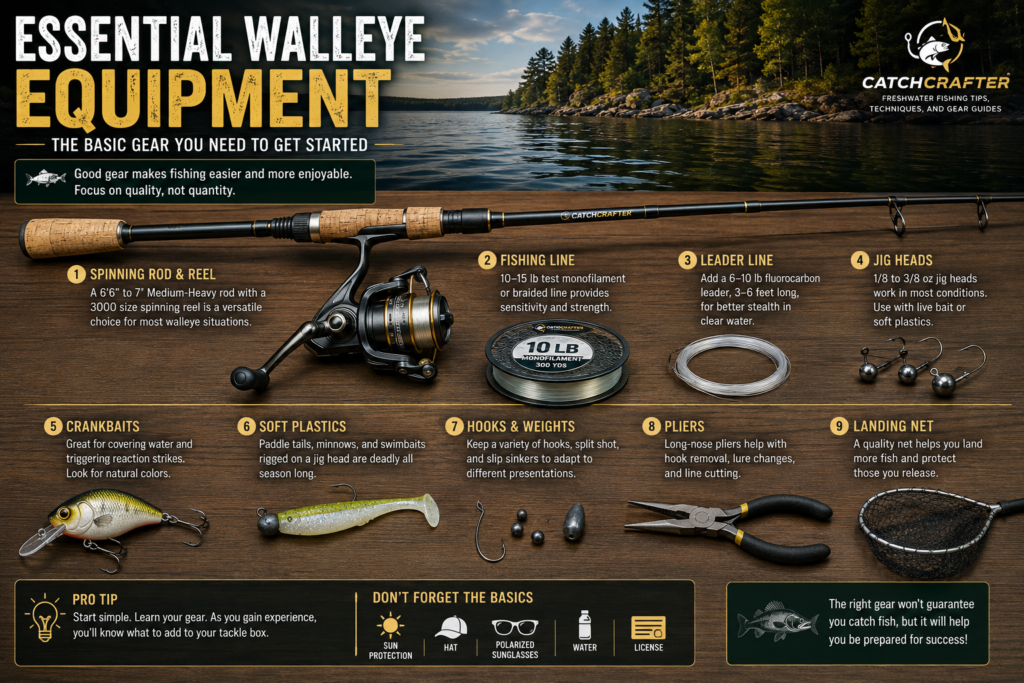
🎣 Essential Walleye Equipment Checklist
| Item | Primary Use |
|---|---|
| Medium Fast Spinning Rod | All-around fishing |
| 2500–3000 Spinning Reel | Smooth retrieves and drag |
| Braided Line | Sensitivity for jigging |
| Fluorocarbon Leader | Clear water presentations |
| Jig Heads | The #1 walleye lure |
| Live Bait Hooks | Minnows, leeches, nightcrawlers |
| Bottom Bouncers | Trolling and drifting |
| Slip Sinker Rig | Live bait presentations |
| Barrel Swivels | Prevent line twist |
🎣 Partner’s Tip
If I could only recommend one walleye setup to a beginner, it would be a 7-foot medium-fast spinning rod paired with a 2500-size reel, 10-pound braided line, and an 8-pound fluorocarbon leader. That combination is versatile enough to fish jigs, crankbaits, live bait, and many other presentations you’ll learn throughout this guide.
Best Walleye Lures
Walk into any tackle shop and you’ll find hundreds of lures marketed to walleye anglers, but you don’t need an overflowing tackle box to catch fish consistently. A relatively small collection of proven presentations can cover nearly every situation you’ll encounter throughout the year.
The key is understanding that walleye lure selection depends heavily on depth, water temperature, available forage, water clarity, and how actively the fish are feeding. A jig worked slowly near the bottom may be perfect one day, while trolling a crankbait or spinner rig may be far more effective when fish are scattered and actively searching for food.
Rather than focusing on specific brands, beginners should first learn the major lure and presentation categories and understand when each one works best. Once you understand the purpose behind each lure, choosing what to tie on becomes much easier.
Throughout this section, we’ll cover some of the most dependable walleye presentations, including jigs, crankbaits, spinner rigs, swimbaits, blade baits, and several live-bait techniques.
Want a deeper look at choosing walleye lures throughout the year? Read our Best Walleye Lures for Every Season guide.
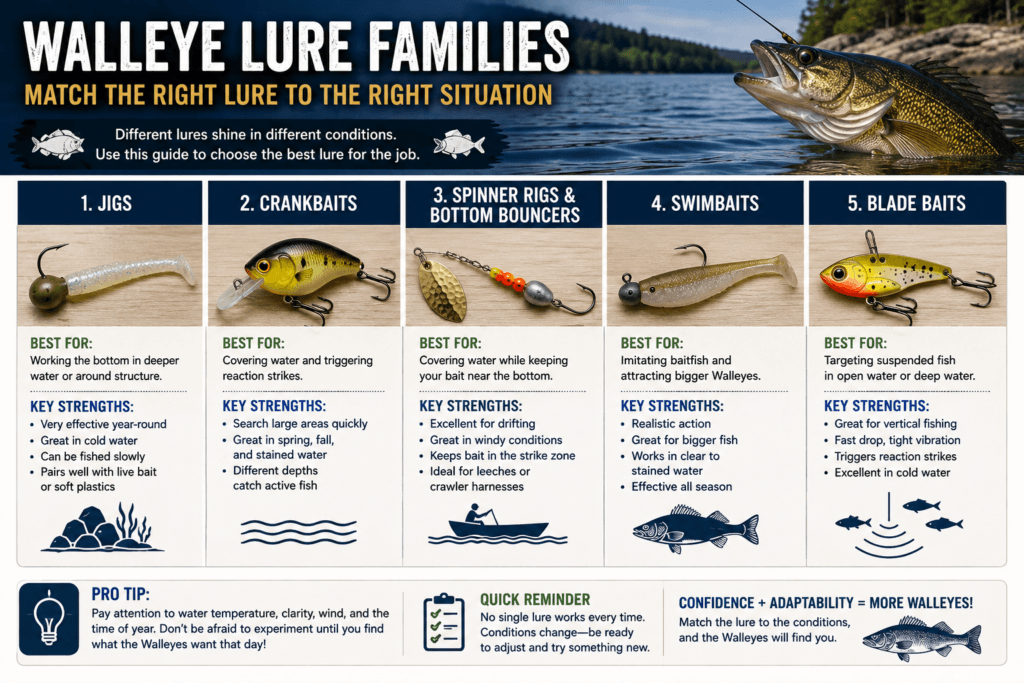
🎣 Walleye Lure Selection at a Glance
| Fishing Situation | Good Starting Choice | Why |
|---|---|---|
| Shallow Spring Water | Jig & Minnow | Slow, natural presentation |
| Deep Structure | Jig or Live-Bait Rig | Keeps bait near fish |
| Covering Open Water | Crankbait | Searches large areas efficiently |
| Summer Trolling | Spinner/Crawler Rig | Covers productive depths |
| Weed Edges | Jig or Swimbait | Easy to work along cover |
| Cold Water | Jig or Blade Bait | Effective with slower fish |
| Suspended Walleye | Crankbait | Can target specific depths |
| Finicky Fish | Live Bait | Natural scent and movement |
🎣 Partner’s Tip
Don’t make the beginner mistake of buying ten different colors of every lure before you’ve learned how to fish them. Start with a few proven presentations and become confident using them.
Knowing where the walleye are and presenting your lure correctly is usually more important than having the newest bait in your tackle box.
🎣 Jigs
If there is one presentation every beginning walleye angler should learn, it’s the jig.
Simple, affordable, and incredibly versatile, jigs can be fished from shore or boat and used in shallow water, deep water, rivers, lakes, and reservoirs. A jig can be tipped with live bait or paired with a soft plastic, allowing anglers to adjust their presentation as conditions change.
One of the biggest advantages of jig fishing is control. By changing jig weight, retrieve speed, and bait choice, you can keep your presentation near the bottom or structure where walleye frequently feed.
A classic jig tipped with a minnow is particularly useful during cooler periods, while soft plastics, leeches, and nightcrawlers can be excellent choices as conditions change.
Choosing Jig Weight
The goal isn’t to use the heaviest jig possible. Use enough weight to maintain contact and understand what your lure is doing.
As a practical starting point:
| Jig Weight | Good Starting Situation |
|---|---|
| 1/16–1/8 oz | Shallow water or light presentations |
| 1/4 oz | Versatile general-purpose choice |
| 3/8 oz | Deeper water or moderate current |
| 1/2 oz+ | Deep water or stronger current |
These aren’t rigid rules. Wind, current, depth, line diameter, and presentation can all affect the amount of weight needed.
Why Jigs Catch Walleye
Jigs can imitate minnows, insects, crayfish, and other prey while allowing the angler to control both depth and movement. They can be hopped, dragged, vertically jigged, slowly retrieved, or held nearly motionless.
That versatility is what makes the jig such an important walleye presentation.
Common Mistakes
One of the biggest beginner mistakes is overworking the jig. Walleye don’t always need an aggressive snapping motion to strike. Small lifts, slow drags, and pauses can be extremely effective.
Another mistake is using too much weight. An unnecessarily heavy jig can reduce the natural movement of the bait and make subtle bites harder to interpret.
Pay attention to what you feel through the rod. Sometimes a walleye bite isn’t a hard strike—the jig simply feels heavier, lighter, or different.
🎣 Partner’s Tip
When you’re unsure what to use, start with a 1/4-ounce jig and adjust from there. If you can’t maintain good contact because of depth, wind, or current, move heavier. If you’re fishing shallow calm water and the jig feels like it’s dropping too quickly, go lighter. Let the conditions choose the weight for you.
🎣 Crankbaits
Crankbaits are one of the best tools for finding active walleye because they allow anglers to cover large areas of water efficiently. Their baitfish-shaped profiles, wobbling action, and ability to reach different depths make them productive from spring through fall.
Walleye commonly feed on minnows, shad, perch, and other small fish, which makes a properly presented crankbait an excellent imitation of their natural forage. Crankbaits can be cast from shore or boat, but they really shine when trolling because anglers can control speed, depth, and location while searching for scattered fish.
Different crankbait styles are designed to reach different parts of the water column. Shallow-running models are useful when walleye move toward shorelines and flats, while deeper-diving crankbaits can reach fish holding along points, drop-offs, reefs, and deeper structure.
Suspending minnow-style baits can also be extremely effective in cooler water because they can be paused during the retrieve, allowing the lure to remain near fish longer.
🎣 Crankbaits at a Glance
| Feature | Recommendation |
|---|---|
| Best Seasons | Spring, Summer, Fall |
| Best Water | Clear to Stained |
| Best Areas | Points, Flats, Drop-offs, Reefs, Open Water |
| Best Use | Casting and Trolling |
| Difficulty | ⭐⭐ Beginner Friendly |
| Why It Works | Imitates baitfish and covers water efficiently |
| Useful Colors | Shad, Perch, Silver, Gold, Chartreuse |
Why Crankbaits Catch Walleye
Crankbaits combine several important strike triggers: profile, vibration, movement, and sometimes sound. A wobbling crankbait resembles a vulnerable baitfish moving through the water, and its vibration can help walleye locate the lure when visibility is reduced.
Perhaps their biggest advantage is efficiency. When you don’t know exactly where the fish are, a crankbait lets you search considerably more water than a slow-moving jig or live-bait presentation.
Once you locate a productive depth or area, you can continue fishing crankbaits or slow down with a jig or live bait to work the fish more thoroughly.
Matching the Diving Depth
One of the most important things beginners should understand is that not every crankbait runs at the same depth.
The lure’s design, bill, line diameter, trolling or retrieve speed, and amount of line out can all influence running depth.
Instead of simply choosing a crankbait because you like its color, think about where the walleye are positioned in the water column and choose a lure capable of reaching them.
A beautiful crankbait running 6 feet deep won’t help much if the fish you’re targeting are holding at 18 feet.
Common Mistakes
One common mistake is fishing crankbaits without considering their running depth. Beginners sometimes choose a lure based entirely on appearance when depth control may be far more important.
Another mistake is assuming that faster is always better. Retrieve and trolling speed can have a major effect on crankbait action, and walleye may prefer different speeds depending on water temperature and activity level.
Finally, don’t automatically assume every strike will feel violent. A walleye can sometimes simply load up the rod while trolling rather than producing the sharp strike you might expect.
🎣 Partner’s Tip
When trolling crankbaits, pay close attention whenever one rod starts producing fish. Note the lure, approximate depth, speed, and amount of line you have out. Walleye often concentrate at a particular depth, and once you discover the pattern, repeating it can turn one fish into several.
🎣 Spinner Rigs & Bottom Bouncers
Spinner rigs paired with bottom bouncers are one of the most dependable ways to catch walleye when fish are spread out along weed edges, flats, points, and other structure. This presentation allows anglers to cover water while keeping live bait close to the bottom, where walleye frequently feed.
A spinner rig—often called a crawler harness—typically consists of a leader, one or more hooks, beads, and a spinning blade. The blade adds flash and vibration while a nightcrawler, leech, or minnow provides natural scent and movement.
The bottom bouncer acts as the weight for the system. Its distinctive wire design helps the rig maintain contact with the bottom while keeping the spinner harness slightly above rocks, gravel, and other structure.
Together, the two components create a versatile presentation that is especially useful when trolling or drifting slowly for walleye.
🎣 Spinner Rigs & Bottom Bouncers at a Glance
| Feature | Recommendation |
|---|---|
| Best Seasons | Late Spring, Summer, Early Fall |
| Best Areas | Flats, Weed Edges, Points, Drop-offs |
| Best Bottom | Sand, Gravel, Rock, Sparse Vegetation |
| Common Bait | Nightcrawlers, Leeches, Minnows |
| Best Use | Slow Trolling and Drifting |
| Difficulty | ⭐⭐⭐ Beginner to Intermediate |
| Why It Works | Combines live bait with flash and vibration |
| Popular Blade Colors | Gold, Silver, Chartreuse, Orange, Perch Patterns |
How the System Works
The bottom bouncer is attached to your main line, and the spinner rig is connected behind it.
As you move through the water, the bottom bouncer tracks along or just above the bottom while the spinner blade rotates behind it. The blade produces flash and vibration, while the live bait trails naturally through the strike zone.
The goal isn’t to drag everything heavily across the bottom. You want enough weight to maintain occasional bottom contact while keeping the bait presented naturally.
Think of the bottom bouncer as your depth-control tool and the spinner harness as your fish-catching presentation.
Choosing Bottom-Bouncer Weight
Depth, wind, current, and trolling speed all influence how much weight you’ll need. Rather than memorizing one perfect size, learn to recognize whether you can maintain good bottom contact and control.
If the rig trails far behind the boat and you struggle to determine where the bottom is, you may need additional weight. If you’re constantly digging hard into the bottom or snagging, you may be using too much weight or letting out too much line.
The goal is control, not simply weight.
Choosing the Right Bait
Nightcrawlers
One of the most popular choices for spinner rigs, particularly as the water warms. Their natural movement and scent make them excellent for covering summer structure.
Leeches
A strong option from late spring through summer where regulations and availability allow. Their natural swimming movement can be especially appealing to walleye.
Minnows
Excellent during cooler periods and whenever walleye are strongly focused on baitfish.
Don’t assume one bait will always outperform the others. Walleye preferences can change, so having more than one option can help you determine what fish want that day.
Why Spinner Rigs Catch Walleye
Spinner rigs give anglers something that many presentations don’t: attraction combined with natural bait.
The spinning blade attracts attention through flash and vibration. Once a walleye approaches, the live bait provides a natural-looking target.
Because the system can be slowly trolled across large areas, it’s particularly effective when walleye aren’t concentrated in one small location.
Common Mistakes
A common beginner mistake is trolling too quickly. Spinner rigs are often most effective when they’re presented slowly enough for walleye to inspect and follow the bait.
Another mistake is allowing the bottom bouncer to drag uncontrollably. Maintaining contact is useful, but continuously plowing it through rocks and debris can lead to snags and poor bait presentation.
Finally, check your bait regularly. A nightcrawler that’s been stripped from the hook won’t catch many walleye, no matter how perfectly you’re trolling.
🎣 Partner’s Tip
When you’re learning to use a bottom bouncer, concentrate on feeling the bottom rather than staring at the rod tip. With practice, you’ll begin recognizing the difference between gravel, rock, vegetation, and an actual strike. That ability to “read” the bottom through your rod can tell you a tremendous amount about the water you’re fishing.
🎣 Swimbaits
Swimbaits are an excellent choice for walleye because they closely imitate one of their primary food sources—baitfish. Their realistic profile and swimming action make them effective in lakes, reservoirs, and rivers, and they can be fished from both shore and boat.
For beginners, a soft paddle-tail swimbait rigged on a jig head is one of the easiest versions to learn. As the lure moves through the water, the paddle-shaped tail produces a natural swimming action with subtle vibration. This allows anglers to cover water while still maintaining control over depth and retrieve speed.
Swimbaits are especially useful when walleye are actively feeding on minnows, shad, perch, or other small forage fish. They can be cast across shallow flats, retrieved along weed edges, worked around rocky points, or allowed to sink before being retrieved through deeper water.
🎣 Swimbaits at a Glance
| Feature | Recommendation |
|---|---|
| Best Seasons | Spring, Summer, Fall |
| Best Water | Clear to Moderately Stained |
| Best Areas | Points, Weed Edges, Flats, Rivers, Open Water |
| Best Style | Soft Paddle-Tail Swimbait |
| Common Size | About 3–4 inches |
| Best Use | Casting and Slow Retrieving |
| Difficulty | ⭐⭐ Beginner Friendly |
| Why It Works | Realistic baitfish profile and swimming action |
| Useful Colors | Pearl White, Shad, Perch, Chartreuse, Natural Minnow |
Choosing the Right Swimbait
You don’t need a huge collection to get started. A few soft paddle-tail swimbaits in natural baitfish colors will handle many situations.
Size should generally reflect the forage walleye are feeding on. Smaller swimbaits can be effective when young baitfish are abundant, while larger profiles may become useful when walleye are targeting larger prey.
Water clarity can also influence color selection. Natural patterns are a good starting point in clear water, while brighter or higher-contrast colors can help fish locate the lure when visibility is reduced.
How to Fish a Swimbait for Walleye
One of the easiest retrieves is also one of the most effective.
Cast the swimbait, allow it to sink toward the desired depth, and begin a slow, steady retrieve.
Occasional pauses or subtle changes in speed can make the lure appear like a vulnerable baitfish and trigger following walleye.
When fishing near the bottom, allow the lure to sink periodically during the retrieve. Around weed edges or shallower cover, keep it high enough to avoid constantly collecting vegetation.
Why Swimbaits Catch Walleye
Walleye are predators, and baitfish make up an important part of their diet. A paddle-tail swimbait combines a realistic silhouette with steady movement and vibration, giving walleye several reasons to strike.
Unlike live bait, a swimbait also allows you to cover water efficiently. That makes it particularly useful when you’re searching for fish rather than working one small area.
Common Mistakes
One of the most common mistakes is retrieving the lure too quickly. A paddle tail doesn’t need to race through the water to create action. A slower retrieve often keeps the lure in the strike zone longer.
Another mistake is using a jig head that’s unnecessarily heavy. Just as with traditional jig fishing, use enough weight to control your presentation without destroying its natural movement.
Finally, don’t assume every bite will nearly pull the rod from your hand. Sometimes you’ll simply feel extra weight or a small tap. When something feels different, set the hook.
🎣 Partner’s Tip
When you’re learning to fish swimbaits for walleye, keep things simple: start with a 3- to 4-inch paddle tail in a natural baitfish color and retrieve it slowly. Pay more attention to keeping the lure at the right depth than constantly changing colors. Once you find the fish, you can fine-tune the presentation.
🎣 Blade Baits
Blade baits are compact metal lures that produce strong vibration when lifted through the water. Although they may not look as realistic as a minnow-style crankbait or swimbait, their vibration and flash can make them extremely effective for walleye—especially when fish are holding deeper or close to the bottom.
One of the greatest strengths of a blade bait is its ability to reach deeper water quickly. Because of its thin metal body and relatively heavy weight, it sinks fast and allows anglers to maintain good contact with the lure even when fishing deeper structure.
Blade baits are especially useful during cooler-water periods in late fall, winter, and early spring, when walleye may be less willing to chase a fast-moving presentation.
Rather than retrieving them continuously, anglers commonly work blade baits with controlled lifts followed by pauses or drops. The lure vibrates strongly during the lift and then falls back toward the bottom, often triggering a strike as it drops.
🎣 Blade Baits at a Glance
| Feature | Recommendation |
|---|---|
| Best Seasons | Early Spring, Late Fall, Winter |
| Best Water | Clear to Stained |
| Best Areas | Deep Points, Rock Piles, Channel Edges, Humps |
| Best Depth | Mid-depth to Deep Water |
| Best Use | Vertical Jigging and Casting |
| Difficulty | ⭐⭐⭐ Intermediate |
| Why It Works | Strong vibration with a fast, compact fall |
| Useful Colors | Silver, Gold, Perch, Shad, Chartreuse |
How to Fish a Blade Bait
Blade baits usually don’t require dramatic rod movements.
Lower or cast the lure into the strike zone, allow it to reach the desired depth, and use a controlled lift of the rod. You should feel the lure begin vibrating as it rises.
Then lower the rod and allow the bait to fall again.
The key word is controlled.
You generally don’t need to rip the lure several feet through the water. Short, controlled lifts can provide plenty of vibration while keeping the bait near walleye holding close to structure.
When casting, blade baits can also be worked with a lift-and-fall retrieve along deeper points, rocky bottoms, and drop-offs.
Why Blade Baits Catch Walleye
Blade baits create a combination of vibration, flash, and sudden movement.
That vibration can help walleye locate the lure, while the falling action can imitate a struggling or injured baitfish.
Their compact profile also makes them excellent for reaching fish quickly when they’re holding in deeper water.
Common Mistakes
One of the biggest mistakes is working a blade bait too aggressively. Excessive snapping can pull the lure away from fish and increase the chance of tangling the hooks around the line.
Another mistake is losing contact with the lure during the fall. Many strikes occur as the blade bait drops, so stay attentive to your line and be ready whenever something feels different.
Finally, blade baits commonly use exposed treble hooks. Around heavy vegetation or snag-filled wood, another presentation may be easier to control.
🎣 Partner’s Tip
You don’t need to make a blade bait jump several feet to get a walleye’s attention. Lift it only enough to feel the blade begin vibrating, then let it fall again. If the lure suddenly feels heavier—or doesn’t fall as far as expected—set the hook. A walleye may have picked it up on the drop.
🪱 Live Bait for Walleye
Live bait has been catching walleye for generations and remains one of the most dependable options for both beginners and experienced anglers. Minnows, nightcrawlers, and leeches all provide natural scent, movement, and appearance that can convince walleye to strike when artificial lures aren’t producing.
The key isn’t simply putting live bait on a hook. Choosing the right bait for the season and presenting it naturally can make a major difference.
Water temperature, available forage, depth, and the mood of the fish can all influence which bait performs best. As a general rule, minnows are particularly popular in colder water, while nightcrawlers and leeches become increasingly useful as the water warms.
🎣 Live Bait at a Glance
| Live Bait | Best Period | Excellent Presentation |
|---|---|---|
| Minnows | Spring, Fall, Winter | Jig, Slip Bobber, Live-Bait Rig |
| Leeches | Late Spring through Summer | Slip Bobber, Live-Bait Rig |
| Nightcrawlers | Late Spring through Fall | Spinner Rig, Bottom Bouncer, Live-Bait Rig |
These are starting points rather than strict rules. Local forage, regulations, and fish behavior can change what works best.
🐟 Minnows
Minnows are one of the classic choices for walleye because small fish make up an important part of their natural diet.
A minnow can be presented beneath a slip bobber, on a live-bait rig, or tipped onto a jig. Jig-and-minnow combinations are especially useful when walleye are near the bottom or concentrated around structure.
Minnows can be particularly effective during colder-water periods when a subtle, natural presentation may outperform a faster-moving lure.
Common Mistake
Avoid overpowering the bait with unnecessarily heavy tackle. The goal is to allow the minnow to move naturally while maintaining enough control to detect a bite.
🪱 Nightcrawlers
Nightcrawlers become especially important as water temperatures rise and are a staple of summer walleye fishing.
They can be fished on simple live-bait rigs, but one of their most popular uses is behind a spinner harness and bottom bouncer. This allows anglers to slowly cover flats, weed edges, points, and other productive areas while combining natural bait with flash and vibration.
Common Mistake
Don’t automatically use an entire crawler. Sometimes a smaller portion provides a better presentation and prevents short-striking fish from repeatedly grabbing the end without reaching the hook.
And check your bait frequently. A bare hook behind a beautiful spinner blade isn’t going to accomplish much!
🩸 Leeches
Leeches are another excellent warm-water walleye bait and can be especially effective beneath slip bobbers or on live-bait rigs.
Their natural swimming movement creates an appealing presentation without requiring much action from the angler. This makes them useful when walleye are holding around reefs, weed edges, rocks, and other defined pieces of structure.
A slip-bobber-and-leech presentation can be particularly effective because it allows the bait to remain in a productive area instead of constantly moving away from the fish.
Common Mistake
Don’t constantly move the bait because you think you need to create action. One advantage of a healthy leech is that it provides its own movement.
Choosing Between the Three
If you’re a beginner and aren’t sure which live bait to try, consider the conditions:
Cold water: Start with minnows.
Warming late-spring water: Minnows and leeches are both worth trying.
Summer: Nightcrawlers and leeches become excellent choices.
Cooling fall water: Minnows often become increasingly important again.
But don’t treat those as absolute rules. If local walleye are feeding heavily on a particular forage, matching what they’re eating can be more important than following a calendar.
⚠️ Check Local Regulations
Rules concerning live bait vary by location. Some waters restrict particular bait species, prohibit transporting live fish, or have special regulations intended to prevent the spread of invasive species and fish diseases.
Always check the current fishing regulations for the water you’re fishing before collecting, transporting, or using live bait.
🎣 Partner’s Tip
If the walleye aren’t cooperating, don’t be afraid to simplify your presentation. A lively minnow, leech, or nightcrawler presented naturally in the right location can outperform a tackle box full of expensive lures. Sometimes the simplest presentation is exactly what the fish want.
🎯 How to Catch Walleye: Essential Techniques
Having the right rod, lure, or live bait is only part of successful walleye fishing. The next step is learning how to present that bait effectively.
Walleye can be caught using many techniques, but beginners don’t need to master all of them at once. Start with a few proven methods, learn how each presentation feels, and gradually add new techniques as your confidence grows.
The most important techniques to understand are jigging, casting, vertical jigging, trolling, drifting, and slip-bobber fishing. Each has situations where it excels.
🎣 Walleye Techniques at a Glance
| Technique | Excellent For | Difficulty |
|---|---|---|
| Jigging | Bottom-oriented fish and structure | ⭐⭐ |
| Casting | Shorelines, points, weeds and shallow water | ⭐⭐ |
| Vertical Jigging | Fish directly beneath the boat | ⭐⭐ |
| Trolling | Covering large areas and locating fish | ⭐⭐⭐ |
| Drifting | Natural presentations across productive water | ⭐⭐ |
| Slip Bobbers | Holding live bait at a precise depth | ⭐⭐ |
🎣 Jigging
Jigging is one of the most important techniques a walleye angler can learn. It allows you to maintain close contact with the bottom while presenting either live bait or soft plastics directly to fish.
Cast or lower the jig into the target area, allow it to reach the desired depth, and use small lifts of the rod followed by controlled drops.
You don’t need exaggerated movements. Often, a subtle lift of several inches followed by a pause is enough.
Pay particular attention as the jig falls because walleye frequently strike during the drop.
🎣 Partner’s Tip
If you’re constantly wondering whether your jig is touching bottom, increase the weight slightly. Once you learn what bottom contact feels like, you can begin experimenting with lighter jigs and more subtle presentations.
🎣 Casting
Casting is especially useful when walleye move onto shallow flats, rocky shorelines, points, weed edges, and river areas.
Jigs, crankbaits, and swimbaits can all be effective casting presentations.
Instead of repeatedly casting into random open water, fan-cast the area. Start on one side and gradually work your casts across the water in different directions.
This helps you cover the area systematically and can reveal where fish are concentrated.
Casting is also one of the most accessible methods for anglers fishing from shore.
🎣 Vertical Jigging
Vertical jigging allows you to present a lure almost directly beneath the boat. It’s particularly effective when you’ve located walleye concentrated along deeper structure, river channels, drop-offs, or other defined areas.
Lower the jig until you establish bottom contact, then lift it with short, controlled movements.
The advantage is precision. Instead of repeatedly casting past the fish, you can keep your presentation close to the depth and structure they’re using.
Common Mistake
Don’t assume more movement equals more bites. When fish are inactive, subtle rod movements and longer pauses can outperform aggressive jigging.
🚤 Trolling
Trolling allows anglers to cover large areas while keeping lures moving through productive depths. It’s particularly useful when walleye are scattered rather than concentrated on one small piece of structure.
Crankbaits and spinner rigs are two classic trolling presentations.
Successful trolling isn’t simply driving the boat around with lures behind it. Pay attention to:
- Depth
- Speed
- Structure
- Baitfish
- Lure choice
- Where strikes occur
When one rod catches a fish, remember what was happening at that moment. You may have discovered a repeatable pattern.
🌊 Drifting
Drifting uses wind or current to move your presentation naturally across productive water.
Jigs and live-bait rigs can both be effective while drifting over flats, points, reefs, and other structure.
Boat control is important. If you’re moving too quickly, your bait may pass through the strike zone unnaturally. When wind becomes strong, anglers may need additional weight or other boat-control techniques to maintain proper contact.
🎈 Slip-Bobber Fishing
Slip bobbers are an excellent way to suspend live bait at a controlled depth while allowing it to remain in a productive area.
Unlike a traditional fixed bobber, the line can slide through a slip bobber until it reaches a bobber stop positioned on the line. This lets you fish considerably deeper water while still casting easily.
Minnows and leeches are particularly popular choices.
Slip bobbers can be excellent:
- Weed edges
- Reefs
- Rock piles
- Drop-offs
- Suspended fish
They’re also beginner-friendly because the float provides an obvious visual indication when a fish takes the bait.
🎣 Partner’s Tip
Once you’ve located walleye on a specific piece of structure, don’t automatically keep moving. A slip bobber lets you place live bait at a precise depth and keep it near those fish. Sometimes slowing down and staying on the fish is much more productive than continuing to search.
The Most Important Lesson
You don’t need to master all six techniques on your first fishing trip.
Start with jigging and casting. Once you’re comfortable with those, experiment with trolling, drifting, vertical jigging, and slip bobbers.
Eventually you’ll begin choosing techniques based on the conditions rather than simply fishing the same way every trip.
That’s when you’re really beginning to think like a walleye angler.
🗓️ Seasonal Walleye Fishing
Walleye behavior changes dramatically throughout the year. Water temperature, spawning activity, available forage, daylight, and weather all influence where fish position themselves and how aggressively they feed.
For beginners, understanding these seasonal movements is far more valuable than memorizing dozens of lures. Once you understand where walleye are likely to be and why they’re there, choosing an effective presentation becomes much easier.
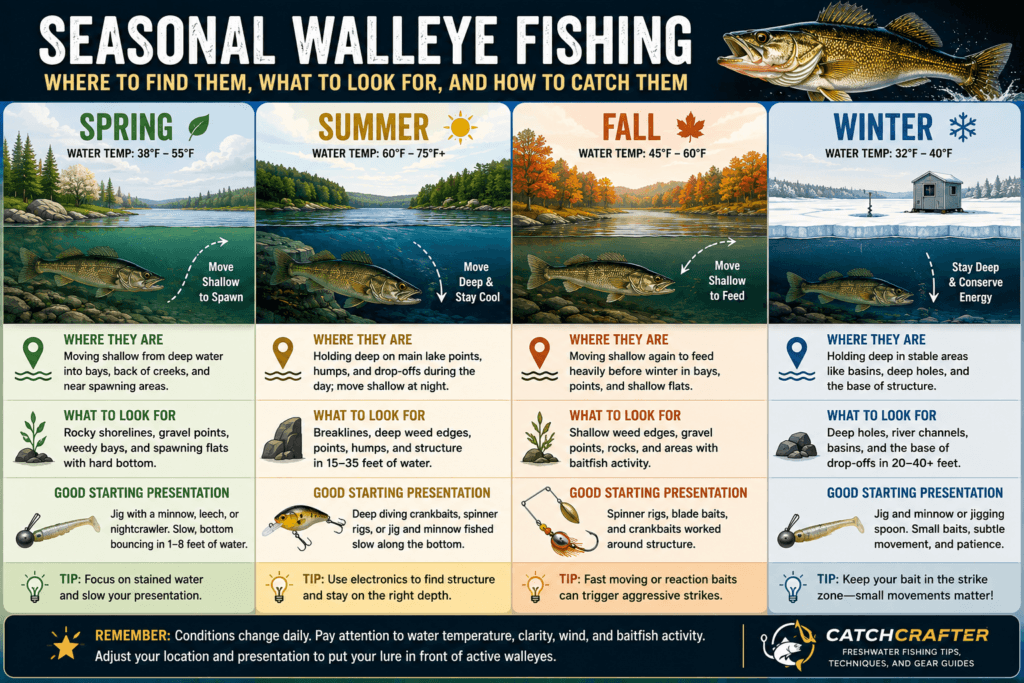
🎣 Seasonal Walleye Fishing at a Glance
| Season | Where to Look | Good Starting Presentations |
|---|---|---|
| 🌱 Spring | Rocky shorelines, river mouths, shallow points | Jigs & minnows, crankbaits |
| ☀️ Summer | Weed edges, deep points, humps, drop-offs | Spinner rigs, bottom bouncers, crankbaits |
| 🍂 Fall | Reefs, points, rocky structure, baitfish areas | Jigs, minnows, crankbaits |
| ❄️ Winter | Deep structure, basin edges, current areas | Jigs, minnows, blade baits |
🌱 Spring Walleye Fishing
Spring is one of the most exciting times to pursue walleye. As water temperatures begin rising, fish move toward spawning areas such as rocky shorelines, gravel flats, tributaries, river mouths, and areas with current.
Before and after spawning, walleye may concentrate in relatively shallow water, giving both shore and boat anglers excellent opportunities.
Low-light periods can be particularly productive. Early morning, evening, cloudy conditions, and even nighttime can bring fish surprisingly close to shore.
Good Spring Presentations
Jigs tipped with minnows are a classic starting choice. Slowly worked soft plastics and minnow-style crankbaits can also be productive.
Because cold-water walleye may not want to chase a fast presentation, slow down and give the fish time to react.
🎣 Partner’s Tip
Spring is one of the best times for shore anglers to catch walleye. Don’t assume you need a boat. Rocky shorelines, river mouths, bridges, and areas near spawning habitat can put feeding fish within casting distance—especially after sunset.
☀️ Summer Walleye Fishing
As summer arrives and surface temperatures rise, many walleye move toward deeper water, offshore structure, and healthy weed edges. Fish may use points, humps, drop-offs, reefs, and other areas that provide access to both comfortable water and food.
This doesn’t mean every walleye automatically goes deep. Productive weeds, windblown shorelines, current, cloudy weather, and low-light periods can still bring fish shallower.
Summer is an excellent time to cover water while searching for active fish.
Good Summer Presentations
Spinner rigs paired with bottom bouncers are excellent for working flats, weed edges, and deeper structure.
Trolled crankbaits can help locate scattered or suspended walleye, while jigs and live-bait rigs remain effective when fish are concentrated in smaller areas.
🎣 Partner’s Tip
During summer, don’t automatically fish the deepest water in the lake. Find the food first. If baitfish are using a weed edge, point, or particular depth, walleye may be nearby regardless of what the textbook says they “should” be doing.
🍂 Fall Walleye Fishing
Fall can produce some outstanding walleye fishing as cooling water changes forage movement and fish begin feeding heavily before winter.
Rocky points, reefs, drop-offs, and areas holding concentrations of baitfish deserve particular attention. Walleye may also move shallower during low-light periods, creating excellent casting opportunities.
As temperatures continue dropping, slower presentations can become increasingly effective.
Good Fall Presentations
Jigs paired with minnows or soft plastics are dependable choices. Crankbaits can also be excellent for covering water and targeting fish feeding on larger baitfish.
This is a good time to experiment with slower retrieves and longer pauses, particularly as the water gets colder.
🎣 Partner’s Tip
Don’t put the fishing gear away just because the weather turns cold. Fall can produce some of the best walleye fishing of the year, and larger fish often become more accessible as they feed before winter. Dress for the conditions and keep fishing.
❄️ Winter Walleye Fishing
Walleye remain catchable throughout winter, whether you’re fishing open water where conditions allow or pursuing them through the ice.
Their metabolism slows as water temperatures drop, so aggressive, fast-moving presentations aren’t always necessary. Walleye may hold around deeper structure, basin edges, channel areas, points, and locations where baitfish concentrate.
During ice-fishing season, changes in depth and structure can be particularly important when choosing where to drill holes.
Good Winter Presentations
Jigs tipped with minnows or minnow heads are classic winter choices. Blade baits and other compact jigging presentations can also produce fish.
Slower movements and longer pauses often become increasingly important.
🎣 Partner’s Tip
Winter rewards patience. If you know fish are present but they won’t commit, don’t immediately abandon the area. Try smaller movements, longer pauses, or a more subtle presentation before moving on. Sometimes the difference between no bite and a walleye is simply slowing down.
🎯 The Seasonal Lesson
The seasons give you a starting point—not a guarantee.
Weather, water clarity, current, forage, lake type, and local conditions can cause walleye to behave differently from one body of water to another.
Instead of thinking:
“It’s summer, so walleye must be deep.”
Learn to think:
“It’s summer. Where are the comfortable conditions and the food?”
That small change in thinking will make you a much more adaptable angler.
⚠️ Common Beginner Walleye Fishing Mistakes
Walleye fishing can sometimes feel frustrating, especially when you’re first learning. You may be fishing productive water with good equipment and still struggle to get bites.
Often, the problem isn’t the lure itself. Small mistakes involving depth, speed, location, or presentation can make a big difference.
Here are some of the most common mistakes new walleye anglers make—and how to avoid them.
Fishing Too Fast
Walleye aren’t always willing to chase a fast-moving lure, particularly in colder water or when fish are inactive.
If you’re not getting bites, slow your retrieve, shorten your jigging movements, and add pauses. Sometimes the best adjustment isn’t changing lures—it’s simply giving the fish more time to strike.
Ignoring Depth
One of the most important lessons in walleye fishing is understanding that depth matters.
If walleye are holding near the bottom in 20 feet of water and your presentation is running 8 feet deep, you may never put your bait in front of them.
Pay attention to where fish are positioned and adjust your lure, weight, line, or presentation accordingly.
Fishing the Same Depth All Day
Walleye move.
A productive spot in the early morning may become nearly empty after the sun rises. Fish can move deeper, shallower, or along structure as light levels, weather, current, and feeding conditions change.
When the bite stops, don’t automatically assume the fish quit feeding. They may simply have moved.
Using Too Much Jig Weight
Heavy jigs can help maintain bottom contact, but unnecessarily heavy weights may reduce the natural action of your presentation.
Use enough weight to maintain control while keeping the bait as natural as conditions allow.
Overworking the Lure
Beginners sometimes assume that aggressive rod movement makes a lure more attractive.
With walleye, subtle presentations often work extremely well.
Small lifts, slow drags, controlled falls, and pauses can produce more strikes than constantly snapping the rod.
Missing Subtle Bites
Not every walleye attacks like a freight train.
Sometimes you’ll feel a small tap. Other times the rod may simply feel heavier—or suddenly lighter.
Pay attention whenever something feels different.
That little change could be a fish.
Focusing Too Much on Lure Color
Color matters, but it’s easy to give it too much importance.
Before changing colors repeatedly, ask yourself:
Am I fishing where the walleye are?
Is my lure reaching the correct depth?
Is my presentation appropriate for the conditions?
Those factors often matter more than whether you’re using gold instead of silver.
Ignoring Wind
Wind can make fishing uncomfortable, but it can also create excellent walleye opportunities.
Wind can push plankton and baitfish toward particular shorelines and create reduced visibility that helps walleye feed more confidently.
A windblown shoreline or point may look rougher than the calm side of the lake—but it may also hold more active fish.
Staying in an Unproductive Area Too Long
Patience is important, but so is knowing when to move.
If you’ve thoroughly worked a promising area at different depths and with appropriate presentations without finding fish, don’t be afraid to search elsewhere.
Walleye fishing is often about finding fish first and fine-tuning your presentation second.
Buying Too Much Tackle Too Soon
You don’t need dozens of crankbaits, hundreds of jig colors, and several specialized rods to begin catching walleye.
Start with a versatile spinning setup and a small selection of proven presentations.
Learn those thoroughly.
Then expand your tackle as your experience tells you what you actually need.
🎣 Partner’s Advice
Don’t judge a fishing trip only by how many walleye you bring to the boat. Pay attention to what the water teaches you. Maybe you discovered a new drop-off, learned how a jig feels on rocky bottom, figured out the right trolling depth, or finally recognized a subtle bite. Those lessons accumulate, and eventually you’ll realize you’re making better decisions without even thinking about them. That’s how an angler grows.
❓ Frequently Asked Questions
What is the best bait for walleye?
There isn’t one bait that’s best under every condition, but minnows, nightcrawlers, and leeches are three of the most dependable live-bait choices. Minnows are especially popular during cooler periods, while nightcrawlers and leeches can be excellent as the water warms.
For artificial presentations, a jig paired with a minnow or soft plastic is one of the most versatile places for a beginner to start.
What is the best time of day to catch walleye?
Early morning and evening are often productive because walleye are well adapted to feeding in low-light conditions. Cloudy days and nighttime can also provide excellent opportunities.
However, walleye can still be caught during bright daylight. They may simply move deeper, hold tighter to structure, or use stained water and vegetation where light penetration is reduced.
How deep should I fish for walleye?
There is no single correct depth because walleye location changes with the season, time of day, water clarity, forage, and the body of water you’re fishing.
Instead of searching for a magic depth, look for structure and food. Points, weed edges, reefs, drop-offs, humps, and current breaks are good places to begin.
What color lure is best for walleye?
Natural baitfish colors such as silver, gold, perch, and shad patterns are excellent starting choices. Brighter colors such as chartreuse can be useful in stained water or reduced visibility.
But remember: location, depth, and presentation usually deserve attention before color.
The perfect color won’t catch many fish if your lure never reaches the walleye.
What size jig should I use?
A 1/4-ounce jig is a useful general-purpose starting point, but the correct weight depends on depth, wind, current, line, and presentation.
Use enough weight to maintain control and understand what your jig is doing without making the presentation unnecessarily heavy.
Can I catch walleye from shore?
Absolutely.
Spring and fall can provide especially good shore-fishing opportunities as walleye move shallower. Rocky shorelines, points, river mouths, bridges, current areas, and access near spawning or feeding locations can all be productive.
Low-light periods and nighttime can be particularly worthwhile for shore anglers.
Do I need a boat to catch walleye?
No. A boat provides access to offshore structure and makes techniques such as trolling easier, but plenty of walleye are caught from shore.
A spinning rod, a small selection of jigs and crankbaits, and knowledge of productive shoreline structure can be enough to get started.
Is braid or monofilament better for walleye?
Both have advantages.
Braided line offers excellent sensitivity and minimal stretch, which makes it useful for detecting subtle bites while jigging.
Monofilament is affordable, forgiving, and easy to handle, making it a good choice for beginners.
Many anglers also use braid as their main line with a fluorocarbon leader when they want sensitivity combined with a less-visible connection near the lure.
Why am I not catching walleye?
Before buying another lure, check the fundamentals:
Are you fishing where walleye are likely to be? Is your presentation reaching their depth? Are you fishing too quickly? Have the fish moved since earlier in the day?
Walleye success often comes from adjusting location, depth, and presentation rather than constantly changing tackle.
Can you catch walleye year-round?
Yes, where seasons and regulations allow. Walleye can be caught during spring, summer, fall, and winter, but their location and activity change throughout the year.
Understanding those seasonal movements is one of the most valuable skills a walleye angler can develop.
🎣 Partner’s FAQ Takeaway
If you remember only three things when the fishing gets difficult, remember these: location, depth, and presentation. Find the fish, put your bait where they can reach it, and present it naturally. Everything else becomes easier once you’ve solved those three pieces of the puzzle.
🎣 Final Thoughts
Walleye fishing can seem complicated when you’re first getting started. There are different lures, techniques, depths, seasonal movements, and countless opinions about the “right” way to catch them.
But the more time you spend on the water, the more you’ll realize that successful walleye fishing comes down to understanding a few fundamentals: find the fish, understand the depth they’re using, and choose a presentation that matches the conditions.
You don’t need the most expensive boat, the newest electronics, or a tackle box overflowing with lures to become a successful walleye angler. Start with a dependable spinning setup, a handful of proven presentations, and a willingness to learn from every trip.
Some days you’ll find the fish quickly.
Other days they’ll make you work for every bite.
That’s part of what makes walleye fishing so rewarding.
Every trip teaches you something—how the fish responded to changing weather, where they positioned along a drop-off, how a subtle jig bite felt through the rod, or why one presentation worked when another didn’t.
Those lessons build on one another.
Before long, you’ll stop wondering what you’re supposed to do and start making decisions based on what the water is telling you.
And that’s when confidence begins to replace guesswork.
Most importantly, don’t let the pursuit of catching more fish take away from the reason you went fishing in the first place.
Enjoy the early mornings.
Enjoy the quiet water.
Enjoy sharing a boat or shoreline with family and friends.
And when that unmistakable golden flash finally appears beneath the surface, enjoy that moment too.
🎣 Partner’s Advice
Don’t measure every fishing trip by the number of walleye you catch. Measure it by what you learned. Every missed bite, every successful adjustment, and every fish you bring to the net teaches you something you can carry into your next trip.
The best anglers never stop learning.
Neither should we.
Thank you for spending some of your time with CatchCrafter. I hope this guide helps you understand walleye a little better, fish with more confidence, and enjoy more successful days on the water.
Respect the resource, follow your local fishing regulations, and leave the water better than you found it. Want to help protect the fishery for future anglers? Read our Practicing Catch And Release Properly guide for tips on handling and releasing fish responsibly.
I’ll see you on the next adventure.
Until next time… Tight Lines!
— Thaddeus 🎣
🎣 Enjoyed This Guide?
If this guide helped you become a more confident walleye angler, explore more beginner-friendly freshwater fishing guides here on CatchCrafter.
Whether you’re learning to catch bass, crappie, or simply improving your overall fishing skills, our goal is to help you understand the fish, make better decisions on the water, and enjoy every trip.