Learning how to tie a few reliable fishing knots is one of the most valuable skills a bass angler can develop. Even the best rod, reel, fishing line, and lure won’t help if your knot fails when you hook the fish of a lifetime.
The good news is that you don’t need to memorize dozens of complicated knots. By learning just a handful of proven knots, you’ll be prepared for almost every bass fishing situation you encounter.
In this guide, I’ll explain the best bass fishing knots for beginners, when to use each one, and provide simple tips to help you tie them with confidence. Whether you’re fishing with monofilament, fluorocarbon, or braided line, these knots will help you spend less time worrying about your tackle and more time catching bass.
Why Fishing Knots Matter
A fishing knot is one of the most important connections you’ll make every time you head to the water. No matter how expensive your rod, reel, fishing line, or lure may be, a poorly tied knot can cause you to lose the fish you’ve been waiting all day to catch.
Strong, reliable knots help you fish with confidence. They keep your lure securely attached, maintain more of your line’s strength, and reduce the chances of equipment failure during a hard fight with a bass.
The good news is that you don’t need to learn dozens of different knots. By mastering just a few easy, proven knots, you’ll be prepared for nearly every bass fishing situation. Whether you’re using monofilament, fluorocarbon, or braided line, these knots will give you the confidence to spend more time fishing and less time worrying about your tackle.
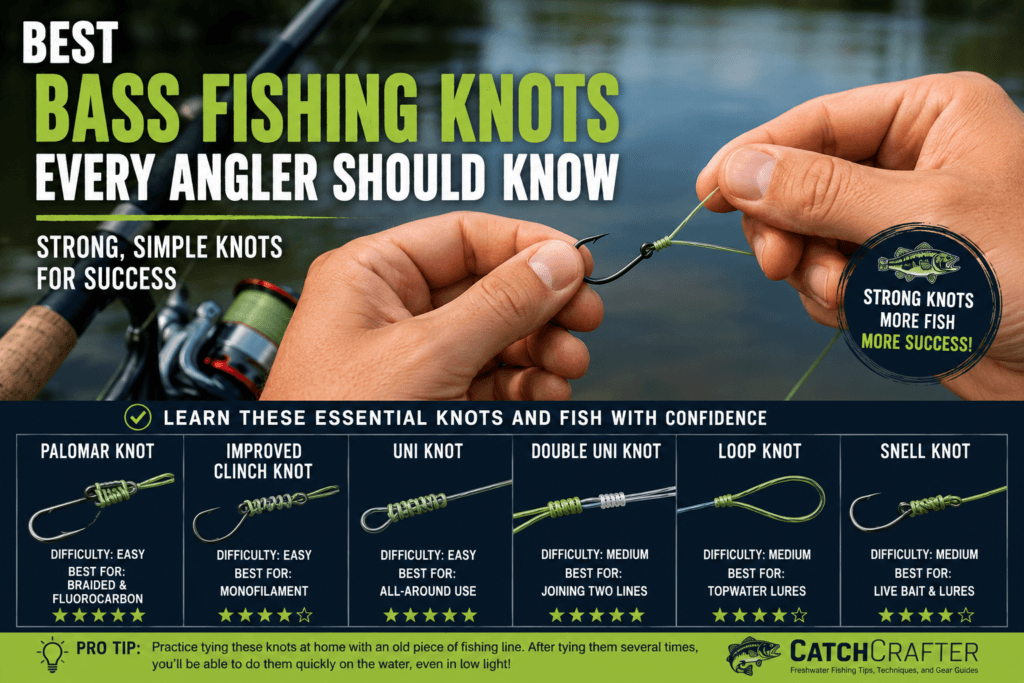
| Fishing Knot | Difficulty | Best For | Line Type |
|---|---|---|---|
| Palomar Knot | Easy | Hooks, lures, swivels | Braided, Fluorocarbon, Monofilament |
| Improved Clinch Knot | Easy | Hooks and lures | Monofilament, Fluorocarbon |
| Uni Knot | Easy | All-around use | All line types |
| Double Uni Knot | Medium | Joining two fishing lines | Braid to Fluorocarbon, Mono |
| Loop Knot | Medium | Topwater lures & jerkbaits | Monofilament, Fluorocarbon |
| Snell Knot | Medium | Worm hooks & flipping | Fluorocarbon, Monofilament |
1. Palomar Knot
⭐⭐⭐⭐⭐ Best Overall Fishing Knot for Beginners
The Palomar Knot is widely considered one of the strongest and easiest fishing knots to learn. It retains a high percentage of your fishing line’s original strength and works exceptionally well with braided, fluorocarbon, and monofilament lines.
One reason anglers love the Palomar Knot is its simplicity. With just a few easy steps, you can create a strong, reliable connection between your line and your hook, lure, or swivel. Because it’s quick to tie, it’s also a great choice when you need to retie after breaking off or changing lures.
Whether you’re fishing soft plastics, crankbaits, spinnerbaits, or topwater lures, the Palomar Knot is a dependable choice that belongs in every bass angler’s skill set.
Pros
- Extremely strong and reliable
- Easy to learn and tie
- Works with braided, fluorocarbon, and monofilament line
- Excellent for hooks, lures, and swivels
- Quick to tie on the water
Cons
- Requires passing the lure or hook through a loop, which can be awkward with very large lures
- Can become difficult with heavy fishing line
Best For
- Beginners
- Hooks
- Artificial lures
- Swivels
- Everyday bass fishing
💡 Beginner Tip
Always wet the knot with a little water or saliva before tightening it. This reduces friction, helps protect your fishing line, and creates a stronger, more reliable knot.
2. Improved Clinch Knot
⭐⭐⭐⭐☆ Best Classic Knot for Monofilament and Fluorocarbon Line
The Improved Clinch Knot has been trusted by anglers for generations and remains one of the easiest knots to learn. It’s an excellent choice for attaching hooks, lures, and swivels when using monofilament or fluorocarbon fishing line.
Although newer knots have become popular, the Improved Clinch Knot continues to be a reliable option because it’s quick to tie and provides excellent knot strength when tied correctly. It’s especially useful for beginners who want a simple knot they can master in just a few minutes.
To get the best performance, always tighten the knot slowly and trim the tag end after checking that the knot is seated properly against the eye of the hook or lure.
Pros
- Easy to learn
- Quick to tie
- Excellent for monofilament and fluorocarbon
- Great for hooks, lures, and swivels
- A trusted, time-tested fishing knot
Cons
- Not the best choice for braided fishing line
- Can weaken if not tightened properly
- Slightly less knot strength than a Palomar Knot
Best For
- Monofilament line
- Fluorocarbon line
- Hooks
- Lures
- Swivels
- Everyday bass fishing
💡 Beginner Tip
Leave about 1/8 inch of the tag end after trimming the knot. This gives you a little extra security if the knot settles slightly after fighting a fish.
3. Uni Knot
⭐⭐⭐⭐⭐ Most Versatile Fishing Knot
The Uni Knot is one of the most versatile fishing knots every angler should learn. It works well with monofilament, fluorocarbon, and braided fishing line, making it an excellent all-purpose knot for beginners and experienced anglers alike.
One of the biggest advantages of the Uni Knot is its flexibility. It can be used to attach hooks, lures, swivels, and even join two fishing lines together when tied as a Double Uni Knot. Because of its strength and reliability, many anglers rely on the Uni Knot as their go-to knot for everyday fishing.
The Uni Knot is easy to tie with a little practice and performs well in both freshwater and saltwater fishing. Once you learn it, you’ll find yourself using it in many different fishing situations.
Pros
- Extremely versatile
- Works with all major fishing line types
- Strong and reliable
- Easy to learn with practice
- Can be adapted into the Double Uni Knot
Cons
- Takes slightly longer to tie than a Palomar Knot
- Requires careful tightening to seat properly
- Beginners may need a few practice attempts
Best For
- Hooks
- Lures
- Swivels
- Monofilament, fluorocarbon, and braided line
- Everyday bass fishing
💡 Beginner Tip
Practice tying the Uni Knot several times at home using an old piece of fishing line. After a little repetition, you’ll be able to tie it quickly and confidently while you’re out on the water.
4. Double Uni Knot
⭐⭐⭐⭐⭐ Best Knot for Joining Two Fishing Lines
The Double Uni Knot is one of the best knots for connecting two different fishing lines. It’s especially popular among bass anglers who use braided line on their reel with a fluorocarbon leader. This combination provides the strength and sensitivity of braid while keeping the nearly invisible fluorocarbon line near the lure.
Although the Double Uni Knot looks more complicated than some other knots, it’s surprisingly easy to learn with a little practice. Once tightened, it forms a strong, dependable connection that passes smoothly through most rod guides.
Whether you’re fishing clear water with a fluorocarbon leader or simply need to join two lines together after a break, the Double Uni Knot is an excellent knot to have in your fishing toolbox.
Pros
- Excellent for joining two fishing lines
- Strong and dependable connection
- Works with braided, fluorocarbon, and monofilament line
- Passes smoothly through most rod guides
- A favorite among bass anglers
Cons
- Takes longer to tie than basic knots
- Requires a little practice to master
- Can become bulky when joining lines with very different diameters
Best For
- Connecting braided line to a fluorocarbon leader
- Joining two monofilament lines
- Joining two fluorocarbon lines
- Everyday bass fishing
- Clear-water presentations
💡 Beginner Tip
Practice tying the Double Uni Knot with two different colored pieces of old fishing line. The contrasting colors make it much easier to see how the wraps come together and help you build confidence before using it on the water.
5. Loop Knot
⭐⭐⭐⭐☆ Best Knot for Maximum Lure Action
The Loop Knot is designed to give your lure more freedom to move naturally in the water. Unlike knots that cinch tightly against the eye of the hook or lure, the Loop Knot leaves a small loop that allows topwater lures, jerkbaits, and soft plastic baits to move with a more lifelike action.
Although it takes a little more practice to tie than some basic knots, many anglers believe the improved lure action is worth the extra effort. This can be especially helpful when bass are hesitant to strike and a more natural presentation is needed.
The Loop Knot is most commonly used with monofilament and fluorocarbon line, making it a great addition to every bass angler’s collection of fishing knots.
Pros
- Gives lures more natural movement
- Improves the action of topwater lures and jerkbaits
- Strong and dependable when tied correctly
- Excellent for finesse presentations
- Helps create a more realistic bait presentation
Cons
- Slightly more difficult to tie than basic knots
- Not necessary for every fishing situation
- Requires occasional practice to tie consistently
Best For
- Topwater lures
- Jerkbaits
- Soft plastic baits
- Finesse fishing
- Monofilament and fluorocarbon line
💡 Beginner Tip
Leave a small loop in front of your lure—about the size of a pencil eraser. A loop that’s too large can reduce casting accuracy, while a small loop provides excellent lure action without sacrificing control.
6. Snell Knot (Bonus)
⭐⭐⭐⭐☆ Best Knot for Worm Hooks and Heavy Cover Fishing
The Snell Knot is a favorite among bass anglers who fish Texas-rigged soft plastics, flipping rigs, and heavy cover. Unlike many other fishing knots, the Snell Knot positions the hook so it can rotate outward during the hookset, helping to improve hook penetration.
Although it’s more advanced than the Palomar or Uni Knot, it’s a valuable knot to learn if you plan to target bass around thick vegetation, fallen trees, or heavy cover.
Many tournament anglers rely on the Snell Knot when using straight-shank worm hooks because of its excellent hook-setting performance. While beginners don’t need to master this knot right away, it’s a great skill to add as your confidence and experience grow.
Pros
- Excellent hook-setting performance
- Ideal for straight-shank worm hooks
- Great for flipping and pitching techniques
- Strong and dependable
- Popular with experienced bass anglers
Cons
- More difficult to tie than basic knots
- Best suited for specific hook styles
- Not necessary for everyday fishing
Best For
- Texas-rigged soft plastics
- Straight-shank worm hooks
- Heavy vegetation
- Flipping and pitching
- Experienced anglers looking to improve hooksets
💡 Beginner Tip
Don’t worry if this knot seems difficult at first. Focus on mastering the Palomar Knot and Uni Knot before learning the Snell Knot. Once you’re comfortable with the basics, adding this knot to your fishing skills will be much easier.
Frequently Asked Questions
What is the strongest fishing knot for bass fishing?
Many anglers consider the Palomar Knot one of the strongest fishing knots because it retains a high percentage of the line’s original strength and works well with braided, fluorocarbon, and monofilament fishing line.
What is the easiest fishing knot for beginners?
The Palomar Knot is often the easiest knot for beginners to learn. It’s simple to tie, extremely reliable, and works with most hooks, lures, and swivels.
Which fishing knot works best with braided line?
The Palomar Knot and Uni Knot are both excellent choices for braided fishing line. If you’re connecting braided line to a fluorocarbon leader, the Double Uni Knot is a dependable option.
Should I wet my fishing knot before tightening it?
Yes. Wetting your knot with water or saliva before tightening helps reduce friction, protects the fishing line from damage, and creates a stronger knot.
How often should I retie my fishing knot?
It’s a good idea to retie your knot whenever you notice fraying, damage, or after catching several fish. Spending a minute to tie a fresh knot can prevent losing your next big bass.
Final Recommendation
Learning to tie a few reliable fishing knots is one of the best investments you can make as a bass angler. You don’t need to memorize dozens of complicated knots to become successful on the water. By mastering a handful of proven knots, you’ll have the confidence to handle almost every bass fishing situation.
If I were teaching a new angler today, these are the first three knots I would recommend learning:
- Palomar Knot – Best overall knot for hooks, lures, and braided line.
- Improved Clinch Knot – A simple, dependable knot for monofilament and fluorocarbon.
- Uni Knot – An extremely versatile knot that works with nearly every type of fishing line.
As your skills improve, adding the Double Uni Knot, Loop Knot, and Snell Knot will prepare you for more advanced techniques and specialized presentations.
Remember, the strongest knot isn’t just the one with the highest breaking strength—it’s the one you can tie correctly every time. Spend a little time practicing at home, and you’ll head to the water with greater confidence and fewer lost fish.
I hope this guide helps you become a more confident and successful bass angler. If you have a favorite fishing knot or a tip that has worked well for you, I’d love to hear about it in the comments below.
Tight lines,
— Thaddeus, CatchCrafter