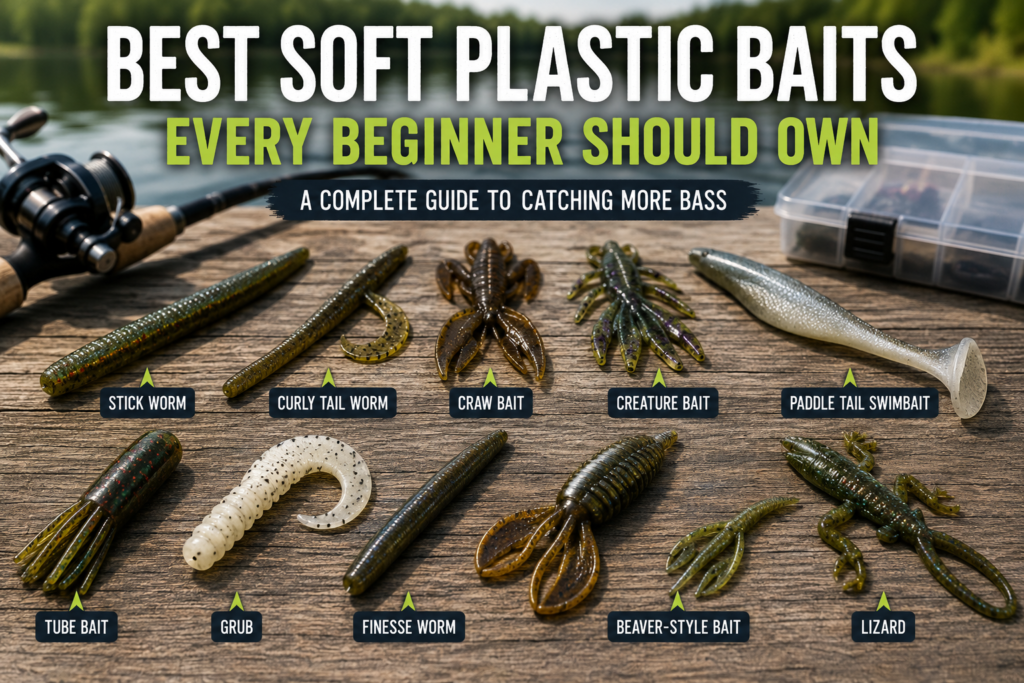
Soft plastic baits are among the most effective and versatile lures in bass fishing. Whether you’re fishing a small neighborhood pond, a large reservoir, or a quiet river, soft plastics consistently catch bass throughout the year. Their lifelike appearance, natural movement, and wide variety of shapes make them a favorite among both beginners and experienced anglers.
One of the biggest advantages of soft plastic baits is their versatility. They can be rigged in several different ways and fished at almost any depth, allowing anglers to adapt to changing conditions and bass behavior. From slow finesse presentations to aggressive power fishing techniques, there’s a soft plastic bait for nearly every situation.
In this guide, I’ll introduce the best soft plastic baits every beginner should own, explain when to use each one, and share practical tips to help you fish them with confidence. By learning a few proven soft plastics, you’ll be well on your way to catching more bass and enjoying every trip to the water.
Why Soft Plastic Baits Catch So Many Bass
Soft plastic baits have earned a reputation as one of the most productive lure categories in bass fishing. Their lifelike appearance, natural movement, and incredible versatility allow anglers to catch bass in nearly every season and almost every type of water.
Unlike many hard baits, soft plastics can be fished slowly and precisely, making them especially effective when bass are less aggressive. They can also be rigged in several different ways, allowing you to fish shallow cover, deep structure, weeds, docks, rocks, and open water with the same bait.
Another advantage is the wide variety of sizes, shapes, and colors available. Whether you’re trying to imitate worms, crawfish, baitfish, salamanders, or other forage, there’s a soft plastic designed for the job.
For beginners, soft plastic baits are an excellent investment because a small collection can handle a wide range of fishing situations without filling an entire tackle box. Learning when and how to use a few proven soft plastics will give you confidence and increase your chances of catching more bass throughout the year.
| Soft Plastic Bait | Difficulty | Best For | Recommended Rig |
|---|---|---|---|
| Stick Worm | Easy | All-around bass fishing | Texas Rig / Wacky Rig |
| Curly Tail Worm | Easy | Active bass | Jig Head / Texas Rig |
| Craw Bait | Easy | Cover & structure | Texas Rig / Jig Trailer |
| Creature Bait | Medium | Heavy cover | Texas Rig |
| Paddle Tail Swimbait | Easy | Open water | Swimbait Hook / Jig Head |
| Tube Bait | Medium | Smallmouth & largemouth | Tube Jig |
| Grub | Easy | Versatile presentations | Jig Head |
| Finesse Worm | Easy | Tough fishing conditions | Drop Shot / Shaky Head |
| Beaver-Style Bait | Medium | Flipping & pitching | Texas Rig |
| Lizard | Easy | Spring bass fishing | Carolina Rig / Texas Rig |
1. Stick Worm
⭐⭐⭐⭐⭐ Best Overall Soft Plastic for Beginners
The stick worm is one of the most versatile and productive soft plastic baits ever created. Its simple design and natural action have helped anglers catch countless bass in ponds, lakes, rivers, and reservoirs across the country.
One of the biggest reasons the stick worm is so effective is that it doesn’t require an aggressive retrieve. As it slowly sinks through the water, the bait produces a subtle side-to-side shimmy that often triggers strikes from bass, even when they’re inactive or pressured.
Stick worms can be rigged in several ways, including the Texas Rig, Wacky Rig, Carolina Rig, and Neko Rig, making them one of the most adaptable soft plastics you can carry in your tackle box. Whether you’re fishing around docks, grass, rocks, or open water, a stick worm is capable of producing fish in almost any situation.
If you’re just beginning your bass fishing journey, a few packs of stick worms in natural colors such as Green Pumpkin, Watermelon Red, and Black & Blue will give you confidence wherever you fish.
Pros
- Extremely versatile
- Easy for beginners to fish
- Effective throughout the year
- Can be rigged in multiple ways
- Natural action attracts pressured bass
Cons
- Tears more easily than some other soft plastics
- Can slide down the hook after repeated catches
- Often requires replacing after several fish
Best For
- Texas Rig
- Wacky Rig
- Carolina Rig
- Neko Rig
- Ponds, lakes, rivers, and reservoirs
💡 Beginner Tip
If you’re only buying one type of soft plastic bait, start with a 5-inch stick worm in Green Pumpkin. It’s one of the most reliable bass-catching baits ever made and is effective in a wide variety of fishing conditions.
2. Curly Tail Worm
⭐⭐⭐⭐⭐ Best Soft Plastic for Active Bass
The curly tail worm has been a favorite among bass anglers for decades because of its simple design and constant movement in the water. As the bait is retrieved, its long curled tail creates a lifelike swimming action that attracts bass from a distance.
One of the biggest advantages of a curly tail worm is its versatility. It can be fished slowly along the bottom, steadily through the middle of the water column, or even faster when bass are actively feeding. This makes it an excellent choice for beginners who are learning different retrieve speeds and presentations.
Curly tail worms perform well when rigged on a Texas Rig, Carolina Rig, or jig head, allowing anglers to fish a variety of depths and cover. They are especially productive during the spring, summer, and early fall when bass are actively searching for food.
Natural colors such as Green Pumpkin, Watermelon Red, and Junebug are excellent starting choices, while brighter colors like Chartreuse can be effective in stained water.
Pros
- Excellent swimming action
- Easy for beginners to fish
- Versatile rigging options
- Effective in multiple seasons
- Attracts active bass
Cons
- Tail can be damaged by aggressive strikes
- Less subtle than a stick worm
- Can twist the line if rigged improperly
Best For
- Texas Rig
- Carolina Rig
- Jig Head
- Active bass
- Spring, summer, and fall fishing
💡 Beginner Tip
Use a slow, steady retrieve and occasionally pause the bait. Many bass strike just after the worm starts moving again, making those brief pauses surprisingly effective.
3. Craw Bait
⭐⭐⭐⭐⭐ Best Soft Plastic for Fishing Heavy Cover
Craw baits are designed to imitate crawfish, one of a bass’s favorite natural food sources. Because crawfish live around rocks, fallen trees, docks, and thick vegetation, craw baits are extremely effective wherever bass are likely to be hiding.
One of the biggest advantages of a craw bait is its lifelike action. Many models feature realistic claws that flap and move as the bait falls or is retrieved, creating a natural presentation that bass find difficult to resist. Craw baits can be fished slowly along the bottom or pitched directly into heavy cover where larger bass often wait to ambush prey.
For beginners, craw baits are most commonly rigged using a Texas Rig or used as a trailer on a bass jig. Both presentations allow the bait to move naturally through cover while reducing the chance of snagging.
Natural colors such as Green Pumpkin, Black & Blue, and Watermelon Red are excellent choices and closely resemble real crawfish in many lakes and rivers.
Pros
- Realistic crawfish profile
- Excellent around heavy cover
- Great for pitching and flipping
- Produces larger bass
- Works well as a jig trailer
Cons
- Requires fishing slowly for best results
- Can snag if not rigged properly
- Slightly more advanced than a stick worm
Best For
- Texas Rig
- Jig Trailer
- Rocks
- Wood
- Docks
- Heavy vegetation
💡 Beginner Tip
Fish a craw bait slowly along the bottom. Crawfish naturally move in short bursts and pauses, so avoid retrieving the bait too quickly. A slow presentation often produces more bites from cautious bass.
🛒 Tackle Box Priority
After you’ve added stick worms and curly tail worms to your tackle box, a craw bait should be your next purchase. It’s an excellent choice for fishing around cover where bigger bass often hide.
4. Creature Bait
⭐⭐⭐⭐☆ Best Soft Plastic for Thick Cover and Big Bass
Creature baits are unique soft plastics designed with multiple legs, flappers, and appendages that create lifelike movement in the water. While they don’t imitate one specific animal, they resemble many of the creatures bass naturally feed on, making them an excellent choice for triggering reaction strikes.
Because of their bulky profile and active movement, creature baits excel when fishing around heavy vegetation, brush piles, fallen trees, and docks where larger bass often hide. They displace more water than slimmer soft plastics, helping bass locate them even in stained or muddy conditions.
Most anglers fish creature baits using a Texas Rig, allowing the bait to slip through heavy cover while remaining nearly weedless. They also make outstanding jig trailers when targeting larger bass.
Natural colors such as Green Pumpkin, Black & Blue, and Watermelon Red remain excellent choices for most situations, while darker colors can be especially effective in low-light conditions.
Pros
- Excellent for heavy cover
- Bulky profile attracts larger bass
- Creates lots of underwater movement
- Great as a Texas Rig or jig trailer
- Effective in stained water
Cons
- Slightly more advanced than basic soft plastics
- Requires heavier tackle in thick cover
- Not always the best choice for inactive bass
Best For
- Texas Rig
- Jig Trailer
- Heavy vegetation
- Brush piles
- Docks
- Bigger bass
💡 Beginner Tip
Don’t be afraid to fish a creature bait slowly. Many bites happen after the bait settles to the bottom and remains still for a few seconds before moving again.
🛒 Tackle Box Priority
After you’ve mastered stick worms and craw baits, add a pack of creature baits for fishing heavier cover and targeting bigger bass. They provide a different profile that bass often find irresistible.
5. Paddle Tail Swimbait
⭐⭐⭐⭐⭐ Best Soft Plastic for Imitating Baitfish
Paddle tail swimbaits are designed to imitate small baitfish, making them one of the most effective soft plastics for bass that are actively feeding. Their realistic swimming action comes from the paddle-shaped tail, which creates a steady side-to-side motion as the bait moves through the water.
One of the biggest advantages of a paddle tail swimbait is its simplicity. Beginners can catch bass by casting the bait and retrieving it at a slow, steady pace. The natural swimming action does most of the work, making it an excellent choice for anglers who are still developing confidence with different fishing techniques.
Paddle tail swimbaits can be rigged on a jig head, weighted swimbait hook, or used as a trailer on a vibrating jig or spinnerbait. They are especially productive around points, weed edges, submerged grass, and open water where bass are chasing baitfish.
Natural baitfish colors such as Shad, Pearl White, Silver, and Ayu are excellent starting choices. In stained water, slightly darker colors often help bass locate the bait more easily.
Pros
- Realistic swimming action
- Easy for beginners to fish
- Excellent for covering water
- Effective throughout the year
- Works well in open water and around vegetation
Cons
- Can be damaged by toothy fish
- Less effective when fished too quickly
- May require different jig head sizes for varying depths
Best For
- Jig Head
- Weighted Swimbait Hook
- Open water
- Weed edges
- Points
- Following schools of baitfish
💡 Beginner Tip
A slow, steady retrieve is usually all you need. Let the paddle tail create the action naturally, and resist the urge to constantly jerk or twitch the bait.
🛒 Tackle Box Priority
After adding stick worms, curly tail worms, and craw baits to your tackle box, a paddle tail swimbait is an excellent choice when bass are feeding on shad or other baitfish. It gives you a completely different presentation than bottom-fishing soft plastics.
6. Tube Bait
⭐⭐⭐⭐☆ Best Soft Plastic for Smallmouth and Largemouth Bass
Tube baits have been catching bass for decades and remain one of the most dependable soft plastics for both largemouth and smallmouth bass. Their hollow body and lifelike tentacles create subtle movement that closely imitates baitfish, crawfish, and other prey bass naturally feed on.
One of the biggest advantages of a tube bait is its versatility. It can be fished by dragging it slowly along the bottom, hopping it over rocks, or swimming it through open water. This natural presentation makes it especially effective in clear water where bass have more time to inspect a bait before striking.
Tube baits are most commonly rigged with an internal tube jig, but they can also be fished on a Texas Rig to reduce snags around weeds and cover. Their compact profile makes them an excellent choice when bass are feeding on smaller forage.
Natural colors such as Green Pumpkin, Smoke, Watermelon Red, and Goby patterns are excellent choices, especially in clear lakes and rivers.
Pros
- Excellent for both largemouth and smallmouth bass
- Realistic underwater action
- Effective in clear water
- Versatile presentation
- Great around rocks and structure
Cons
- Can take a little practice to rig correctly
- Hollow body may tear after repeated catches
- Internal jig heads require some practice for beginners
Best For
- Internal Tube Jig
- Texas Rig
- Rocky shorelines
- Points
- Clear water
- Smallmouth bass
💡 Beginner Tip
When fishing a tube bait, let it fall on a semi-slack line and watch carefully for any sudden movement. Many bass strike while the bait is falling, and the bite can be very subtle.
🛒 Tackle Box Priority
Once you’ve built confidence with stick worms, craw baits, and paddle tail swimbaits, tube baits are a great addition to your tackle box—especially if you fish rocky lakes, rivers, or waters known for producing smallmouth bass.
7. Grub
⭐⭐⭐⭐☆ Best Soft Plastic for Versatility and Multi-Species Fishing
Grubs may have a simple design, but they’ve earned a reputation as one of the most versatile soft plastic baits ever made. Their compact body and curly tail create a natural swimming action that attracts bass, crappie, walleye, and many other freshwater species.
One of the reasons grubs are so popular is their ease of use. They can be fished on a jig head with a slow, steady retrieve or bounced along the bottom to imitate small baitfish and aquatic creatures. Their straightforward presentation makes them an excellent choice for beginners learning different retrieval techniques.
Grubs are available in a wide range of colors, but natural shades such as White, Smoke, Green Pumpkin, and Chartreuse are excellent starting points. Because they appeal to multiple species, grubs are a smart addition to any angler’s tackle box.
Pros
- Extremely versatile
- Easy for beginners to fish
- Effective for multiple freshwater species
- Affordable and widely available
- Great year-round bait
Cons
- Smaller profile may attract smaller fish
- Curly tail can tear after repeated use
- Less effective in heavy vegetation
Best For
- Jig Head
- Open water
- Shore fishing
- Rivers
- Lakes
- Multi-species fishing
💡 Beginner Tip
A simple, slow retrieve is often the most effective way to fish a grub. Occasionally pause the bait during the retrieve, as many strikes occur just as it begins moving again.
🛒 Tackle Box Priority
After you’ve built a collection of stick worms, craw baits, and paddle tail swimbaits, add a few grubs to your tackle box. They’re affordable, easy to fish, and capable of catching a variety of freshwater species throughout the year.
8. Finesse Worm
⭐⭐⭐⭐⭐ Best Soft Plastic for Tough Fishing Conditions
When bass become pressured or less active, a finesse worm can be one of the most productive baits in your tackle box. Its slim profile and subtle action often convince cautious bass to bite when larger or more aggressive baits fail.
Finesse worms are especially effective during cold fronts, clear water conditions, or on heavily fished lakes where bass have seen countless lures. Their natural appearance and gentle movement make them an excellent choice when fish are reluctant to feed.
These baits are commonly fished using a Drop Shot Rig, Shaky Head, Ned Rig, or weightless Texas Rig. Each presentation allows the finesse worm to move naturally while remaining in the strike zone longer.
Natural colors such as Green Pumpkin, Watermelon Red, Morning Dawn, and Black are excellent starting choices and consistently produce fish in a wide range of conditions.
Pros
- Excellent for pressured bass
- Natural presentation
- Easy to fish slowly
- Effective in clear water
- Produces bites when other baits fail
Cons
- Not designed for heavy cover
- Smaller profile may not attract aggressive bass
- Requires patience and a slower presentation
Best For
- Drop Shot Rig
- Shaky Head
- Ned Rig
- Weightless Texas Rig
- Clear water
- Tough fishing conditions
💡 Beginner Tip
When fishing a finesse worm, slow down. Small movements and long pauses often trigger more bites than constant action. If you think you’re fishing slowly enough, try slowing down even more.
🛒 Tackle Box Priority
Once you’ve learned the basics with stick worms and curly tail worms, add a pack of finesse worms to your tackle box. They’re invaluable on days when bass aren’t cooperating and can often turn a slow day into a successful one.
9. Beaver-Style Bait
⭐⭐⭐⭐☆ Best Soft Plastic for Flipping and Pitching Heavy Cover
Beaver-style baits have become a favorite among bass anglers because of their compact profile and ability to slip through heavy vegetation with ease. Designed for flipping and pitching, these baits imitate crawfish and other bottom-dwelling creatures that bass commonly feed on.
Unlike bulkier creature baits, beaver-style baits have a streamlined body that allows them to penetrate thick grass, brush piles, and fallen timber with fewer hang-ups. This makes them an excellent choice when targeting bass hiding in places where other lures struggle to reach.
Most anglers fish beaver-style baits using a Texas Rig with a pegged bullet weight, allowing the bait to fall naturally through cover while remaining weedless. They also work exceptionally well as jig trailers.
Natural colors such as Green Pumpkin, Black & Blue, and Okeechobee Craw are proven choices in a variety of water conditions.
Pros
- Excellent for heavy cover
- Compact profile slips through vegetation easily
- Great for flipping and pitching
- Produces quality bass
- Weedless when rigged correctly
Cons
- Best suited for specific techniques
- Requires heavier tackle for thick cover
- Less effective in open water presentations
Best For
- Texas Rig
- Flipping
- Pitching
- Heavy vegetation
- Brush piles
- Laydown trees
💡 Beginner Tip
Don’t let the name intimidate you. Start by fishing beaver-style baits around isolated cover such as a single dock post or fallen tree before moving into thicker vegetation. This will help you build confidence while learning how the bait behaves.
🛒 Tackle Box Priority
Once you’ve become comfortable fishing stick worms and craw baits, a beaver-style bait is an excellent addition if you want to target bass holding deep in heavy cover.
10. Lizard
⭐⭐⭐⭐☆ Best Soft Plastic for Spring Bass Fishing
Soft plastic lizards have been a favorite among bass anglers for years because they closely resemble salamanders and other small creatures that bass instinctively attack, especially during the spawning season. Their long body, lively legs, and swimming tail create plenty of movement that attracts curious and aggressive fish.
Lizards are most effective during the spring when bass are protecting their nests, but they can also produce fish throughout the summer and early fall. They are commonly fished on a Texas Rig or Carolina Rig, allowing anglers to cover shallow flats, points, and weed edges with a natural presentation.
Natural colors such as Green Pumpkin, Watermelon Red, Junebug, and Black are excellent choices for most fishing conditions. Matching the water clarity and forage in your local waters will help increase your success.
Pros
- Excellent during the bass spawning season
- Realistic profile with lots of natural movement
- Easy to fish with common rigs
- Effective in shallow and moderately deep water
- Great for covering water with a Carolina Rig
Cons
- Most productive during specific seasons
- Can be overlooked outside the spring
- Long body may require careful rigging
Best For
- Texas Rig
- Carolina Rig
- Spring bass fishing
- Shallow flats
- Weed edges
- Points
💡 Beginner Tip
If you’re fishing during the spring, slowly drag a lizard near likely spawning areas and pause it occasionally. Many strikes happen while the bait is sitting still, as bass often react instinctively to protect their nests.
🛒 Tackle Box Priority
After you’ve built a solid collection of the more versatile soft plastics, add a few lizards before the spring season. They’re an excellent seasonal bait that can produce outstanding results when bass are spawning.
Frequently Asked Questions
What is the best soft plastic bait for beginners?
A 5-inch stick worm is one of the best soft plastic baits for beginners because it’s easy to fish, incredibly versatile, and catches bass in a wide variety of conditions.
What color soft plastic catches the most bass?
Natural colors such as Green Pumpkin, Watermelon Red, Black & Blue, and Junebug consistently produce bass across many different lakes and rivers. Matching the water clarity and local forage can improve your success.
Which soft plastic bait catches the biggest bass?
While any soft plastic can catch trophy bass, craw baits, creature baits, and beaver-style baits are excellent choices when targeting larger fish in heavy cover.
Can I use the same soft plastic bait all year?
Yes. Stick worms, finesse worms, paddle tail swimbaits, and craw baits can all be effective throughout the year. Seasonal conditions may influence which bait performs best on any given day.
How many soft plastic baits should a beginner own?
You don’t need dozens of different baits to catch bass. Start with a few proven options, learn how to fish them well, and gradually expand your tackle box as your confidence and experience grow.
Final Recommendation
Soft plastic baits have earned their place among the most effective lures in bass fishing because they are versatile, realistic, and capable of catching fish in almost any condition. Whether you’re fishing from the bank, a boat, or a kayak, learning how to use a few proven soft plastics will give you the confidence to catch more bass throughout the year.
If I were helping someone build their very first tackle box, these would be my top recommendations:
- Stick Worm – The best all-around soft plastic for beginners.
- Curly Tail Worm – A versatile bait with excellent action.
- Craw Bait – Perfect for fishing around cover and structure.
- Paddle Tail Swimbait – Outstanding for imitating baitfish.
- Finesse Worm – A must-have when bass become pressured or inactive.
As your experience grows, adding creature baits, tube baits, beaver-style baits, grubs, and lizards will prepare you for even more fishing situations.
Remember, success doesn’t come from owning every bait on the market. It comes from learning when and how to fish a handful of proven soft plastics with confidence.
I hope this guide helps you spend less time wondering which bait to tie on and more time enjoying your day on the water.
Tight lines,
— Thaddeus, CatchCrafter
Have a favorite soft plastic bait or a technique that’s worked well for you? Share your experience in the comments below. I’d love to hear what’s helping you catch more bass!
Recommended Reading
Continue building your bass fishing knowledge with these CatchCrafter guides:
- Best Bass Fishing Rod and Reel Combos Under $100 – Learn how to choose a dependable setup without overspending.
- Best Fishing Line for Bass: Monofilament vs. Fluorocarbon vs. Braided Line – Understand which fishing line is best for different techniques and conditions.
- Best Bass Fishing Lures for Beginners – Discover ten proven lures every new bass angler should know.
- Best Bass Fishing Knots Every Angler Should Know – Learn the essential knots that will help you fish with confidence and reduce lost fish.