Last Updated: August 27, 2026
📖 Reading Time: Approximately 20–25 minutes
🎣 Skill Level: Beginner to Intermediate
In this guide, you’ll learn where to find crappie throughout the year, how to choose the right tackle and baits, understand seasonal movements, and use proven techniques that consistently put more crappie in the boat.7
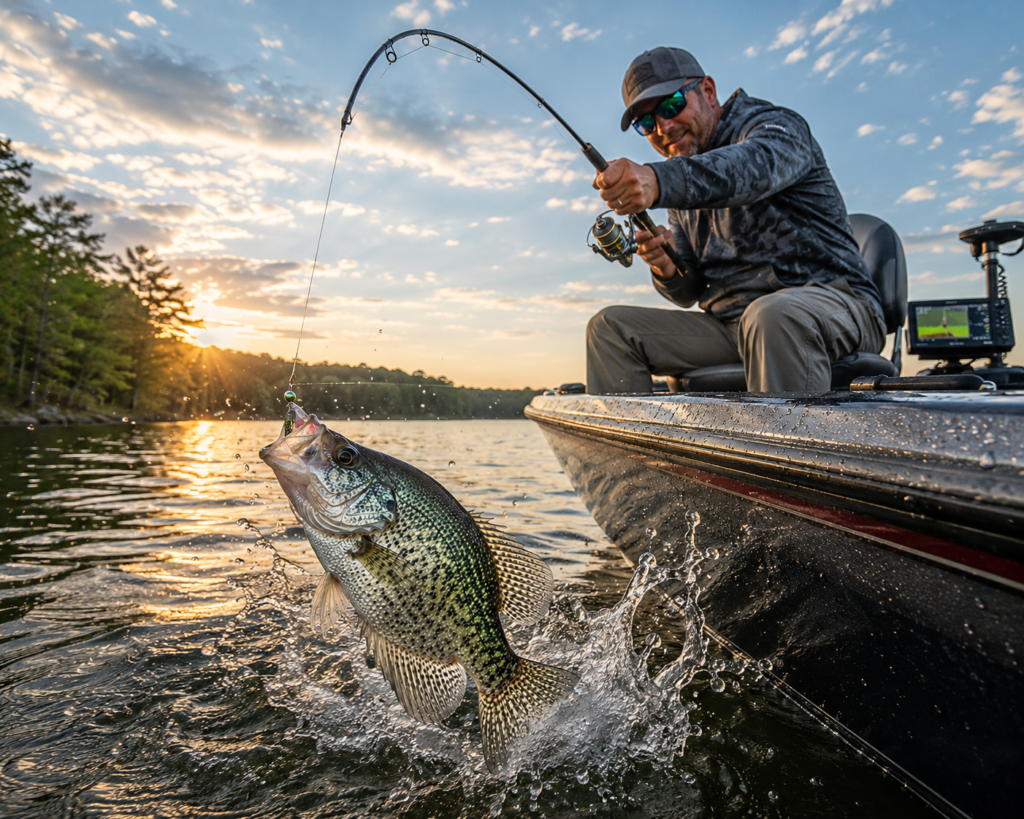
Crappie fishing has become one of my favorite ways to spend time on the water. I do much of my fishing on a large lake that’s well known for its outstanding crappie population, and over the years I’ve learned that consistently catching crappie isn’t about luck—it’s about understanding where they live, how they move throughout the seasons, and how to present the right bait at the right depth and at the right time.
Whether you’re fishing from the bank, a dock, or a boat, crappie are exciting to catch and excellent table fare. Their willingness to bite, combined with the challenge of locating active schools, keeps anglers coming back season after season.
The good news is that catching more crappie doesn’t require expensive equipment or years of experience. With a basic understanding of crappie behavior, seasonal movements, habitat, depth, and a handful of proven techniques, anyone can become a more successful crappie angler.
In this complete guide, I’ll share the techniques, tackle, seasonal patterns, and lessons I’ve learned over the years to help you find crappie, determine the depth they’re holding, choose the right presentation, catch more fish, and enjoy more successful days on the water.
🎣 Partner’s Tip: Throughout this guide, you’ll see one principle repeated again and again: find the fish first, find their depth second, and fine-tune your bait or lure after you’ve put it in front of them.
🎣 Partner’s Advice
If you’re new to crappie fishing, don’t feel like you need to buy every jig color, rod, or electronic gadget before heading to the lake. Crappie are one of the most enjoyable freshwater fish to catch, and success comes from learning where they hold, understanding how they move with the seasons, and presenting your bait naturally. Build your skills one trip at a time, let your tackle collection grow along with your confidence, and most importantly, enjoy every day you spend on the water.
Black Crappie vs. White Crappie
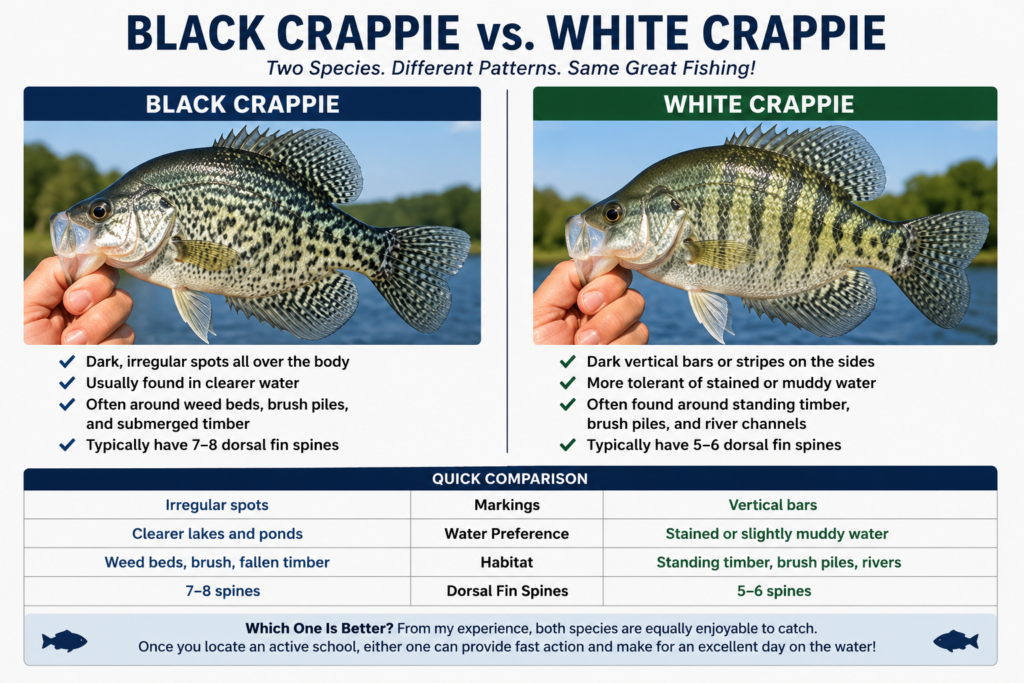
Many anglers are surprised to learn there are two common species of crappie in North America: Black Crappie and White Crappie. While they look similar, each species has unique markings and habitat preferences that can help you identify them and improve your success on the water.
Black Crappie are usually found in clearer water around weed beds, submerged timber, and brush piles. Their bodies are covered with dark, irregular spots.
White Crappie are more commonly found in stained or slightly muddy water and are often associated with standing timber, brush piles, and river channels. Instead of scattered spots, they have distinct vertical bars along their sides.
Although the two species have different markings and habitat preferences, they are often caught using the same lures, baits, and techniques. Once you locate an active school, either species can provide fast and exciting action.
🎣 Black vs. White Crappie at a Glance
| Feature | Black Crappie | White Crappie |
|---|---|---|
| Body Pattern | Random dark spots | Vertical bars |
| Preferred Water | Clear water | Stained or slightly muddy water |
| Common Cover | Weed beds, brush, timber | Standing timber, brush, river channels |
| Best Techniques | Jigs, minnows, small plastics | Jigs, minnows, small plastics |
| Difficulty | Beginner Friendly | Beginner Friendly |
🎣 Partner’s Tip
Don’t spend too much time worrying about whether you’ve caught a Black Crappie or a White Crappie. Focus on finding active schools, fishing the right depth, and presenting your bait naturally. Once you locate feeding fish, both species are a blast to catch and provide excellent table fare.
Understanding Crappie
Crappie may not get the same attention as bass or walleye, but don’t let their size fool you. They’re one of the most enjoyable freshwater fish to catch, and once you find an active school, the action can be fast and exciting. That’s one of the reasons I keep coming back to crappie fishing year after year.
One of the biggest keys to catching crappie consistently is understanding that they don’t simply stay in one place. They school, suspend at different depths, follow baitfish, use cover, and change locations as seasons and water conditions change.
Crappie are strongly associated with cover and structure. Brush piles, submerged timber, docks, standing trees, vegetation, creek channels, drop-offs, and other structural features can all provide feeding opportunities or places for fish to hold.
But finding good-looking cover is only part of the puzzle. You also need to determine where the crappie are positioned around that cover and what depth they’re using.
One thing I’ve learned over the years is that crappie fishing often comes down to paying attention to the little details. A change in depth, retrieve speed, jig size, line diameter, or presentation can sometimes turn a slow day into one you’ll remember.
And once you catch one crappie, pay attention. That fish may have just told you where the rest of the school is holding.
Understanding Crappie at a Glance
| Characteristic | What It Means for Anglers |
|---|---|
| Schooling Fish | If you catch one, more are usually nearby. |
| Favorite Cover | Brush piles, timber, docks, weeds, fallen trees. |
| Best Seasons | Spring and Fall are often the most productive. |
| Feeding Habits | Crappie feed throughout the year but change depth with the seasons. |
| Success Tip | Slow presentations often produce more bites. |
🎣 Partner’s Tip
One of the biggest mistakes new crappie anglers make is leaving too soon. If you catch one crappie, don’t immediately move to another spot. Slow down, make several more casts at different depths, and thoroughly work the area. More often than not, where there’s one crappie, there are many more nearby.
Choosing the Right Crappie Fishing Gear
Crappie don’t require heavy or expensive tackle. In fact, one of the reasons they’re so enjoyable to catch is that relatively simple fishing equipment can handle most situations.
A good crappie setup should help you present small baits accurately, detect light strikes, control your presentation at the proper depth, and still provide enough backbone to pull fish away from brush, docks, and other cover.
There isn’t one perfect setup for every crappie technique. A rod that’s excellent for casting small jigs may not be the best choice for spider rigging, dock shooting, or long-line trolling.
For most anglers, however, a light or ultralight spinning setup paired with light fishing line provides an excellent starting point.
If you’re just getting started, don’t feel like you need to buy everything at once. A dependable rod and reel, appropriate fishing line, a small selection of jigs, and a few proven live-bait options can prepare you for a tremendous amount of crappie fishing.
🎣 Partner’s Tip: Don’t make crappie fishing more complicated than it needs to be. Start with a dependable light spinning setup, a few proven jigs or minnows, and concentrate on location and depth. Finding the fish matters far more than owning a tackle box full of lures.
Beginner Crappie Gear Checklist
| Gear | Recommendation | Why It Works |
|---|---|---|
| Rod | 6½–7 ft Light or Ultralight | Sensitive enough to detect light bites. |
| Reel | Size 1000–2000 Spinning Reel | Lightweight and easy to use. |
| Fishing Line | 4–6 lb Monofilament or Fluorocarbon | Better lure action and improved bite detection. |
| Primary Lures | Small tube jigs, curly-tail grubs, marabou jigs | Proven producers in most conditions. |
| Live Bait | Minnows | A reliable choice when fish are less aggressive. |
🎣 Partner’s Tip
If you’re on a budget, spend your money on a quality rod and reel first. You can catch crappie with a handful of jigs and a bucket of minnows, but a balanced setup will make every cast more enjoyable and help you detect the light bites crappie are famous for.
Best Rod & Reel Combos for Crappie
When it comes to crappie fishing, choosing the right rod and reel combo can make a noticeable both your success and your enjoyment on the water. Crappie have relatively soft mouths, so lightweight equipment helps you detect subtle bites while reducing the chance of pulling the hook free during the fight.
For most anglers, a spinning combo is the best all-around choice. It’s easy to use, casts lightweight jigs and live bait with excellent accuracy, and works well whether you’re fishing from the bank, a dock, or a boat.
Recommended Crappie Rod & Reel Setups
| Fishing Style | Recommended Setup | Best For |
|---|---|---|
| All-Around Fishing | 6½–7 ft Light Spinning Combo | Most anglers and everyday fishing |
| Dock Fishing | 6 ft Light Spinning Combo | Accurate casts around docks and brush |
| Bank Fishing | 7 ft Light or Ultralight Spinning Combo | Longer casts from shore |
| Vertical Jigging | 10–12 ft Jig Pole | Fishing standing timber and brush piles |
| Live Minnow Fishing | Light Spinning Combo | Slip bobbers and live bait presentations |
🎣 Partner’s Tip
If you’re buying your first crappie setup, don’t overcomplicate it. A 6½ to 7-foot light-action spinning combo paired with 4–6 lb line will handle nearly every crappie fishing situation you’ll encounter. As you gain experience, you can always add specialty rods for techniques like vertical jigging or spider rigging.
Finding Crappie Throughout the Year
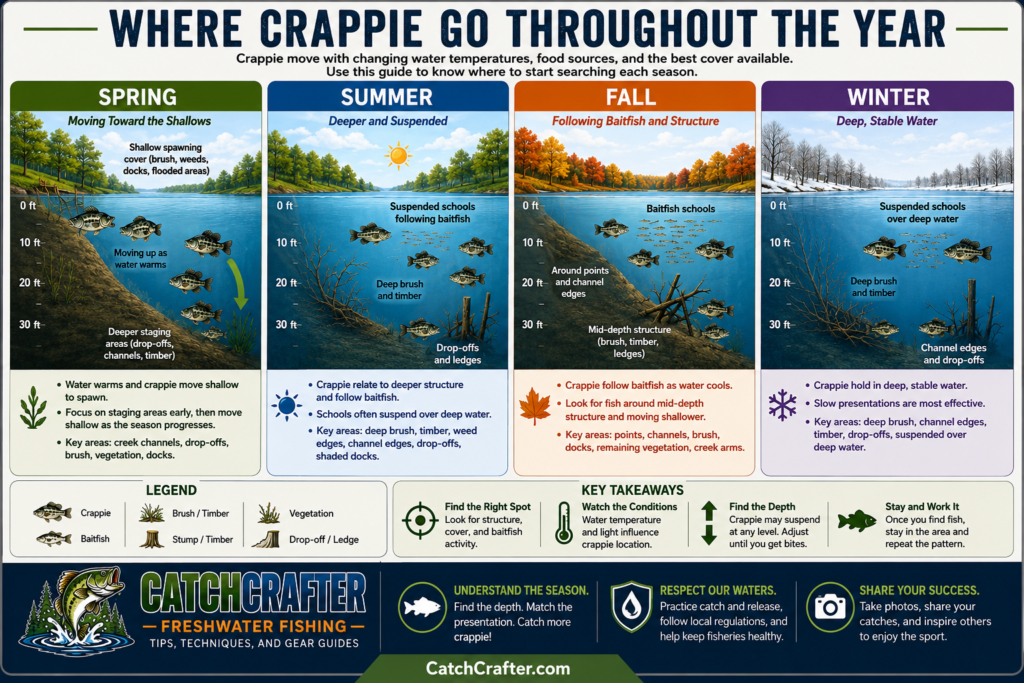
One of the biggest lessons I’ve learned about crappie fishing is that catching more fish usually isn’t about having a different lure—it’s about finding where the fish are holding. Crappie spend most of their time relating to structure and cover, and their location changes as water temperatures and seasons change.
Once you understand where crappie are likely to be during different times of the year, you’ll spend less time searching and more time catching fish.
Throughout the year, crappie move between shallow and deeper water in response to changing water temperatures, spawning activity, and the availability of baitfish. Learning these seasonal movements is one of the biggest steps toward becoming a consistently successful crappie angler.
Seasonal Crappie Movement at a Glance
| Season | Where to Look | What Crappie Are Doing |
|---|---|---|
| 🌱 Spring | Shallow coves, brush piles, spawning flats | Moving shallow to spawn and feed |
| ☀️ Summer | Deep brush piles, docks, standing timber | Holding in cooler, shaded water |
| 🍂 Fall | Creek channels, flats, and baitfish schools | Feeding heavily before winter |
| ❄️ Winter | Deep channels, basins, submerged structure | Conserving energy in deeper water |
🎣 Partner’s Tip
One of the biggest mistakes I see anglers make is staying in one spot too long. If the fish aren’t biting, don’t automatically change lures. Try changing your location or fishing depth first. Crappie are schooling fish, and once you locate an active school, the action can be fast and exciting.
🌸 Spring Crappie Fishing
Spring is one of the most exciting times of the year to fish for crappie. As water temperatures begin to rise, crappie gradually leave their deeper winter locations and move toward shallower areas in preparation for spawning.
Early in the spring, look for crappie along creek channels, drop-offs, points, submerged timber, and deeper brush near spawning areas. These locations give fish access to deeper water while allowing them to move toward the shallows as conditions improve.
As the water continues to warm, crappie begin moving into protected coves, shallow bays, creek arms, flooded brush, vegetation, docks, and other suitable spawning habitat. Their exact timing can vary considerably from one lake to another, so water conditions and fish location are more useful than relying on the calendar alone.
During this period, small jigs and live minnows can both be extremely effective. Because crappie may be holding at a very specific depth, adjust your presentation until you begin getting bites—and then try to duplicate that depth.
🎣 Partner’s Tip: Don’t assume every crappie in the lake moves shallow at the same time. During changing spring conditions, some fish may already be shallow while others remain along nearby deeper staging areas. If the shallow bite disappears, back out toward the first significant drop or cover and keep searching.
Best Spring Baits & Lures
- Small Tube Jigs
- Live Minnows
- Small Minnow-Style Soft Plastics
- Hair Jigs
🌱 Spring Crappie Quick Guide
| What to Look For | Best Places |
|---|---|
| Warming water | Protected coves |
| Spawning activity | Shallow brush piles |
| Cover | Fallen trees and docks |
| Active fish | Vegetation and shoreline structure |
☀️ Summer Crappie Fishing
As water temperatures increase, crappie usually move into deeper water during the day, seeking cooler temperatures and comfortable oxygen levels. Rather than staying shallow, they’re more likely to hold around brush piles, bridge pilings, standing timber, submerged structure, and deep docks, where they can find both shade and an easy meal.
During the summer months, the best fishing often occurs during the early morning and late evening, when cooler temperatures encourage crappie to move into more active feeding areas. During the heat of the day, focus on deeper structure and fish your presentation slowly and deliberately.
🎣 Best Summer Baits & Lures
- Tube Jigs
- Small Crankbaits
- Live Minnows
- Hair Jigs
☀️ Summer Crappie Quick Guide
| What to Look For | Best Places |
|---|---|
| Cooler water | Deep brush piles |
| Shade | Boat docks and bridge pilings |
| Structure | Standing timber and submerged cover |
| Active fish | Early morning and late evening |
🎣 Partner’s Tip
Many anglers give up once the summer heat sets in, but crappie don’t disappear—they simply move deeper. Slow down your presentation, fish the shade, and concentrate on deeper structure. If you stay patient, summer can produce some surprisingly good catches.
🍂 Fall Crappie Fishing
As water temperatures begin to cool, crappie become much more active and often move back toward shallower water to feed. Fall is one of the best times of the year to locate large schools of hungry fish as they build energy reserves before winter.
Focus your efforts around creek channels, brush piles, submerged timber, docks, and flats where baitfish are concentrated. If you can find the bait, there’s a good chance crappie won’t be far away. Once you locate an active school, it’s common to catch several fish from the same area before the action slows.
🎣 Best Fall Baits & Lures
- Spinner Jigs
- Soft Plastic Grubs
- Crankbaits
- Tube Jigs
🍂 Fall Crappie Quick Guide
| What to Look For | Best Places |
|---|---|
| Schools of baitfish | Creek channels |
| Cooling water | Brush piles |
| Feeding activity | Flats near deeper water |
| Cover | Docks and submerged timber |
🎣 Partner’s Tip
Fall is one of my favorite times to crappie fish because the fish are actively feeding. Don’t spend too much time in one spot if you’re not getting bites. Cover water until you locate a school, then slow down and thoroughly work the area. Crappie often group together, so finding one usually means more are nearby.
❄️ Winter Crappie Fishing
Winter can be one of the most challenging seasons for crappie fishing, but it can also be one of the most rewarding. As water temperatures drop, crappie typically move into deeper water where they conserve energy and gather around structure. Although they become less active, they continue to feed, especially when presented with a slow, natural presentation.
Look for crappie around deep brush piles, creek channels, submerged timber, bridge pilings, and channel edges. Electronics can be especially helpful during the winter, allowing you to locate schools of fish before making your presentation.
Best Winter Baits & Lures
- Small Tube Jigs
- Hair Jigs
- Live Minnows
- Soft Plastic Grubs
❄️ Winter Crappie Quick Guide
| What to Look For | Best Places |
|---|---|
| Deep water | Creek channels |
| Wintering schools | Brush piles |
| Structure | Standing timber and bridge pilings |
| Slow-moving fish | Channel edges and deep cover |
🎣 Partner’s Tip
Patience is the key to winter crappie fishing. Slow your presentation, fish vertically whenever possible, and give the lure time to stay in the strike zone. Even when the bite feels slow, schools of crappie can produce excellent catches once you locate them.
Choosing the Right Lure Color
Selecting the right lure color can make a noticeable difference in your success, especially when water clarity, light conditions, and weather change throughout the day. While crappie will often strike a variety of colors, matching your lure to the conditions can improve visibility and increase bites.
Clear Water
In clear water, natural-looking colors usually produce the best results because they closely resemble the baitfish that crappie feed on.
Recommended Colors
- Shad
- Pearl White
- Smoke
- Silver
- Natural Minnow
Stained Water
When the water has reduced visibility, brighter colors help crappie locate your lure more easily.
Recommended Colors
- Chartreuse
- Pink
- Orange
- White/Chartreuse
- Electric Chicken
Muddy Water
In muddy water, visibility is extremely limited. Bright, high-contrast colors are often the easiest for crappie to find.
Recommended Colors
- Solid Chartreuse
- Black/Chartreuse
- Orange/Chartreuse
- Bright Pink
Cloudy Days and Low Light
On cloudy days or during the early morning and evening, brighter colors often stand out better and attract more attention.
Try These Colors
- Chartreuse
- Pink
- Orange
- White/Chartreuse
💡 Partner’s Pick
If I could carry only three crappie lure colors, they would be:
🥇 Chartreuse – My first choice for stained water and low-light conditions.
🥈 Pearl White – A dependable natural color that performs well in clear water.
🥉 Black/Chartreuse – A high-contrast combination that continues to produce when visibility is poor.
With just these three colors in your tackle box, you’ll be prepared for almost any crappie fishing situation.
Seasonal Lure Selection
Crappie behavior changes throughout the year as water temperatures rise and fall. Understanding which lures work best during each season can help you spend less time experimenting and more time catching fish.
🎣 Seasonal Lure Quick Guide
| Season | Recommended Lure | Why It Works |
|---|---|---|
| 🌱 Spring | Tube Jig | Excellent around shallow cover and spawning areas. |
| ☀️ Summer | Small Crankbait | Covers deeper water and helps locate active fish. |
| 🍂 Fall | Spinner Jig | Great for covering water and finding feeding schools. |
| ❄️ Winter | Marabou Hair Jig | Subtle presentation for cold, less active crappie. |
🎣 Partner’s Pick
If I had to simplify lure selection for the entire year, this is what I’d recommend:
🥇 Spring: Tube Jig
🥇 Summer: Small Crankbait
🥇 Fall: Spinner Jig
🥇 Winter: Marabou Hair Jig
These four lures cover nearly every crappie fishing situation you’ll encounter. Keep a few colors and sizes of each in your tackle box, and you’ll be prepared whether you’re fishing from the bank, a dock, or a boat.
Live Baits for Crappie
While artificial lures are incredibly effective, there are times when nothing outperforms live bait. Natural scent, lifelike movement, and realistic presentation make live bait an excellent choice when crappie are less aggressive or feeding selectively.
Many experienced anglers carry both artificial lures and live bait so they can adapt to changing conditions throughout the day. Knowing which live bait to use—and when to use it—can significantly improve your success on the water.
🎣 Best Live Baits for Crappie
| Live Bait | Best For | Why It Works |
|---|---|---|
| Fathead Minnows | Year-round fishing | Natural swimming action and consistent producer. |
| Nightcrawlers | Spring and summer | Affordable, readily available, and effective under a float. |
| Waxworms | Cold water and finesse fishing | Small profile and natural scent for finicky fish. |
| Crickets | Warm-weather shallow fishing | Excellent around docks and shoreline cover. |
🎣 Partner’s Pick
If I could choose only one live bait for crappie, it would be fathead minnows. They’re dependable, easy to find, and consistently produce fish throughout the year. I always keep a bucket of lively minnows on hand because they’re hard to beat when the bite gets tough.
How to Find and Catch Crappie Without a Boat
Crappie fishing isn’t limited to anglers with boats. Some of the best crappie fishing of the year can happen within casting distance of the bank, especially when fish move shallow during the spring.
Public docks, fishing piers, bridges, riprap banks, creek mouths, submerged brush, fallen trees, and shorelines with quick access to deeper water can all be productive places to look for crappie.
One of the biggest advantages bank anglers have is the ability to thoroughly work a small area. Instead of constantly moving, make several casts from different angles and experiment with different depths until you locate fish.
A slip bobber paired with a live minnow or small jig is especially useful from shore because it allows you to control exactly how deep your bait is fishing. Casting small jigs and slowly retrieving them at different depths is another simple and effective way to locate active crappie.
Early morning and evening can be especially productive around docks and shoreline cover as crappie move into areas where baitfish are active.
🎣 Partner’s Tip: When fishing from shore, don’t just cast straight out toward the deepest water. Fan-cast the entire area—left, right, straight ahead, and along the shoreline. Crappie may be holding much closer to the bank than you expect.
Choosing the Right Technique
| Technique | Best Situation | Difficulty |
|---|---|---|
| Vertical Jigging | Deep structure | ⭐⭐ Beginner |
| Slip Bobber | Suspended fish | ⭐ Very Beginner |
| Dock Shooting | Fish under docks | ⭐⭐⭐⭐ Advanced |
| Spider Rigging | Covering large areas | ⭐⭐⭐ Intermediate |
Vertical Jigging
How It Works
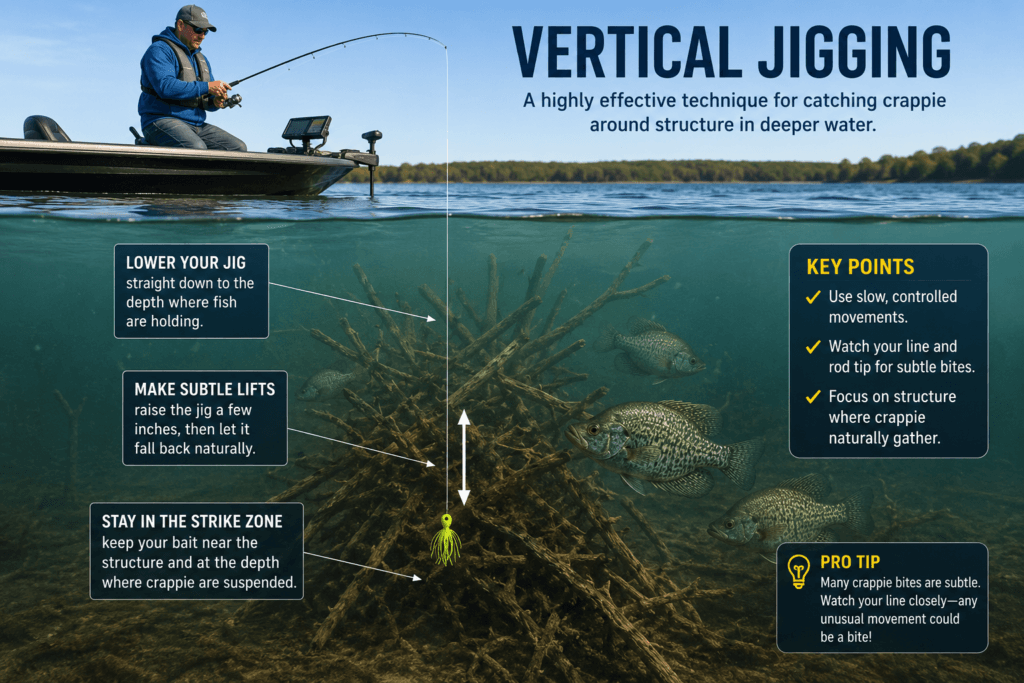
Vertical jigging is one of the most effective techniques for catching crappie holding around submerged structure. The method involves lowering a jig or live bait straight down into brush piles, standing timber, bridge pilings, docks, or other cover where crappie naturally gather.
The key is to keep your bait in the strike zone and use slow, controlled movements. Often, only slight lifts of a few inches are needed to trigger a bite. Since crappie frequently suspend at specific depths, maintaining the proper presentation is more important than constantly moving the bait.
Best Time to Use It
- Winter
- Summer
- When crappie are holding in deeper water
- Around submerged brush piles and standing timber
Where It Excels
- Brush piles
- Standing timber
- Bridge pilings
- Boat docks
- Deep creek channels
Common Mistakes to Avoid
- Jigging too aggressively instead of making subtle movements.
- Fishing above or below the depth where crappie are suspended.
- Ignoring light bites that may only feel like added weight.
- Moving too quickly between spots without thoroughly working productive cover.
💡 Pro Tip
Watch your fishing line as closely as your rod tip. Many crappie bites are so subtle that the only indication is a slight twitch or the line moving sideways. If something feels different, set the hook—you’ll often be surprised to find a crappie on the other end.
🎣 Partner’s Advice
One thing I’ve learned is that patience pays off when vertical jigging. Resist the urge to constantly move your bait. Let it hover naturally around the cover, make small movements, and give crappie time to react. Some of the biggest slabs are caught by anglers who fish slowly and methodically.
🎯 Quick Summary
Difficulty: ⭐⭐☆☆☆ (Beginner)
Best Season: Winter and Summer
Best Depth: Deep Water
Works Best With:
- Tube Jigs
- Hair Jigs
- Live Minnows
Slip Bobber Fishing
How It Works
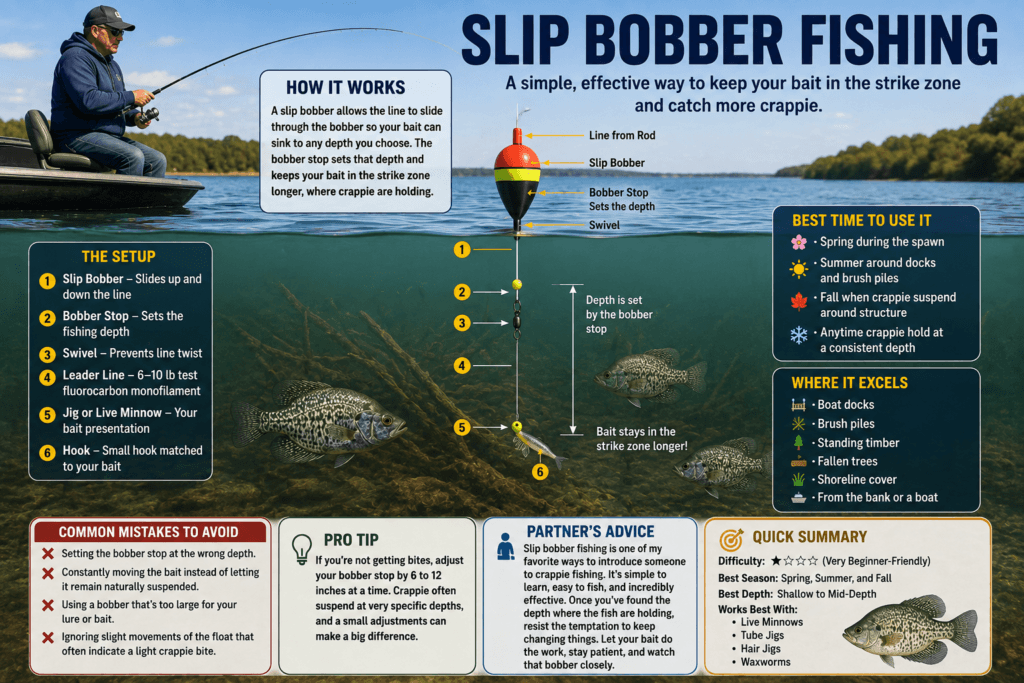
Slip bobber fishing is one of the most effective and beginner-friendly techniques for catching crappie. Unlike a fixed bobber, a slip bobber allows you to fish at virtually any depth by using a bobber stop to control how far your bait sinks.
This technique keeps your bait suspended in the strike zone longer, making it ideal for targeting crappie holding around brush piles, docks, standing timber, and submerged vegetation. Whether you’re using a small jig or a live minnow, the natural presentation often results in more bites.
Best Time to Use It
- Spring during the spawn
- Summer around docks and brush piles
- Fall when crappie suspend around structure
- Anytime crappie are holding at a consistent depth
Where It Excels
- Boat docks
- Brush piles
- Standing timber
- Fallen trees
- Shoreline cover
- Fishing from the bank or a boat
Common Mistakes to Avoid
- Setting the bobber stop at the wrong depth.
- Constantly moving the bait instead of letting it remain naturally suspended.
- Using a bobber that’s too large for your lure or bait.
- Ignoring slight movements of the float that often indicate a light crappie bite.
💡 Pro Tip
If you’re not getting bites, adjust your bobber stop by 6 to 12 inches at a time. Crappie often suspend at very specific depths, and a small adjustment can make a big difference.
🎣 Partner’s Advice
Slip bobber fishing is one of my favorite ways to introduce someone to crappie fishing. It’s simple to learn, easy to fish, and incredibly effective. Once you’ve found the depth where the fish are holding, resist the temptation to keep changing things. Let your bait do the work, stay patient, and watch that bobber closely.
🎯 Quick Summary
Difficulty: ⭐☆☆☆☆ (Very Beginner-Friendly)
Best Season: Spring, Summer, and Fall
Best Depth: Shallow to Mid-Depth
Works Best With:
- Live Minnows
- Tube Jigs
- Hair Jigs
- Waxworms
Dock Shooting
How It Works
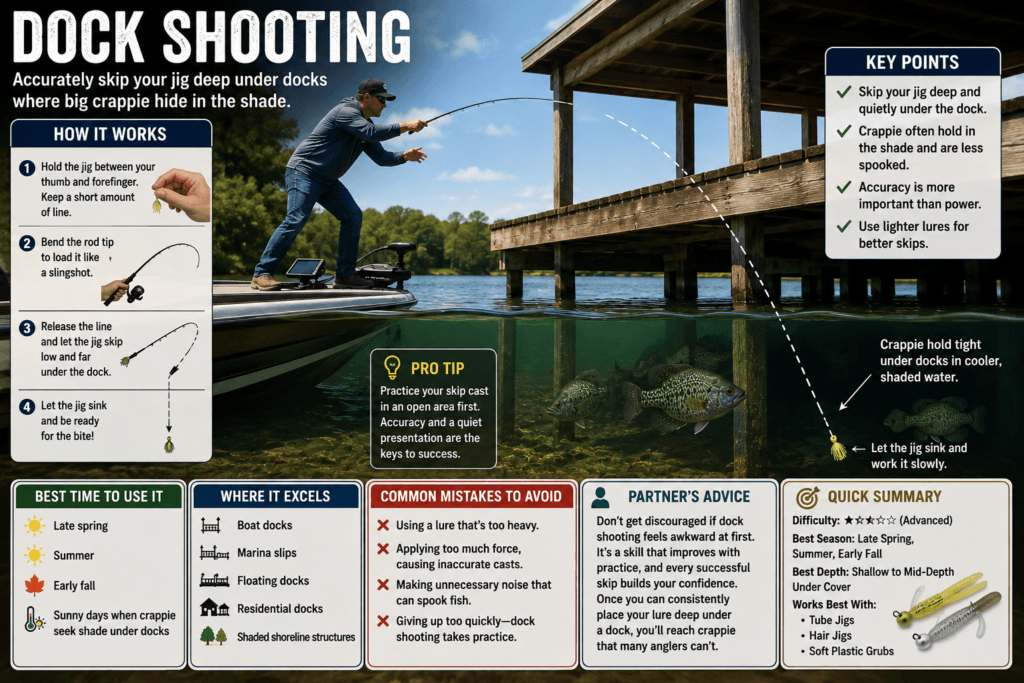
Dock shooting is an advanced crappie fishing technique that allows anglers to reach fish hiding deep beneath docks, boat slips, and other structures that are difficult to access with a traditional cast. By holding the jig between your thumb and forefinger, bending the rod, and releasing the lure like a slingshot, you can accurately skip it far underneath the dock.
This technique is especially effective during the warmer months when crappie seek shade and cooler water beneath docks. A quiet, accurate presentation often results in strikes from fish that receive very little fishing pressure.
Best Time to Use It
- Late spring
- Summer
- Early fall
- Sunny days when crappie move beneath docks for shade
Where It Excels
- Boat docks
- Marina slips
- Floating docks
- Residential docks
- Shaded shoreline structures
Common Mistakes to Avoid
- Using a lure that’s too heavy, making it difficult to skip smoothly.
- Applying too much force, causing inaccurate casts.
- Making unnecessary noise that can spook fish under the dock.
- Giving up too quickly—dock shooting takes practice and patience.
💡 Pro Tip
Start practicing at a local pond or even in your backyard using a casting plug or practice weight. As your accuracy improves, you’ll gain the confidence to place your lure exactly where the biggest crappie like to hide.
🎣 Partner’s Advice
Don’t get discouraged if dock shooting feels awkward at first. It’s a skill that improves with practice, and every successful skip builds your confidence. Once you learn to consistently place your lure deep beneath a dock, you’ll be able to reach crappie that many anglers simply can’t.
🎯 Quick Summary
Difficulty: ⭐⭐⭐⭐☆ (Advanced)
Best Season: Late Spring, Summer, Early Fall
Best Depth: Shallow to Mid-Depth Under Cover
Works Best With:
- Tube Jigs
- Hair Jigs
- Soft Plastic Grubs
Spider Rigging
How It Works
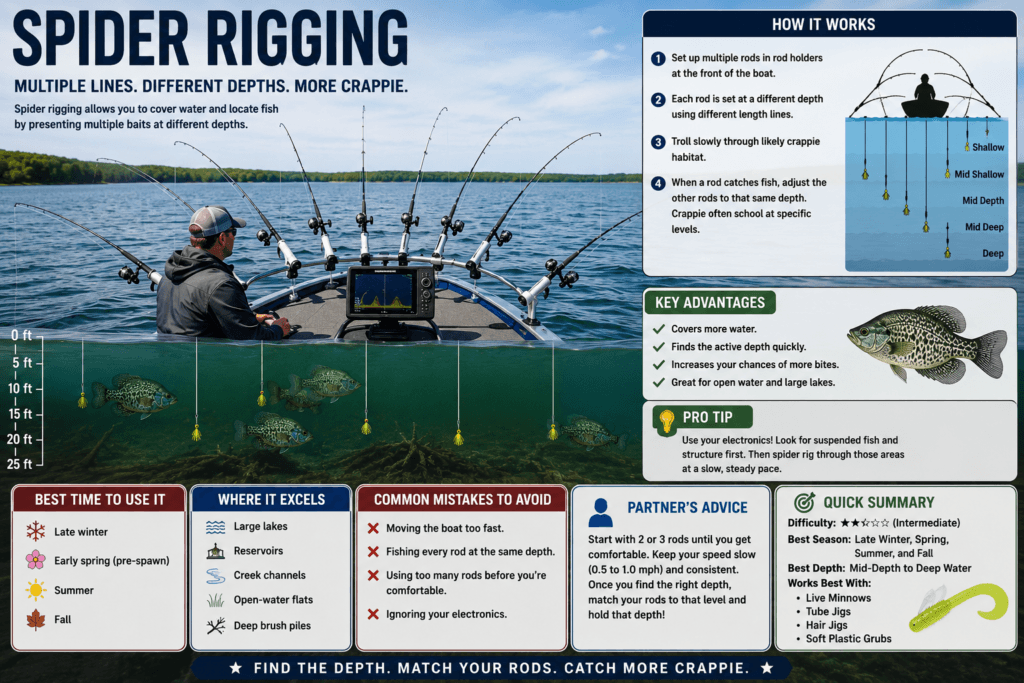
Spider rigging is a popular technique that involves fishing with multiple rods extending from the front of the boat, each presenting a bait at a different depth. By slowly moving through likely crappie habitat, anglers can cover a large area while determining where fish are suspended in the water column.
Once the productive depth is identified, you can adjust the remaining rods to match it, increasing your chances of catching more crappie. Spider rigging is especially effective on large lakes, reservoirs, and open-water flats where crappie often roam in search of baitfish.
Best Time to Use It
- Late winter
- Early spring (pre-spawn)
- Summer
- Fall
Where It Excels
- Large lakes
- Reservoirs
- Creek channels
- Open-water flats
- Deep brush piles
Common Mistakes to Avoid
- Moving the boat too quickly, causing baits to rise above the fish.
- Fishing every rod at the same depth instead of experimenting until you locate the active fish.
- Using too many rods before becoming comfortable managing them.
- Ignoring electronics that can help identify fish-holding depths and underwater structure.
💡 Pro Tip
Once one rod starts catching fish consistently, adjust the others to match that same depth. Crappie often school tightly and matching the productive depth can quickly increase your catch.
🎣 Partner’s Advice
Spider rigging can look intimidating at first, but it doesn’t have to be. Begin with just two or three rods until you’re comfortable controlling the boat and managing multiple lines. As your confidence grows, you can gradually add more rods and refine your presentation.
🎯 Quick Summary
Difficulty: ⭐⭐⭐☆☆ (Intermediate)
Best Season: Late Winter, Spring, Summer, and Fall
Best Depth: Mid-Depth to Deep Water
Works Best With:
- Live Minnows
- Tube Jigs
- Hair Jigs
- Soft Plastic Grubs
Casting and Retrieving
How It Works
Casting and retrieving is one of the simplest and most effective ways to catch crappie, making it an excellent technique for anglers of all skill levels. By casting a jig, soft plastic, spinner jig, or small crankbait and retrieving it at a steady pace, you can quickly cover water and locate active fish.
The key is to vary your retrieve speed until you find what the crappie prefer. Pay attention to what happens after each cast. If you get a bite after a five-second countdown or during a pause in your retrieve, repeat that presentation. Crappie often respond to a very specific speed and depth on any given day. Some days they respond to a slow, steady retrieve, while other times short pauses or occasional twitches will trigger reaction strikes.
Best Time to Use It
- Spring
- Summer
- Fall
- Whenever you’re searching for active fish
Where It Excels
- Shorelines
- Weed edges
- Boat docks
- Brush piles
- Riprap banks
- Open water near structure
Common Mistakes to Avoid
- Retrieving the lure too quickly.
- Using the same retrieve speed all day without experimenting.
- Ignoring changes in fish depth and location.
- Casting repeatedly to the same spot instead of covering new water.
- Setting the hook too aggressively. Crappie have soft mouths, also known as paper mouths, so a smooth hookset is often all that’s needed.
💡 Pro Tip
Try counting your lure down before beginning your retrieve. For example, let it sink for three, five, or even ten seconds before reeling. This simple adjustment helps you fish different depths until you locate suspended crappie.
🎣 Partner’s Advice
Casting and retrieving is often my first choice when fishing unfamiliar water. It allows me to cover a lot of ground quickly and find active crappie. Once I locate a productive area, I usually slow down and work it thoroughly. Sometimes I’ll switch to vertical jigging or a slip bobber presentation to stay in the strike zone longer.
🎯 Quick Summary
Difficulty: ⭐☆☆☆☆ (Very Beginner-Friendly)
Best Season: Spring, Summer, and Fall
Best Depth: Shallow to Mid-Depth
Works Best With:
- Tube Jigs
- Soft Plastic Grubs
- Spinner Jigs
- Small Crankbaits
Trolling for Crappie
How It Works
Trolling is an excellent technique for locating scattered crappie over large areas of water. Instead of casting to one spot, you slowly move the boat while pulling jigs, crankbaits, or live bait behind you. This allows you to cover more water and quickly determine where crappie are feeding.
One of the biggest advantages of trolling is that it helps you locate suspended fish that may not be holding tightly to visible structure. By adjusting your speed, lure depth, and presentation, you can fine-tune your setup until you find the most productive combination.
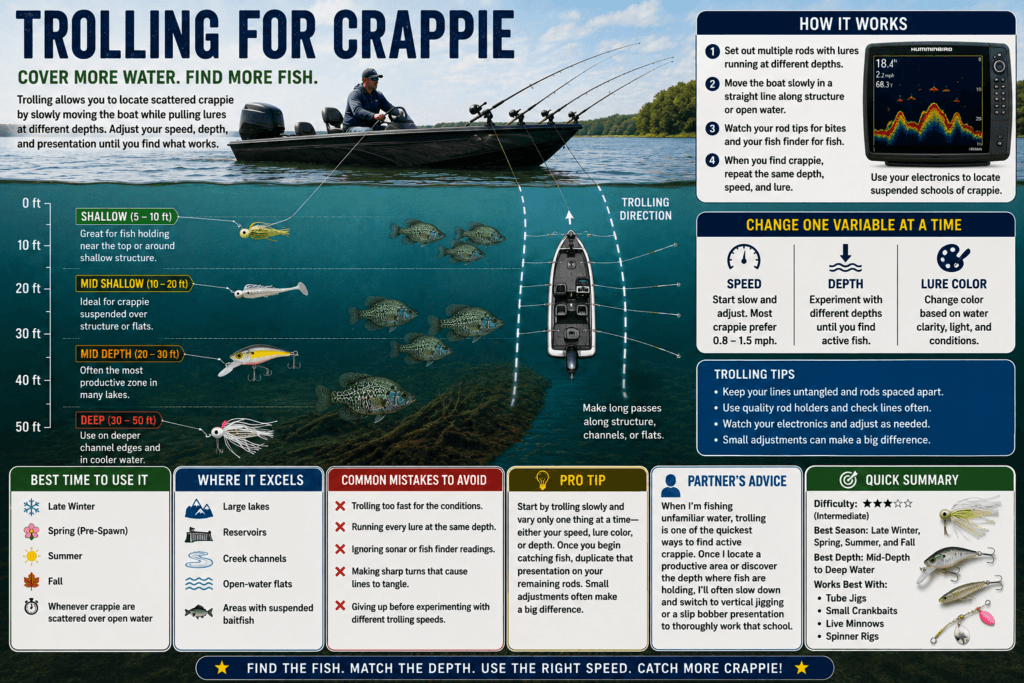
Best Time to Use It
- Late Winter
- Spring (Pre-Spawn)
- Summer
- Fall
- Whenever crappie are scattered over open water
Where It Excels
- Large lakes
- Reservoirs
- Creek channels
- Open-water flats
- Areas with suspended baitfish
Common Mistakes to Avoid
- Trolling too fast for the conditions.
- Running every lure at the same depth.
- Ignoring sonar or fish finder readings.
- Making sharp turns that cause lines to tangle.
- Giving up before experimenting with different trolling speeds.
💡 Pro Tip
Start by trolling slowly and vary only one thing at a time—either your speed, lure color, or depth. Once you begin catching fish, duplicate that presentation on your remaining rods. Small adjustments often make a big difference.
🎣 Partner’s Advice
When I’m fishing unfamiliar water, trolling is one of the quickest ways to find active crappie. Once I locate a productive area or discover the depth where fish are holding, I’ll often slow down and switch to vertical jigging or a slip bobber presentation to thoroughly work that school.
🎯 Quick Summary
Difficulty: ⭐⭐⭐☆☆ (Intermediate)
Best Season: Late Winter, Spring, Summer, and Fall
Best Depth: Mid-Depth to Deep Water
Works Best With:
- Tube Jigs
- Small Crankbaits
- Live Minnows
- Spinner Rigs
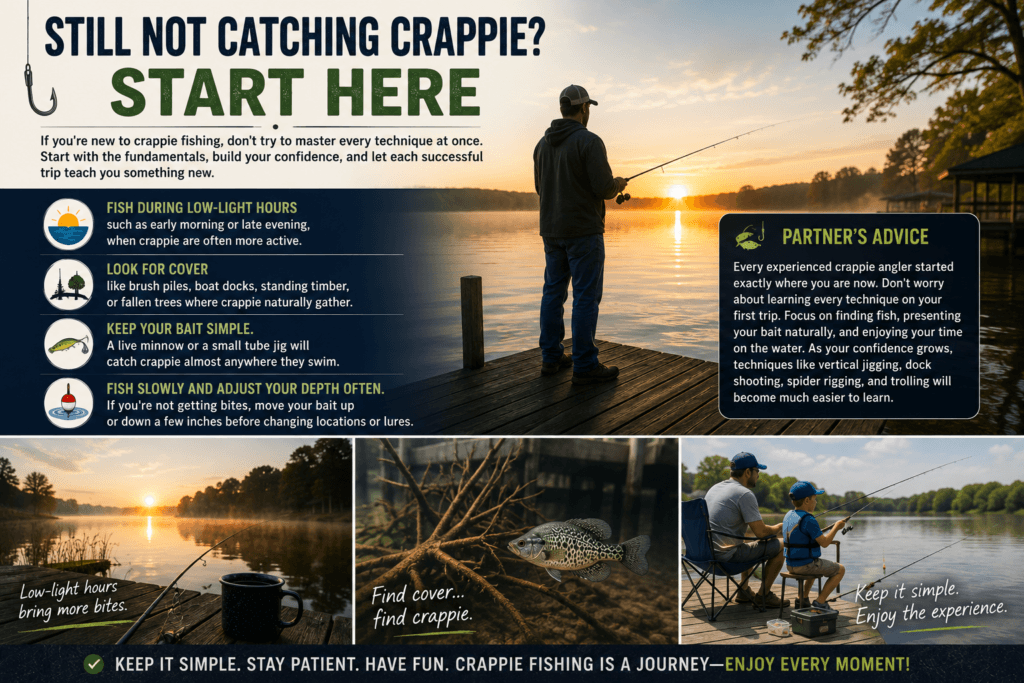
If you’re new to crappie fishing, don’t try to master every technique at once. Start with the fundamentals, build your confidence, and let each successful trip teach you something new.
Still Not Catching Crappie? Start Here
Start with These Simple Steps
✅ Fish during low-light hours such as early morning or late evening, when crappie are often more active.
✅ Look for cover like brush piles, boat docks, standing timber, or fallen trees where crappie naturally gather.
✅ Keep your bait simple. A live minnow or a small tube jig will catch crappie almost anywhere they swim.
✅ Fish slowly and adjust your depth often. If you’re not getting bites, move your bait up or down a few inches before changing locations or lures.
🎣 Partner’s Advice
Every experienced crappie angler started exactly where you are now. Don’t worry about learning every technique on your first trip. Focus on finding fish, presenting your bait naturally, and enjoying your time on the water. As your confidence grows, techniques like vertical jigging, dock shooting, spider rigging, and trolling will become much easier to learn.
Crappie Conservation and Selective Harvest
Crappie are an excellent fish for the table, and keeping a few fish for a meal is part of the enjoyment of crappie fishing for many anglers. At the same time, practicing selective harvest can help protect quality fishing for the future.
Always check the current fishing regulations for the water you’re fishing, including daily limits, possession limits, and any size restrictions that may apply. Regulations can vary from one state or body of water to another.
When keeping crappie, consider taking only the fish you realistically plan to use. Releasing some of the larger fish can also help maintain healthy populations, since larger crappie are mature fish that contribute to future spawning.
If you’re releasing a crappie, handle it carefully, minimize the amount of time it spends out of the water, and return it as quickly as possible.
Responsible fishing also means taking care of the places we fish. Pick up discarded fishing line and trash, respect other anglers, and leave docks, shorelines, and access areas in better condition than you found them.
🎣 Partner’s Tip: There’s nothing wrong with bringing home crappie for dinner—that’s one of the pleasures of fishing. Just keep what you’ll use, follow local regulations, and release the rest carefully so other anglers can enjoy the same opportunity in the future.
Frequently Asked Questions
If you’re just getting started with crappie fishing, you’re not alone. These are some of the most common questions anglers ask about finding, catching, and understanding crappie. Hopefully, the answers below will help you spend less time wondering and more time catching fish.
What is the best bait for crappie?
Both live bait and artificial lures can be highly effective for crappie, but many anglers consider live minnows the gold standard because they closely imitate the baitfish crappie naturally feed on. When using artificial lures, tube jigs, hair jigs, and soft plastic grubs consistently produce excellent results throughout the year.
The best choice often depends on water conditions, the season, and how active the fish are. Keeping both live bait and artificial lures in your tackle box gives you the flexibility to adapt to changing conditions.
What is the best time of day to catch crappie?
Crappie are generally most active during the early morning and late evening when light levels are lower and baitfish are feeding. However, they can be caught throughout the day, especially when fishing around docks, brush piles, bridge pilings, and other areas that provide shade and cover.
During the spring spawning season, crappie may remain active for much of the day as they move into shallow water to reproduce.
What water temperature do crappie prefer?
Crappie become increasingly active as water temperatures reach 55°F to 70°F. Spring spawning typically begins when temperatures approach the lower end of this range, although the exact timing varies depending on your location and weather conditions.
During the summer, warmer water often pushes crappie into deeper, cooler areas, while colder winter temperatures usually cause them to gather around deeper structure where they conserve energy.
Where do crappie go during the summer?
As water temperatures rise, crappie usually move away from shallow spawning areas and seek cooler water around submerged brush piles, standing timber, bridge pilings, creek channels, and deeper docks. They often suspend at specific depths, making electronics and depth control valuable tools for locating fish.
Early mornings, evenings, and overcast days can also bring crappie closer to shallow cover.
How deep do crappie stay?
Crappie can be found anywhere from 2 feet to more than 30 feet deep, depending on the season, water temperature, and available cover. During the spring spawn, they’re often found in shallow water, while summer and winter usually find them holding deeper around structure.
Rather than focusing on a specific depth, look for areas where baitfish are present and adjust your presentation until you locate the active fish.
What pound-test line should I use for crappie?
For most crappie fishing situations, 4- to 6-pound-test monofilament or fluorocarbon line provides an excellent balance of strength, sensitivity, and natural lure presentation. If you’re fishing around heavy brush or submerged timber, some anglers prefer 8-pound braided line with a fluorocarbon leader for added strength and better sensitivity.
The best choice depends on the cover you’re fishing and the techniques you’re using, but lighter line generally allows your bait to move more naturally and helps detect subtle bites.
What is the best rod length for crappie fishing?
A 6½- to 7-foot light or ultralight spinning rod is one of the most versatile choices for crappie fishing. This length offers a good combination of casting distance, sensitivity, and control while remaining comfortable to use throughout the day.
Longer rods are often preferred for spider rigging and trolling, while shorter rods can be beneficial when fishing around docks or in tight spaces.
Do crappie bite better before or after a cold front?
Crappie typically feed more actively before a cold front as changing weather conditions often trigger increased feeding activity. After a cold front passes, crappie frequently become less aggressive and may move slightly deeper or hold tighter to cover.
During post-front conditions, slowing your presentation and using smaller lures or live bait can help encourage reluctant fish to bite.
Can you catch crappie from the bank?
Absolutely! Many anglers enjoy excellent crappie fishing from the bank, especially during the spring spawning season when fish move into shallow water. Docks, fallen trees, brush piles, bridges, and shoreline vegetation are all productive areas to target.
A slip bobber rig with a live minnow or a small tube jig is often one of the most effective setups for bank anglers.
What colors do crappie see best?
Crappie respond to different lure colors depending on water clarity, light conditions, and available forage. In clear water, natural colors such as white, pearl, silver, and smoke often work best. In stained or muddy water, brighter colors like chartreuse, pink, orange, and black/chartreuse are easier for fish to see.
If one color isn’t producing bites, don’t hesitate to experiment. Sometimes a simple color change is all it takes to trigger more strikes.
Fishing is a journey of patience, learning, and time on the water. Every trip is another opportunity to become a better angler.
Final Thoughts
Successful crappie fishing isn’t about owning the most expensive equipment or filling your tackle box with every lure on the market. It’s about understanding the fish, recognizing seasonal patterns, choosing the right presentation, and adapting to changing conditions on the water.
Throughout this guide, we’ve explored the essential gear, fishing line, lures, live bait, seasonal movements, and proven techniques that consistently help anglers catch more crappie. Whether you’re fishing from the bank, a dock, a kayak, or a boat, the fundamentals remain the same: find the fish, present your bait naturally, and stay patient.
One lesson I’ve learned over the years is that buying more gear doesn’t automatically make you a better crappie angler. Spending time on the water, learning how crappie relate to structure, and understanding how they respond to changing conditions will always do more for your success than owning an expensive tackle collection.
Every lake is a little different, and every fishing trip teaches you something new. Pay attention to the conditions, learn from each outing, and don’t be afraid to make small adjustments. Sometimes slowing your retrieve or changing your jig depth by just a few inches is all it takes to turn a slow day into a productive one.
Most importantly, don’t measure every trip by the number of fish you catch. Some of the best days on the water are the ones spent with family and friends, enjoying the outdoors, learning something new, and creating memories that last a lifetime.
🎣 Partner’s Final Tip
If the fish aren’t biting, don’t immediately change lures. Slow down, experiment with your depth, and stay patient. Sometimes a small adjustment in depth or presentation is all it takes to start getting bites again.
We’d Love to Hear From You
Have a favorite crappie fishing tip, technique, or lure that wasn’t mentioned in this guide?
Share your experience in the comments below! Whether you’re just getting started or have years of experience, your advice could help another angler enjoy a more successful day on the water.
If you enjoyed this guide, be sure to explore the other freshwater fishing resources here on CatchCrafter as we continue building a complete library of fishing tips, techniques, and honest gear recommendations.
Until next time…
Tight Lines!
— Thaddeus