Last Updated: August 4, 2026
📖 Reading Time: Approximately 25 minutes
Skill Level: Beginner to Intermediate
In this guide, you’ll learn everything from understanding bass behavior and choosing the right equipment to selecting effective lures and avoiding common beginner mistakes.
Learn the proven techniques, seasonal patterns, and tackle recommendations that help anglers catch more bass throughout the year.
Whether you’re chasing your first largemouth from the bank or searching for trophy smallmouth from a boat, success comes from understanding how bass think, where they move, and what they feed on.
In this complete CatchCrafter guide, you’ll discover:
✅ Where bass hold during every season
✅ The best lures for different water conditions
✅ Rod, reel, and line recommendations
✅ Proven techniques for largemouth and smallmouth bass
✅ Common mistakes that cost anglers fish
✅ Conservation tips that protect future fisheries
Whether you’re a beginner or an experienced angler looking to sharpen your skills, this guide will help you spend less time guessing and more time catching bass.
Bass fishing is one of the most popular freshwater sports in North America—and for good reason. Few fish fight as hard or offer as much excitement as a largemouth or smallmouth bass. Whether you’re fishing from the bank, a kayak, or a boat, learning how bass behave throughout the seasons can dramatically improve your success.
In this guide, I’ll share the techniques, tackle, and lessons that have helped me catch more bass over the years. My goal is to help you spend less time guessing where bass are hiding and more time enjoying your time on the water.
Understanding Bass Behavior
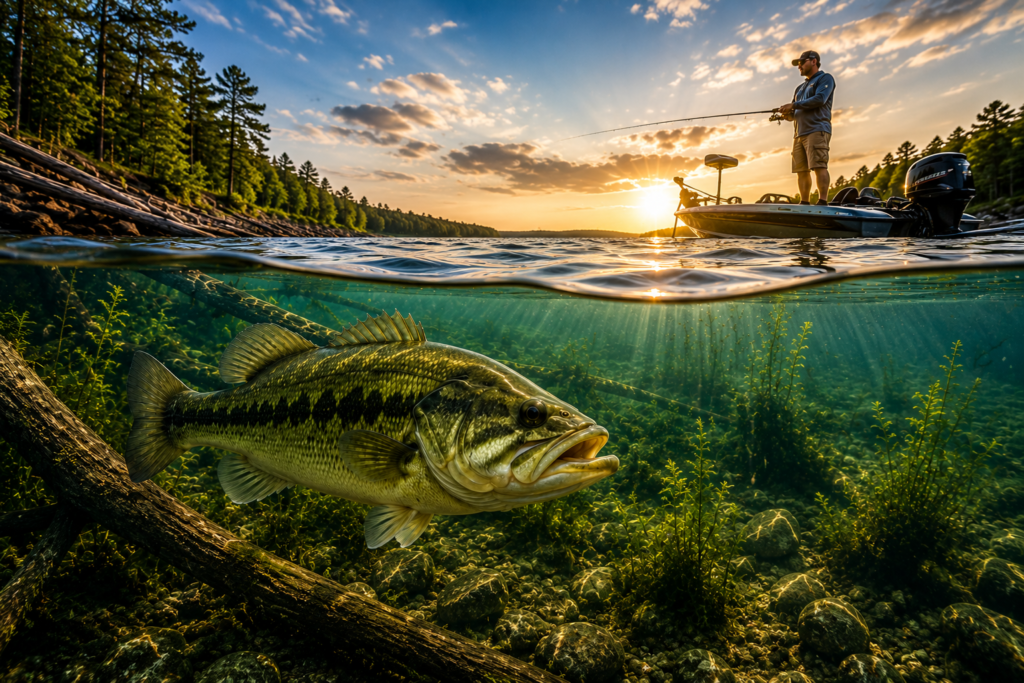
One of the biggest reasons some anglers consistently catch more bass than others isn’t because they own better equipment—it’s because they understand how bass behave. Bass don’t randomly swim around a lake. Their movements are influenced by water temperature, available cover, seasonal changes, weather conditions, and the location of baitfish.
Once you learn why bass move and where they’re likely to be throughout the year, you’ll spend less time searching and more time putting fish in the boat or on the bank.
Bass Are Ambush Predators
Unlike many fish that spend much of their time roaming open water, bass are opportunistic predators. They prefer areas where they can hide and ambush unsuspecting prey. Fallen trees, weed beds, docks, rocky points, bridge pilings, and submerged brush all provide the cover bass use to conserve energy while waiting for an easy meal. Instead of constantly chasing baitfish, bass often let the food come to them.
What Bass Eat
Bass feed on a wide variety of prey depending on what’s available in the body of water they’re living in. Minnows, shad, bluegill, crayfish, frogs, insects, and even small mice or ducklings can become a meal for a hungry bass. Learning what bass are feeding on during different times of the year will help you choose the right lure, color, and presentation.
Seasonal Behavior
Water temperature has a tremendous impact on bass behavior. During the spring, warming water pulls bass into shallow areas to spawn. As summer temperatures rise, many bass move deeper or seek shaded cover where the water is cooler, and oxygen levels are higher. Fall triggers another feeding frenzy as bass actively chase baitfish to prepare for winter. During the coldest months, their metabolism slows considerably, making slower presentations much more effective.
Weather Matters
Weather conditions can also influence where bass are located and how aggressively they feed. Changes in barometric pressure, cloud cover, wind, rainfall, and water clarity all affect bass activity. While no two fishing trips are exactly alike, anglers who learn to recognize these changing conditions often find fish more consistently than those who rely on luck alone.
🎣 Partner’s Advice
One lesson I’ve learned over the years is that successful bass fishing rarely comes down to having the most expensive equipment. It’s usually the angler who pays attention to the small details—water temperature, seasonal movements, available cover, and forage—that catches the most fish. Once you begin understanding why bass move and where they position themselves, choosing the right lure and presentation becomes much easier.
🎣 Partner’s Tip
Bass don’t randomly swim around looking for food—they position themselves where food naturally comes to them. Whenever you’re fishing, ask yourself, “If I were a bass trying to ambush prey, where would I hide?” More often than not, that’s exactly where you’ll find them.
Where Bass Live
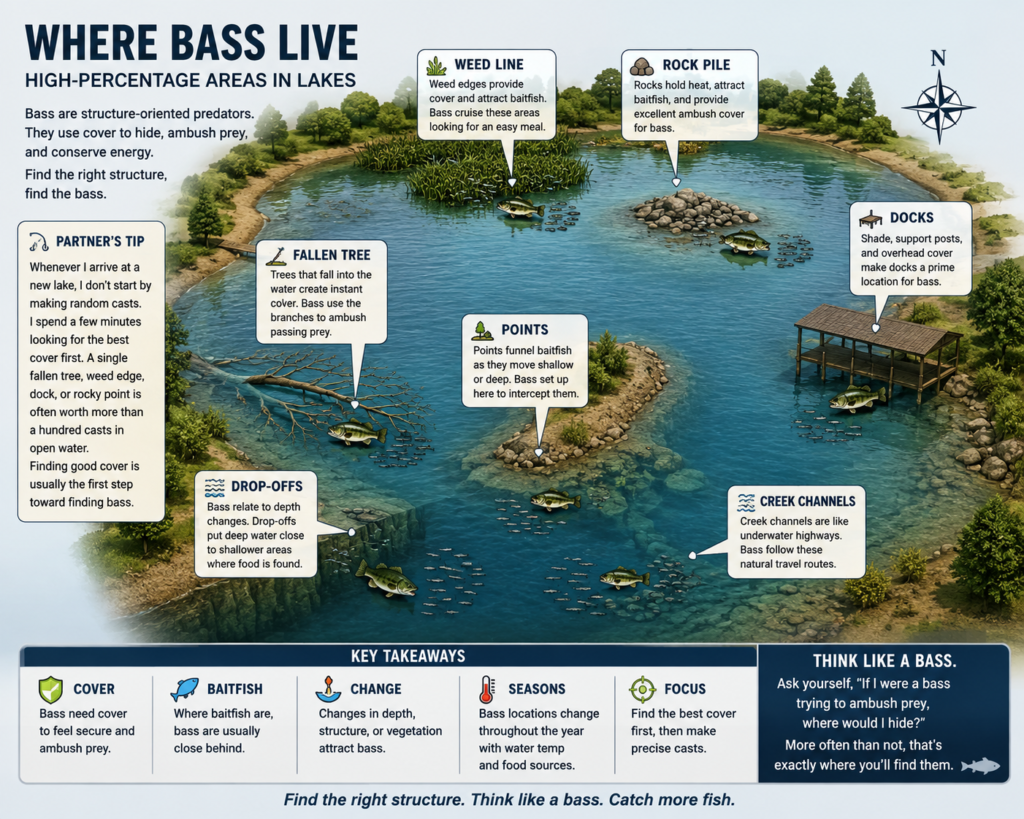
One of the biggest misconceptions about bass fishing is that bass can be found just anywhere in the water. While bass may roam in search of food, they spend most of their time in areas that provide cover, access to prey, and comfortable water conditions. Learning to identify these high-percentage locations will dramatically increase your chances of finding active fish.
Bass are structure-oriented predators. They prefer areas where they can hide, ambush prey, and conserve energy rather than constantly swimming through open water. Fallen trees, submerged brush, weed lines, docks, rock piles, creek channels, points, and drop-offs all provide the cover bass naturally seek. The exact locations change throughout the year as water temperatures, oxygen levels, and available forage shift with the seasons.
The more quality cover an area contains, the more likely it is to attract baitfish—and where baitfish gather, bass are rarely far behind.
🎣 Partner’s Tip
Whenever I arrive at a new lake, I don’t start by making random casts. I spend a few minutes looking for the best cover first. A single fallen tree, weed edge, dock, or rocky point is often worth more than a hundred casts in open water. Finding good cover is usually the first step toward finding bass.
Bass are structure-oriented predators. Look for changes in depth, cover, and available food to locate high-percentage areas where bass are most likely to hold.
Lakes
Lakes provide bass with a wide variety of habitat, allowing them to move between shallow and deep water as conditions change throughout the year. Rather than roaming aimlessly, bass use weed lines, docks, fallen trees, rock piles, creek channels, and drop-offs as feeding and resting areas.
During the spring, bass often move into shallow coves and protected shorelines to spawn. As summer temperatures increase, many bass seek deeper water or shaded cover where oxygen levels are higher and water temperatures are more comfortable. In the fall, bass frequently follow schools of baitfish back into shallower water, feeding aggressively before winter arrives.
When fishing a lake, look for areas that combine cover, depth changes, and nearby food sources. Bass often position themselves where they can easily move between deep and shallow water without expending much energy.
🎣 Partner’s Tip
When I arrive at a new lake, I don’t try to fish the entire shoreline. Instead, I look for areas that offer several types of cover close together—like a dock near a weed line or a rocky point next to deeper water. Those locations consistently hold more bass than long stretches of featureless shoreline.
Ponds
Farm ponds and small community ponds may be limited in size, but they can produce outstanding bass fishing. Because there is less water to cover, locating bass is often easier. Focus on shoreline cover such as fallen trees, weed edges, docks, culverts, and any areas where deeper water meets shallow flats. During hot summer afternoons, shaded banks can become especially productive as bass seek cooler water.
🎣 Partner’s Tip
One mistake I see anglers make on small ponds is fishing too fast. Since ponds have less water, bass are often closer than you think. Slow down, fish every piece of cover carefully, and don’t overlook the shoreline right at your feet.
Reservoirs
Reservoirs combine characteristics of both lakes and rivers, creating some of the most productive bass fisheries in the country. Creek channels, flooded timber, submerged roadbeds, rock piles, and long points all become prime holding areas. Water levels often fluctuate throughout the year, so successful reservoir anglers learn to adjust their approach based on changing conditions. Following baitfish and paying attention to seasonal movements can help narrow down where bass are most likely to be holding.
🎣 Partner’s Tip
When I fish a reservoir, I spend just as much time looking for baitfish as I do looking for bass. If I find schools of bait near creek channels, points, or flooded timber, I know bass are usually close by.
Rivers
River bass live differently than lake bass because current constantly influences where they position themselves. Rather than fighting the current, bass look for places where they can conserve energy while waiting for food to drift by. Eddies behind rocks, fallen trees, bridge pilings, current breaks, and deeper pools are all excellent places to find both largemouth and smallmouth bass. Smallmouth, in particular, thrive in clearer rivers with rocky bottoms and moderate current.
🎣 Partner’s Tip
Whenever I fish a river, I ask myself one question: “Where can a bass rest without fighting the current?” More often than not, that’s where I make my first cast. Bass are masters at conserving energy while letting the current bring food to them.
Largemouth Bass vs. Smallmouth Bass
Lakes often have all the essentials for bass: lots of sunken trees, weed beds, rocky shores, and deepwater dropoffs. Most of the time, bass won’t be in completely open water. They’re close to something they can hide behind or use to ambush prey.
During the early morning and right before sunset, bass get more active near the shore or shallower water. As the day heats up, they often move deeper or tuck under thick cover for shade.
- Structure is Key: Downed trees, brush piles, and docks are always worth checking. Bass lurk in these areas, waiting for baitfish to pass by.
- Vegetation Hotspots: Weeds, especially those creating edges or thick mats, work like bass magnets. I’ve found lots of success flipping soft plastics or topwater frogs right over these spots.
- Depth Changes: Points, ledges, and sudden drops in lake bottoms often give bass a way to move up and down with changing light or water temperature.
Largemouth Bass vs. Smallmouth Bass
Although largemouth bass and smallmouth bass belong to the same family and share many similarities, each species has developed unique characteristics that influence where they live, how they feed, and the techniques anglers use to catch them. Learning these differences will help you choose better fishing locations, select more effective lures, and understand why one species may be thriving while the other is absent.
Largemouth bass are the most widely distributed and heavily targeted bass species in North America. They thrive in warm, slow-moving water filled with vegetation, fallen timber, docks, and other heavy cover. Smallmouth bass, on the other hand, prefer cooler, clearer water with rocky bottoms, moderate current, and abundant oxygen. Although both species are aggressive predators, they often require different approaches depending on the body of water and the season.
Once you understand each species’ preferred habitat and feeding behavior, you’ll be able to predict where they’re most likely to be and choose techniques that match the conditions.
Largemouth vs. Smallmouth Comparison
| Feature | Largemouth Bass | Smallmouth Bass |
|---|---|---|
| Body Color | Olive green with a dark horizontal stripe | Bronze or brown with vertical bars |
| Mouth Size | Upper jaw extends well past the eye | Upper jaw ends near the middle of the eye |
| Preferred Water | Warm lakes, ponds, reservoirs | Cooler lakes and flowing rivers |
| Best Habitat | Weeds, docks, timber, lily pads | Rocks, gravel, points, current breaks |
| Typical Depth | Shallow to moderate depth | Moderate to deeper water |
| Primary Forage | Bluegill, frogs, shad, crawfish | Crawfish, minnows, baitfish |
| Fight | Powerful surges and jumps | Fast runs with incredible endurance |
| Average Size | Usually larger overall | Slightly smaller but extremely strong |
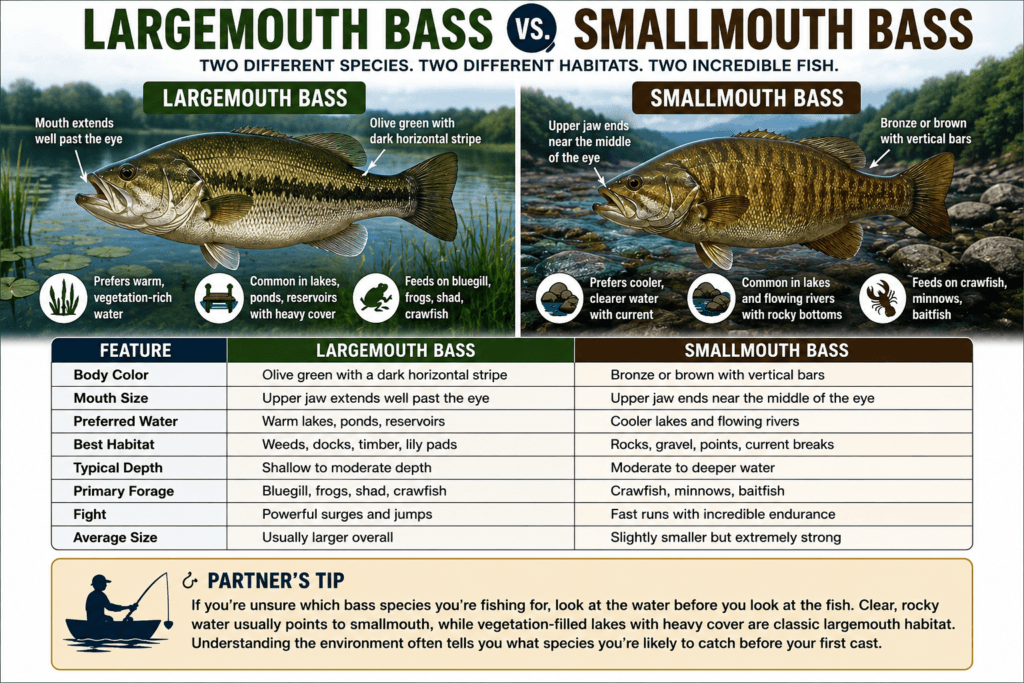
Largemouth and smallmouth bass may belong to the same family, but their preferred habitats, feeding behavior, and fighting styles are very different. Understanding these differences will help you choose better locations, presentations, and lures throughout the year.
🎣 Partner’s Tip
If you’re unsure which bass species you’re fishing for, look at the water before you look at the fish. Clear, rocky water usually points to smallmouth, while vegetation-filled lakes with heavy cover are classic largemouth habitat. Understanding the environment often tells you what species you’re likely to catch before your first cast.
Seasonal Bass Fishing
Bass behavior changes dramatically throughout the year as water temperatures, daylight hours, and available food sources change. Understanding these seasonal patterns can help you spend less time searching for fish and more time catching them. While no two lakes are exactly alike, bass generally follow predictable movements that anglers can use to their advantage.
Instead of fishing the same way year-round, successful bass anglers adjust their locations, lure choices, and presentations to match the season. Knowing where bass are likely to be and how actively they’re feeding will greatly improve your chances of success.
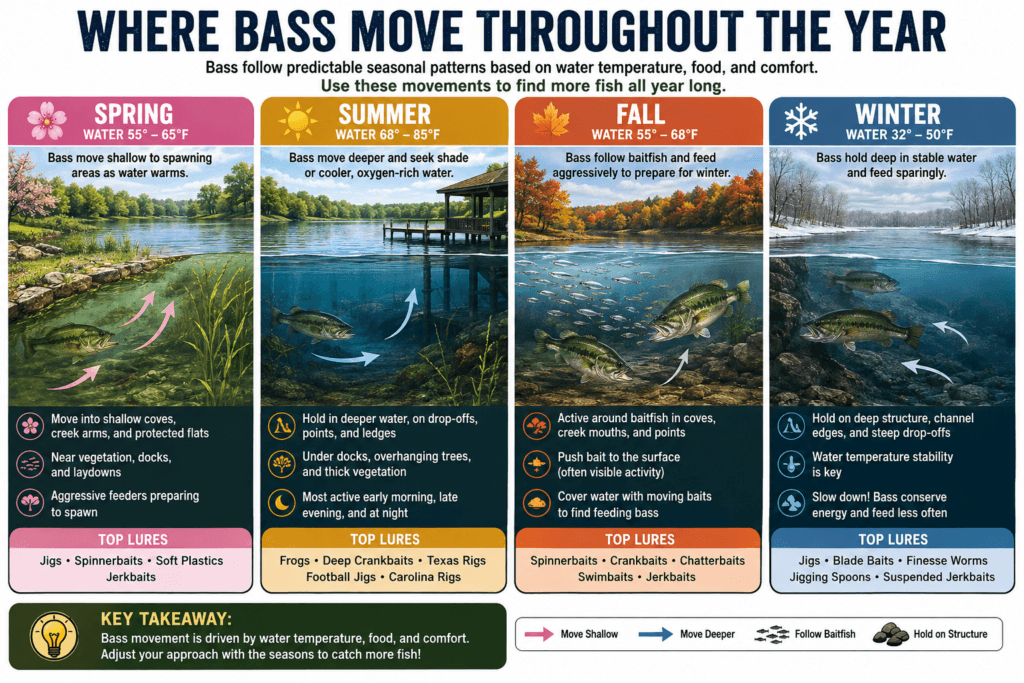
Bass behavior changes throughout the year as water temperature, daylight, and available forage change. Understanding these seasonal movements will help you locate bass more consistently and choose the right presentation for the conditions.
🌸 Spring Bass Fishing
As water temperatures begin to rise, bass become increasingly active after the winter months. They move from deeper water toward shallow coves, creek arms, and protected flats in preparation for the spawn. During this period, bass feed aggressively to build energy reserves, making spring one of the best seasons to catch both numbers of fish and larger bass.
Focus on warming shorelines, emerging vegetation, docks, and shallow cover. Soft plastic worms, jigs, spinnerbaits, and suspending jerkbaits are all productive choices. Slow to moderate retrieves often produce the best results as bass transition toward spawning areas.
🎣 Partner’s Tip
Look for the warmest water in the lake during early spring. Even a difference of a few degrees can attract baitfish—and the bass that follow them.
☀️ Summer Bass Fishing
As summer arrives and water temperatures continue to rise, bass adjust their daily routines to stay comfortable and conserve energy. During the hottest part of the day, they often move to deeper water, seek heavy vegetation, or position themselves beneath docks, overhanging trees, and other shaded cover. Oxygen levels become increasingly important, making areas with moving water or deeper structure especially productive.
The best fishing during summer usually occurs during the cooler parts of the day. Early mornings, late evenings, and even nighttime can provide excellent opportunities as bass move into shallower water to feed. During bright midday conditions, slow presentations around heavy cover often outperform fast-moving lures.
Topwater frogs, deep-diving crankbaits, Texas-rigged worms, football jigs, and Carolina rigs are all dependable summer producers. Matching your lure to the depth and cover you’re fishing will greatly improve your chances of finding active bass.
🎣 Partner’s Tip
During hot summer afternoons, don’t assume the bass have stopped feeding. More often than not, they’ve simply moved to deeper water or heavier cover where temperatures and oxygen levels are more comfortable.
🍂 Fall Bass Fishing
Fall is one of the most exciting seasons for bass anglers. As water temperatures begin to cool, baitfish become increasingly active, and bass feed aggressively to build energy reserves before winter. This feeding period often produces fast action and gives anglers an excellent opportunity to catch quality fish.
Look for schools of baitfish near creek mouths, points, coves, and shallow flats. Bass frequently push bait toward the surface, creating visible feeding activity that can be identified from a distance. Covering water with moving baits such as spinnerbaits, crankbaits, chatterbaits, and swimbaits is an effective way to locate active fish.
Although bass may be widely scattered during early fall, they often group together around baitfish as the season progresses. Paying close attention to bird activity and surface disturbances can help you quickly locate feeding schools.
🎣 Partner’s Tip
If you find the baitfish, you’re often close to finding bass. During fall, forage becomes one of the most reliable clues to locating active fish.
❄️ Winter Bass Fishing
Winter bass fishing requires patience, but it can also produce some surprisingly large fish. As water temperatures drop, a bass’s metabolism slows significantly, meaning they feed less often and are less willing to chase fast-moving lures. Success during winter usually comes from slowing down and presenting your bait carefully.
Bass often hold near deeper structure, channel edges, steep drop-offs, and underwater points where water temperatures remain more stable. Jigs, finesse worms, blade baits, jigging spoons, and suspending jerkbaits can all be effective when worked slowly with long pauses.
Winter isn’t usually about catching large numbers of bass—it’s about making precise presentations to fish that are conserving energy. Anglers who remain patient and fish methodically are often rewarded with quality catches.
🎣 Partner’s Tip
When you think you’re fishing slowly enough during winter, slow down even more. Long pauses are often what convince cold-water bass to bite.
Choosing the Right Bass Fishing Equipment
Selecting the right equipment can make bass fishing more enjoyable and increase your confidence on the water. While it’s easy to become overwhelmed by the endless selection of rods, reels, fishing lines, and tackle available today, the truth is that you don’t need expensive gear to become a successful bass angler. A well-balanced setup that matches the techniques you use most often will outperform an expensive outfit that’s poorly suited to the conditions.
For anglers just getting started, one versatile rod and reel combination can handle a wide variety of bass fishing techniques. As your experience grows, you may decide to add specialized equipment for heavy cover, finesse fishing, or topwater presentations, but building a solid all-around setup first is the smartest investment.
The following sections will help you understand how to choose the right rod, reel, fishing line, and terminal tackle so you can fish more effectively in a variety of conditions.
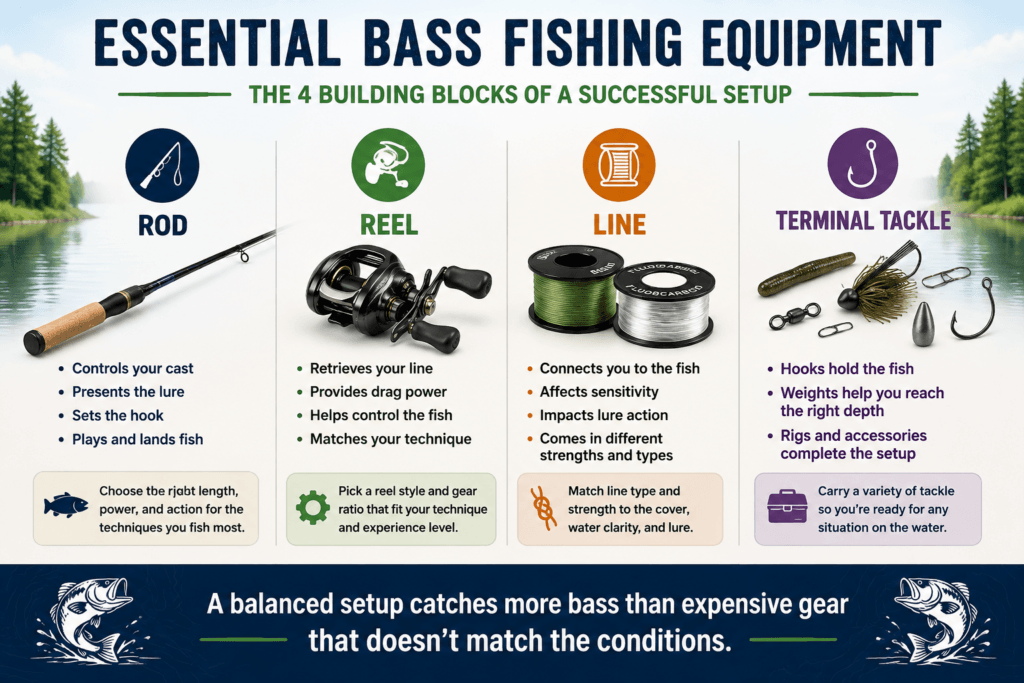
Every successful bass setup starts with four essentials: the right rod, reel, fishing line, and terminal tackle. Understanding how each piece works together will help you fish more efficiently in a variety of conditions.
Choosing the Right Bass Rod
Your fishing rod is one of the most important pieces of equipment you’ll own because it directly affects casting distance, lure presentation, hook-setting power, and your ability to fight fish. Fortunately, you don’t need a garage full of rods to become a successful bass angler. One well-balanced rod can handle a wide variety of bass fishing techniques.
If you’re still deciding on your first setup, check out our guide for detailed recommendations and buying tips. Best Bass Fishing Rod and Reel Combos Under $100 – Buyer’s Guide
For most anglers, a 7-foot Medium-Heavy power rod with a Fast action is the best all-around choice. This combination provides enough backbone to set hooks effectively while remaining sensitive enough to detect subtle bites. It also performs well with many of the most popular bass lures, including Texas-rigged worms, jigs, spinnerbaits, chatterbaits, and crankbaits.
Rod length also plays an important role. Longer rods generally cast farther and provide better leverage when fighting fish, while shorter rods offer greater accuracy when casting around docks, trees, and other tight cover. For most freshwater bass fishing situations, a rod between 6 feet 10 inches and 7 feet 3 inches offers an excellent balance of casting distance, accuracy, and control.
Power and action are often confused by new anglers. Power describes the rod’s lifting strength, while action describes where the rod bends under pressure. A Medium-Heavy Fast Action rod has become the industry standard because it provides the versatility needed for most bass fishing techniques without requiring multiple specialized rods.
🎣 Rod Selection at a Glance
| Fishing Style | Recommended Rod |
|---|---|
| Beginner All-Around | 7′ Medium-Heavy Fast |
| Soft Plastics | 7′ Medium-Heavy Fast |
| Jigs | 7’2″ Heavy Fast |
| Spinnerbaits | 7′ Medium-Heavy Moderate-Fast |
| Crankbaits | 7′ Medium Moderate |
| Topwater | 7′ Medium-Heavy Fast |
| Finesse Fishing | 6’10” Medium Fast Spinning |
🎣 Partner’s Tip
If you’re buying your first bass rod, don’t overthink it. A quality 7-foot Medium-Heavy Fast Action rod is versatile enough to fish most bass lures and techniques you’ll use for years to come. As your experience grows, you can always add specialized rods later.
Choosing the Right Bass Reel
A quality fishing reel works hand in hand with your rod to improve casting accuracy, retrieve lures smoothly, and help you control bass during the fight. While there are many styles and sizes of reels available, most bass anglers rely on either spinning reels or baitcasting reels, each offering advantages for different fishing techniques and experience levels.
Spinning Reels
Spinning reels are an excellent choice for beginners because they’re easy to use, require very little adjustment, and are less likely to develop the frustrating line tangles known as “bird’s nests.” They excel when casting lighter lures such as finesse worms, drop-shot rigs, shaky heads, and small swimbaits. A 2500-size spinning reel paired with a medium or medium-heavy rod is one of the most versatile combinations for freshwater bass fishing.
Baitcasting Reels
Baitcasting reels offer greater casting accuracy, increased power, and better control when fishing heavier lures or targeting bass around thick vegetation, docks, and submerged timber. Although they require a little practice to master, many experienced bass anglers prefer baitcasters because they allow precise lure placement and provide greater leverage when fighting larger fish. A gear ratio between 7.1:1 and 7.5:1 is considered an excellent all-around choice for most bass fishing situations.
Gear Ratio
Gear ratio refers to how many times the spool turns with one complete rotation of the reel handle. Higher gear ratios retrieve line faster, making them ideal for techniques that require quick line pickup, while lower gear ratios provide more cranking power for deep-diving crankbaits and other resistance-heavy lures. If you’re only buying one baitcasting reel, a 7.1:1 gear ratio offers an excellent balance of speed and versatility.
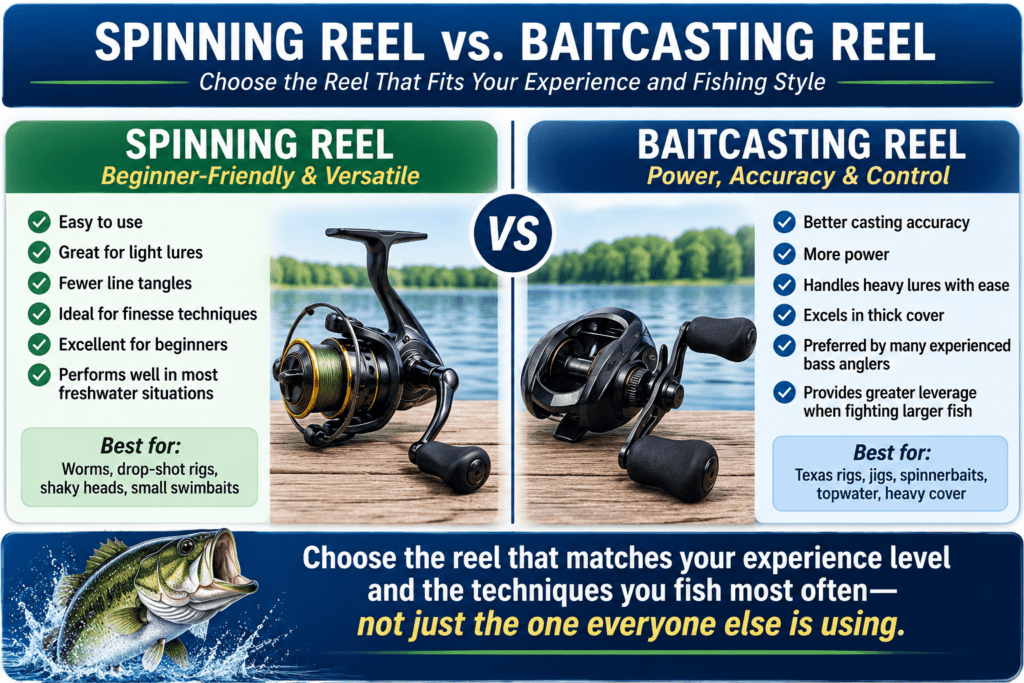
🎣 Bass Reel Selection at a Glance
| Fishing Style | Recommended Reel |
|---|---|
| Beginner All-Around | 2500 Spinning Reel |
| Finesse Fishing | 2500 Spinning Reel |
| Texas Rigs & Jigs | 7.1:1 Baitcaster |
| Spinnerbaits | 7.1:1 Baitcaster |
| Topwater | 7.3:1 Baitcaster |
| Heavy Cover | 8.1:1 Baitcaster |
| Deep Crankbaits | 6.3:1 Baitcaster |
🎣 Partner’s Tip
If you’re just starting bass fishing, don’t feel like you have to learn a baitcaster in day one. A quality spinning reel is simple to use, highly versatile, and capable of catching bass in almost any situation. Once you’ve built confidence with the basics, learning to use a baitcaster becomes much easier.
Choosing the Right Fishing Line
Choosing the right fishing line is just as important as selecting the right rod and reel. Your fishing line affects casting distance, lure action, sensitivity, hook-setting power, and your ability to land fish. While there are dozens of specialty lines available today, most bass anglers rely on three main types: monofilament, fluorocarbon, and braided line. Each has advantages depending on the fishing conditions and techniques you’re using.
Want to understand when to use braid, fluorocarbon, or monofilament? Read our Best Fishing Line for Bass guide.
Monofilament Line
Monofilament is an excellent all-around fishing line, especially for beginners. It is affordable, easy to handle, and provides enough stretch to help prevent fish from throwing the hook during the fight. Monofilament also floats, making it a great choice for topwater lures and general-purpose bass fishing.
Fluorocarbon Line
Fluorocarbon sinks naturally and is nearly invisible underwater, making it an excellent choice for clear water and finesse presentations. It offers greater sensitivity than monofilament, allowing anglers to detect subtle bites and maintain better contact with bottom-moving lures such as Texas rigs, jigs, and Carolina rigs.
Braided Line
Braided line has virtually no stretch, providing exceptional sensitivity and powerful hook sets. Its high strength-to-diameter ratio makes it ideal for fishing heavy vegetation, thick cover, and lily pads where extra pulling power is needed. Many anglers also use braided line with a fluorocarbon leader to combine strength with low underwater visibility.
For most beginners, 10- to 12-pound monofilament is an excellent starting point because it is forgiving, versatile, and easy to manage. As your confidence grows, experimenting with fluorocarbon and braided line will allow you to fine-tune your setup for specific fishing techniques and conditions.
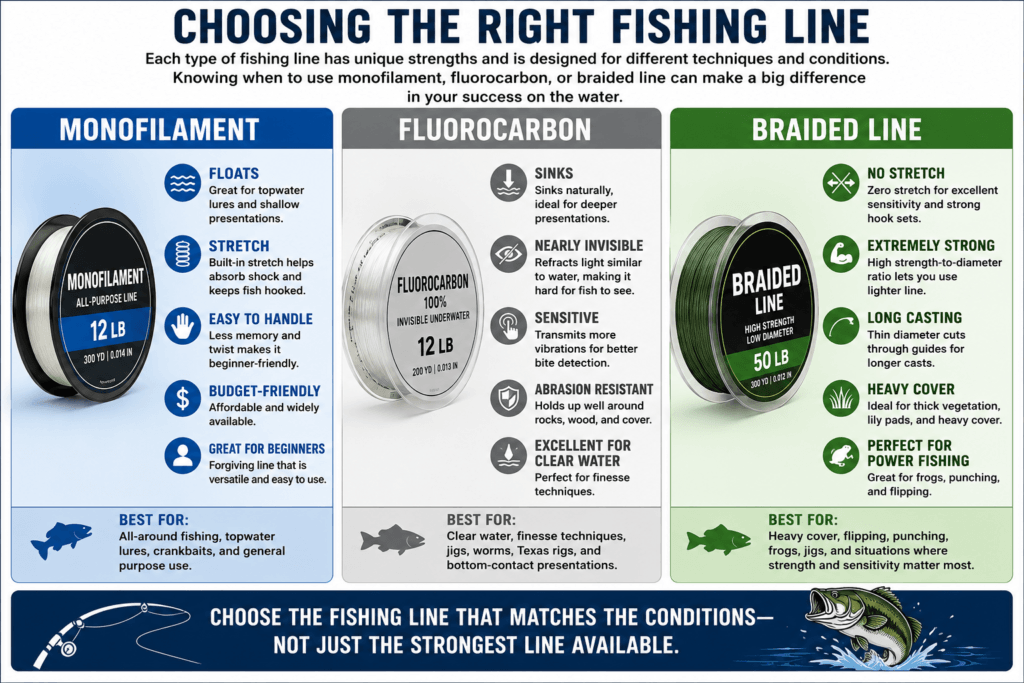
Every fishing line has strengths and weaknesses. Choosing the right one depends on the water clarity, the type of cover you’re fishing, and the presentation you’re using.
🎣 Bass Fishing Line at a Glance
| Fishing Situation | Recommended Line |
|---|---|
| Beginner All-Around | 10–12 lb Monofilament |
| Clear Water | 12–15 lb Fluorocarbon |
| Heavy Cover | 40–50 lb Braided Line |
| Topwater Lures | 12–15 lb Monofilament or 30 lb Braid |
| Finesse Fishing | 10 lb Braid with 8 lb Fluorocarbon Leader |
| Texas Rigs & Jigs | 15–17 lb Fluorocarbon |
🎣 Partner’s Tip
If you’re new to bass fishing, don’t worry about owning every type of fishing line. Learn how to fish one line well before expanding your options. Confidence and experience will teach you when it’s time to switch to a more specialized setup.
Want to learn more about choosing the right fishing line? Read our complete guide: Best Fishing Line for Bass.
Essential Terminal Tackle
While rods, reels, and fishing line receive most of the attention, terminal tackle plays a critical role in every successful bass fishing setup. Hooks, sinkers, swivels, snaps, and weights may be small, but choosing the right components can improve lure presentation, increase hook-up percentages, and help you land more fish.
One of the most versatile hook styles for bass fishing is the Extra Wide Gap (EWG) hook, which is commonly used with soft plastic worms, creature baits, and stick baits. Offset worm hooks are another excellent option, especially when fishing Texas-rigged plastics through weeds, brush, and other heavy cover.
Bullet weights are among the most popular sinkers for bass anglers because they slide easily through vegetation and pair perfectly with Texas rigs. Split-shot weights, drop-shot weights, and football jig heads each have their place depending on the fishing technique and water conditions.
Many anglers also carry a small selection of barrel swivels, snaps, bobber stops, and beads to help rig different presentations quickly. Keeping your terminal tackle organized in a small tackle box or utility tray makes it easier to adapt to changing conditions without wasting valuable fishing time.
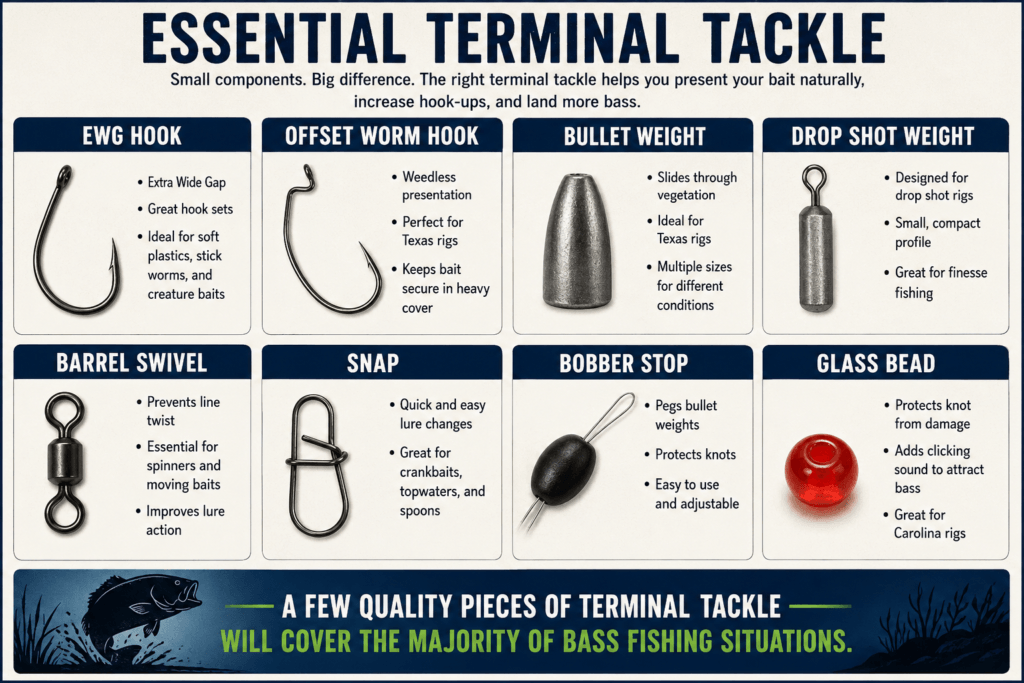
🎣 Essential Terminal Tackle Checklist
| Item | Primary Use |
|---|---|
| EWG Hooks | Soft plastics, stick worms, creature baits |
| Offset Worm Hooks | Texas rigs and weedless presentations |
| Bullet Weights | Texas rigs and flipping cover |
| Drop Shot Weights | Finesse fishing |
| Split Shot Weights | Light finesse presentations |
| Barrel Swivels | Prevent line twist |
| Snaps | Quick lure changes |
| Bobber Stops | Pegging bullet weights |
| Glass or Plastic Beads | Protect knots and add clicking sound |
🎣 Partner’s Tip
You don’t need to buy every hook and weight available. Start with a few quality EWG hooks, offset worm hooks, and bullet weights in several sizes. These simple items will cover the majority of bass fishing techniques and give you plenty of versatility on the water.
Choosing the Right Bass Lure
Bass anglers have thousands of lure options available, but choosing the right one doesn’t have to be complicated. The most successful anglers don’t simply tie on a favorite lure and hope for the best. Instead, they consider several important factors, including water temperature, water clarity, weather conditions, available cover, and the type of forage bass are feeding on.
Some lures are designed to cover large areas quickly and help locate active fish, while others excel at tempting inactive bass that are holding close to cover. Learning when and where to use each type of lure will greatly increase your confidence and help you spend more time fishing productive water.
Rather than trying to carry every lure available, build your tackle box around a handful of proven lure categories. A small collection of soft plastics, jigs, spinnerbaits, crankbaits, chatterbaits, topwater lures, swimbaits, and jerkbaits will allow you to fish effectively in almost any bass fishing situation.
As you gain experience, you’ll naturally learn which lures work best in your local waters. The goal isn’t to own hundreds of lures—it’s to understand why each lure works and when it gives you the greatest advantage.
🎣 Partner’s Tip
If you only carried eight types of bass lures for the rest of your life, you could still catch bass almost anywhere in North America. Confidence in a few proven lures will always outperform a tackle box filled with baits you’ve never learned to fish.
🎣 Partner’s Advice
If you’re new to bass fishing, don’t feel like you need to buy every lure in this guide.
The goal isn’t to fill your tackle box overnight—it’s to learn what each lure is designed to do.
As you read through each section, take your time studying the pictures and learning when each lure works best. Start with a few proven choices that match the type of water you fish most often. As your confidence grows, you can gradually add new lures and techniques to your collection.
Remember, successful anglers don’t catch more fish because they own the most tackle—they catch more fish because they understand when and where to use the lures they have.
Throughout this guide you’ll find images, quick-reference tables, and practical tips to help you understand not just what each lure looks like, but when and why it catches bass.
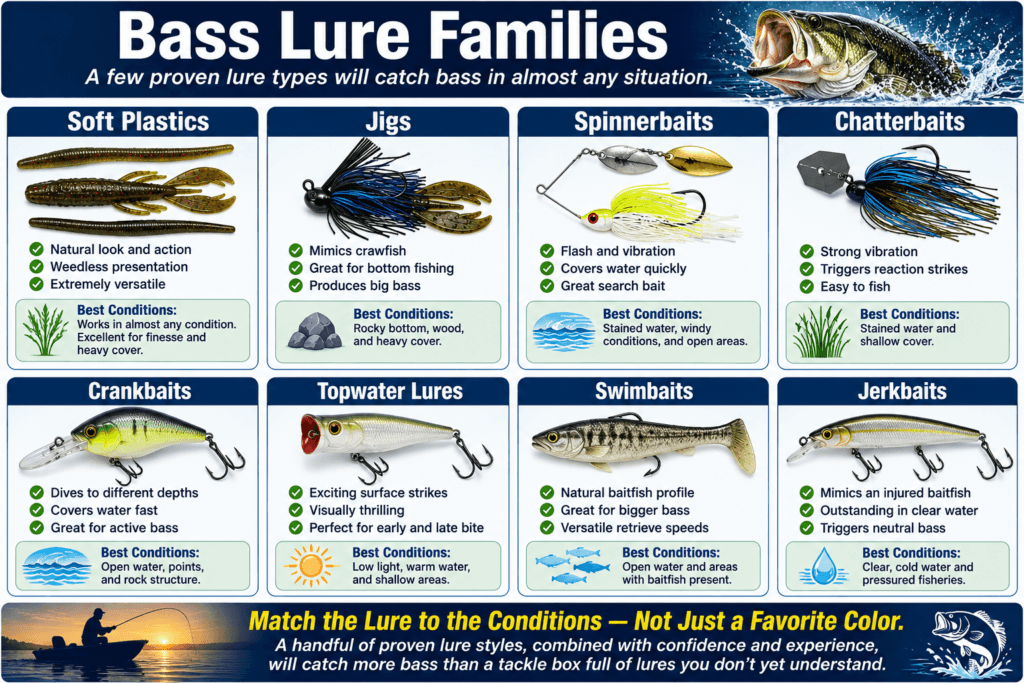
🎣 Bass Lure Selection at a Glance
| Fishing Conditions | Best Lure | Why It Works |
|---|
| Heavy Weeds | Texas-Rigged Worm or Frog | Weedless presentation |
| Clear Water | Jerkbait or Finesse Worm | Natural appearance |
| Stained Water | Spinnerbait or Chatterbait | Strong vibration |
| Rocky Bottom | Football Jig | Mimics crawfish |
| Open Water | Crankbait or Swimbait | Covers water quickly |
| Surface Feeding | Walking Bait or Popper | Matches surface activity |
| Cold Water | Jig or Jerkbait | Slow, deliberate presentation |
| Covering Water Quickly | Spinnerbait or Lipless Crankbait | Efficient search bait |
🎣 Partner’s Tip
Don’t get caught up thinking you need dozens of different lures. A handful of proven lure styles, combined with confidence and experience, will catch bass almost anywhere. Learn when each lure works best, and you’ll spend more time catching fish and less time guessing.
Soft Plastic Baits
Soft plastic baits have earned a reputation as one of the most effective and versatile lure categories in bass fishing. Whether you’re fishing a small farm pond, a natural lake, or a large reservoir, soft plastics consistently produce bass throughout the year. Their realistic appearance, subtle action, and ability to imitate many of a bass’s favorite food sources make them one of the first lure categories every angler should learn to fish.
What makes soft plastics so effective is their versatility. By changing the way they’re rigged, the same bait can be presented in heavy vegetation, open water, around docks, rocky bottoms, or deep structure. Few lure categories offer as many presentation options, making soft plastics a favorite among both beginners and experienced tournament anglers.
From stick worms and ribbon-tail worms to creature baits, crawfish imitations, and paddle-tail swimbaits, there’s a soft plastic designed for almost every fishing situation. Instead of filling your tackle box with dozens of soft plastics, start with a handful of proven styles and learn when each one performs best.
Ready to learn one of the most effective bass rigs? See our How to Fish a Texas Rig guide.
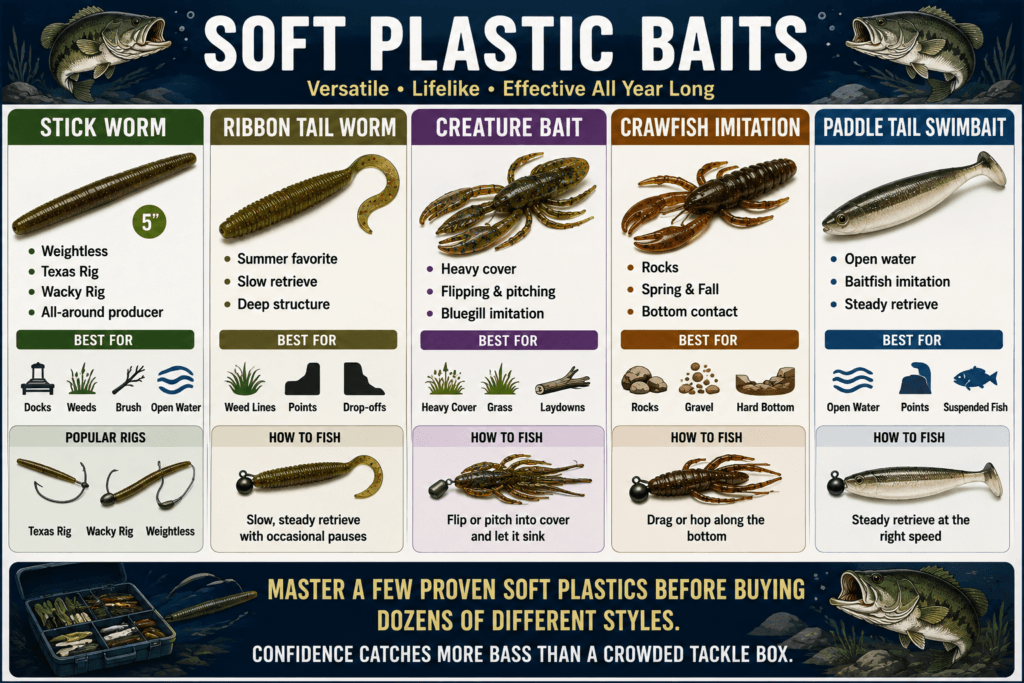
🎣 Soft Plastic Baits at a Glance
| Soft Plastic | Best Season | Best Cover | Why It Works |
|---|---|---|---|
| Stick Worm | Spring–Fall | Docks, Weeds, Brush | Slow natural fall triggers strikes |
| Ribbon Tail Worm | Summer | Weed Lines, Points | Creates lifelike swimming action |
| Creature Bait | Spring–Summer | Heavy Cover | Mimics bluegill and crawfish |
| Crawfish Imitation | Spring & Fall | Rocks, Gravel | Matches one of bass’ favorite foods |
| Paddle Tail Swimbait | All Year | Open Water | Realistic baitfish profile |
Why Soft Plastics Catch So Many Bass
Soft plastics succeed because they imitate prey that bass naturally feed on every day. Worms, crawfish, salamanders, baitfish, and other aquatic creatures are common food sources, and a properly presented soft plastic can closely resemble each of them.
Unlike many hard baits that rely on speed or vibration, soft plastics often tempt bass with slow, natural movements. This makes them especially effective when fish are pressured, inactive, or holding tight to cover. Sometimes simply allowing the bait to fall naturally is enough to trigger a strike.
Common Mistakes
Many beginners fish soft plastics too quickly. One of the biggest advantages of these lures is their natural action, so slow retrieves and occasional pauses often produce more bites than constant movement. Another common mistake is rigging the bait crooked on the hook, which reduces its lifelike appearance and can cause it to spin unnaturally through the water.
🎣 Partner’s Tip
If you’re only going to buy one soft plastic bait, make it a 5-inch stick worm in Green Pumpkin. Rigged Texas-style, wacky-style, or weightless, it’s one of the most versatile bass lures ever created and has probably caught millions of bass across North America.
Jigs
Jigs have earned a reputation as one of the most dependable bass lures ever created. While they may not always produce the highest number of fish, they consistently catch larger bass throughout the year. Whether you’re fishing rocky points, submerged timber, docks, weed edges, or deep structure, a properly presented jig can tempt bass that ignore faster-moving lures.
One of the biggest advantages of jigs is their versatility. By changing the trailer, jig weight, or retrieve speed, anglers can imitate crawfish, bluegill, baitfish, and other prey bass feed on naturally. Jigs perform exceptionally well around heavy cover where many other lures struggle, making them a favorite among tournament anglers and weekend fishermen alike.
Although jigs can be fished year-round, they are especially productive during cooler water temperatures when bass are feeding heavily on crawfish. Learning to fish a jig with patience and confidence is one of the fastest ways to improve your bass fishing success.
Want to master one of bass fishing’s most productive techniques? Read our complete guide: How to Fish A Bass JIG
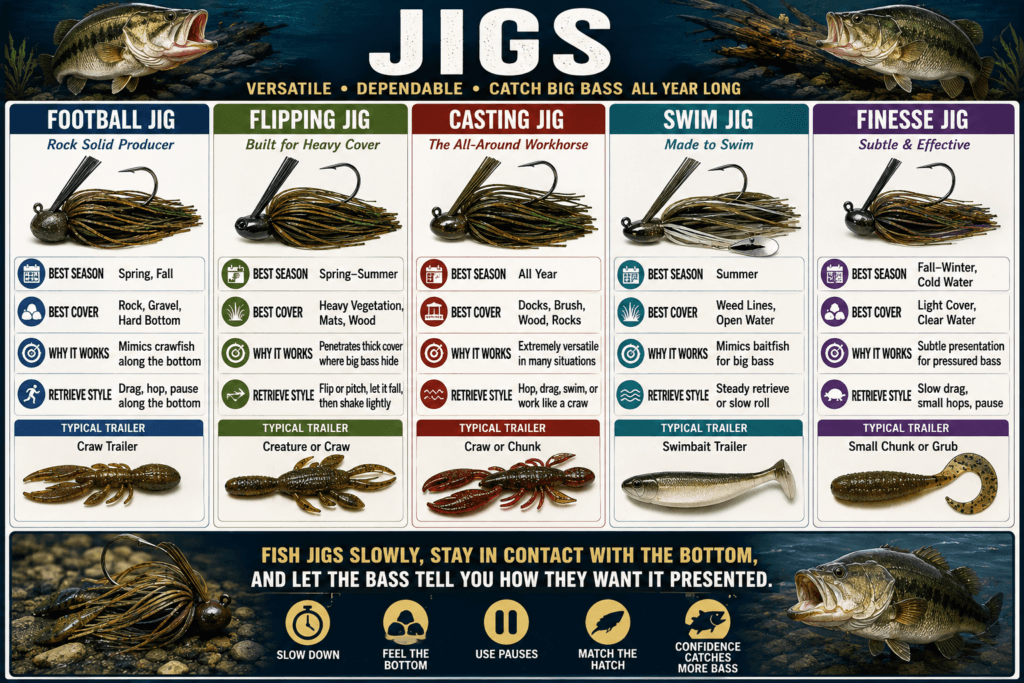
🎣 Jigs at a Glance
| Jig Type | Best Season | Best Cover | Why It Works |
|---|---|---|---|
| Football Jig | Spring, Fall | Rock, Gravel | Mimics crawfish along the bottom |
| Flipping Jig | Spring–Summer | Heavy Cover | Penetrates weeds and wood |
| Casting Jig | All Year | Docks, Brush | Extremely versatile |
| Swim Jig | Summer | Weed Lines | Mimics baitfish |
| Finesse Jig | Cold Water | Light Cover | Subtle presentation for pressured bass |
Why Jigs Catch Big Bass
Jigs imitate one of a bass’s favorite meals—crawfish. When worked slowly across rocks, wood, or other bottom structure, they closely resemble the natural movements of a crawfish trying to escape. Adding a soft plastic trailer creates even more realistic action, making the lure difficult for bass to ignore.
Unlike reaction baits that rely on speed, jigs often excel when bass are inactive or holding tight to cover. Their compact profile allows anglers to fish places where larger lures would frequently become snagged.
Common Mistakes
Many anglers fish jigs too quickly. Instead of constantly retrieving the lure, allow it to contact the bottom and use slow hops, short drags, and occasional pauses. Another common mistake is using a trailer that’s too large for the jig, which can reduce its natural appearance and make it harder for bass to inhale the bait.
🎣 Partner’s Tip
If you’re only going to own one jig, make it a 3/8-ounce black-and-blue casting jig paired with a matching craw trailer. It catches bass in stained water, around wood, docks, rocks, and vegetation, making it one of the most versatile lures you’ll ever tie on.
Spinnerbaits
Spinnerbaits have been catching bass for decades and remain one of the best lures for locating active fish. Their spinning blades create both flash and vibration, making them highly effective in stained water, windy conditions, and around shallow cover where bass rely on their lateral line to detect prey.
One of the biggest advantages of a spinnerbait is its weedless design. The upward-facing hook and wire frame allow it to move through grass, brush, laydowns, and dock pilings with fewer snags than many other lures. This makes spinnerbaits an excellent choice when bass are holding tight to cover.
Spinnerbaits are available in several blade styles, each producing a different action. Willow blades create more flash and are ideal for clear water and faster retrieves. Colorado blades produce strong vibration and excel in stained or muddy water. Indiana blades offer a balance of flash and vibration, making them a versatile choice for changing conditions.
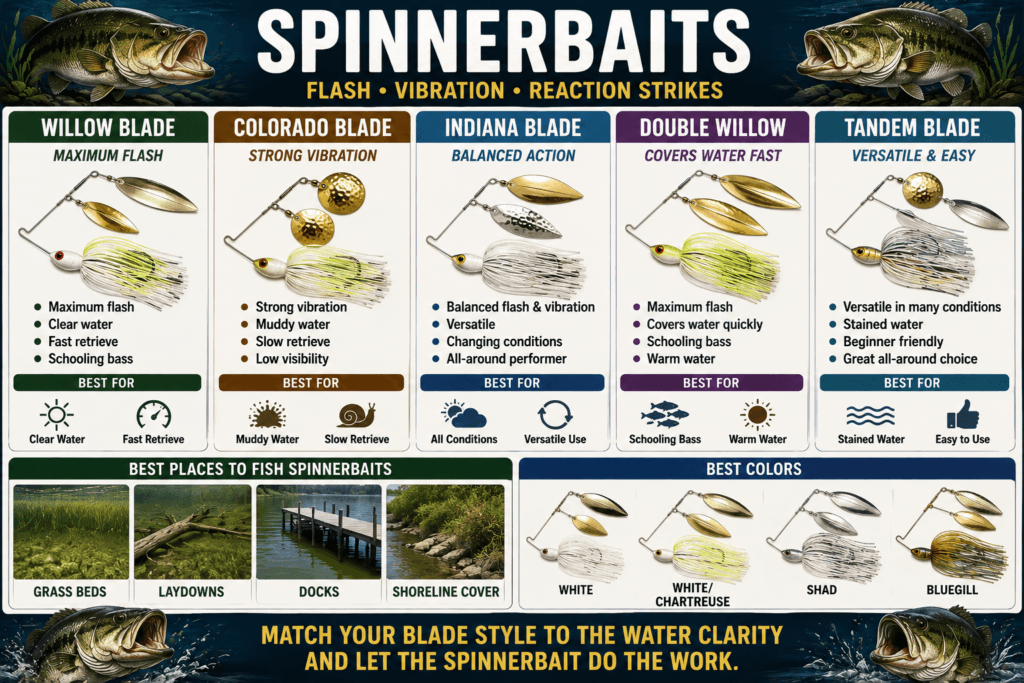
🎣 Spinnerbaits at a Glance
| Feature | Recommendation |
|---|---|
| Best Season | Spring, Summer, Fall |
| Best Water | Slightly Stained to Muddy |
| Best Cover | Grass, Wood, Docks, Shoreline Cover |
| Difficulty | ⭐⭐ Beginner Friendly |
| Why It Works | Flash and vibration trigger reaction strikes |
| Best Colors | White, White/Chartreuse, Bluegill, Shad |
Why Spinnerbaits Catch Bass
Spinnerbaits imitate injured baitfish moving through the water. The spinning blades reflect light and create vibrations that help bass locate the lure, even when visibility is poor. Because they can be retrieved at different speeds and depths, spinnerbaits are excellent search baits when you’re trying to cover water and locate active fish.
Common Mistakes
One of the most common mistakes is retrieving a spinnerbait at the same speed all the way back to the boat or shoreline. Changing your retrieve by slowing down, speeding up, or briefly pausing often triggers reaction strikes. Another mistake is avoiding cover. Spinnerbaits are designed to be fished around grass, fallen trees, and docks—some of the very places where bass spend much of their time.
🎣 Partner’s Tip
If the wind picks up, don’t head for the truck—pick up a spinnerbait. Wind breaks up the water’s surface, reduces visibility, and often makes bass more aggressive. Some of my favorite bass fishing days have been the windiest ones because a spinnerbait can really shine when conditions get rough.
Crankbaits
Crankbaits are among the best lures for covering water and quickly locating active bass. Unlike slower presentations such as jigs or soft plastics, crankbaits allow anglers to search large areas efficiently while triggering reaction strikes from fish that may not be actively feeding. Their realistic baitfish profiles and built-in wobbling action make them a proven producer throughout much of the year.
One of the biggest advantages of crankbaits is the variety of diving depths available. By choosing the right lure, anglers can effectively target bass holding in shallow water, along mid-depth points, or on deep structure. The shape and size of the lure’s bill determine how deep it dives and how it moves through the water.
Squarebill crankbaits excel around shallow wood and rocky cover because their wide bills help deflect off obstacles without snagging easily. Medium-diving crankbaits are excellent for points, drop-offs, and submerged vegetation, while deep-diving crankbaits are designed to reach bass holding in deeper water during the summer and winter months.
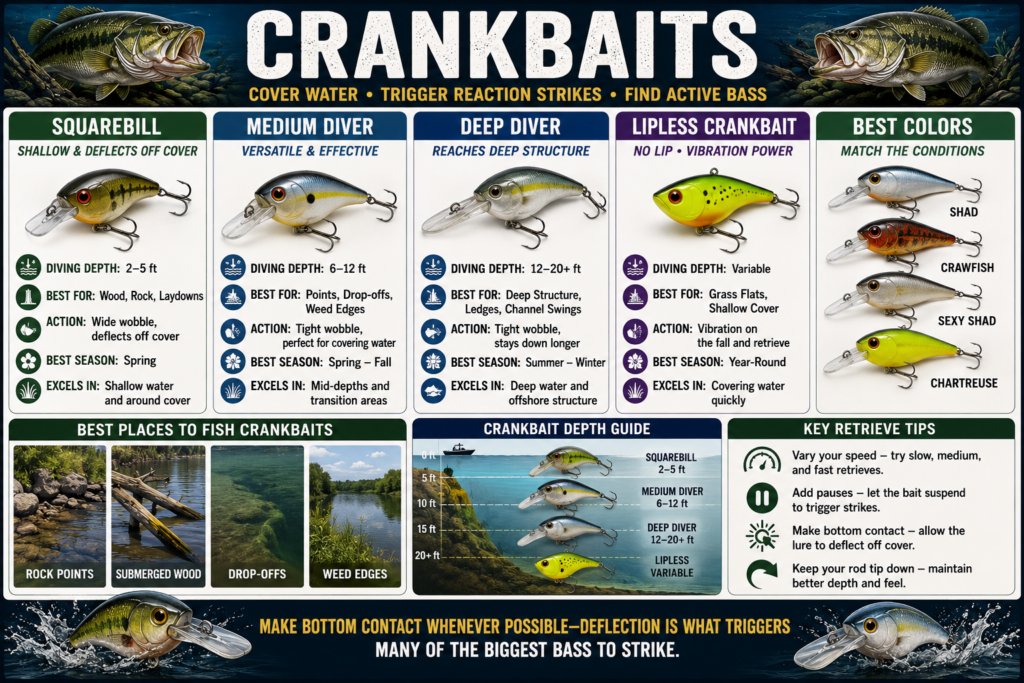
🎣 Crankbaits at a Glance
| Feature | Recommendation |
|---|---|
| Best Season | Spring, Summer, Fall |
| Best Water | Clear to Slightly Stained |
| Best Cover | Rock, Wood, Points, Drop-offs |
| Difficulty | ⭐⭐ Beginner Friendly |
| Why It Works | Covers water quickly and triggers reaction strikes |
| Best Colors | Shad, Crawfish, Chartreuse, Sexy Shad |
Why Crankbaits Catch Bass
Crankbaits imitate injured baitfish and crawfish, two of the bass’s favorite food sources. Their wobbling action, combined with sudden deflections off rocks, stumps, and submerged timber, often causes bass to strike instinctively. Even inactive fish will frequently react when a crankbait suddenly changes direction after contacting cover.
Because crankbaits allow anglers to fish efficiently over large areas, they are one of the best tools for locating schools of bass before slowing down with more precise presentations.
Common Mistakes
Many anglers choose the wrong diving depth for the water they’re fishing. A crankbait is most effective when it occasionally contacts the bottom or cover during the retrieve. Another common mistake is retrieving at a constant speed. Varying your retrieve with pauses, speed changes, or brief stops can make the lure appear more like an injured baitfish and trigger more strikes.
🎣 Partner’s Tip
Don’t be afraid to bump your crankbait into rocks, stumps, or submerged timber. That sudden deflection often triggers the hardest strikes because it makes the lure look like a frightened baitfish trying to escape. Some of my best bass have come just after the lure ricocheted off cover.
Crankbait Depth Guide
| Crankbait Type | Typical Diving Depth | Best Use |
|---|---|---|
| Squarebill | 2–5 ft | Wood, rocks, shallow cover |
| Medium Diver | 6–12 ft | Points, weed edges, drop-offs |
| Deep Diver | 12–20+ ft | Offshore structure, ledges |
Chatterbaits
Chatterbaits, also known as vibrating jigs, have become one of the most effective modern bass lures because they combine the best features of a jig and a spinnerbait. The metal blade attached to the front of the lure creates a powerful vibration that bass can detect through their lateral line, making chatterbaits especially effective in stained water, windy conditions, and around vegetation.
One of the biggest advantages of a chatterbait is its versatility. It can be retrieved steadily like a spinnerbait, bounced along the bottom like a jig, or ripped free from grass to trigger aggressive reaction strikes. This ability to imitate both baitfish and crawfish makes it a productive lure throughout much of the year.
Most anglers pair chatterbaits with a soft plastic trailer to add bulk, movement, and a more natural swimming action. Paddle-tail swimbaits and craw-style trailers are among the most popular choices because they complement the lure’s vibration while giving bass a larger target to attack.
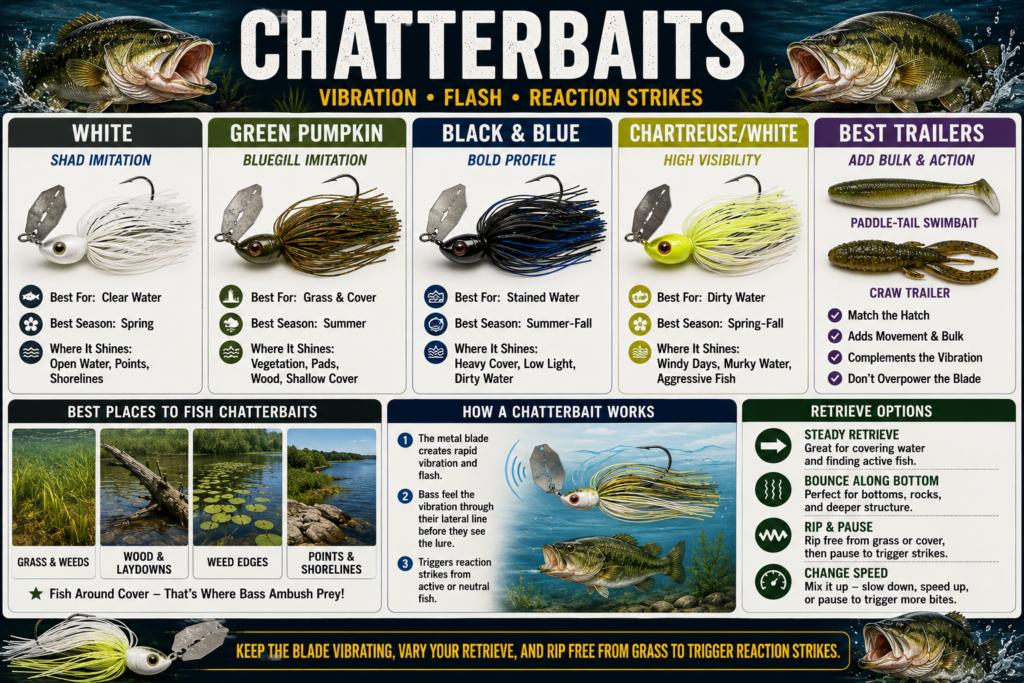
🎣 Chatterbaits at a Glance
| Feature | Recommendation |
|---|---|
| Best Season | Spring, Summer, Fall |
| Best Water | Clear to Stained |
| Best Cover | Grass, Weed Edges, Wood |
| Difficulty | ⭐⭐ Beginner Friendly |
| Why It Works | Strong vibration triggers reaction strikes |
| Best Colors | White, Green Pumpkin, Black & Blue, Chartreuse/White |
Why Chatterbaits Catch Bass
The secret to a chatterbait is vibration. As the blade moves through the water, it produces a rapid side-to-side action that resembles a fleeing baitfish. Bass often detect this vibration long before they see the lure, making chatterbaits an excellent choice when visibility is reduced or when fish are actively feeding around vegetation and shallow cover.
Unlike many lures, chatterbaits perform well at a variety of retrieve speeds. A slow retrieve keeps the lure close to the bottom, while a faster retrieve can imitate a baitfish trying to escape. Changing retrieve speed during the cast often triggers strikes from following bass.
Common Mistakes
One of the biggest mistakes anglers make is fishing chatterbaits only in open water. These lures are designed to work around grass, weeds, and other cover where bass naturally ambush prey. Another mistake is using a trailer that overpowers the lure’s action. Choose a trailer that complements the vibration instead of reducing it.
🎣 Partner’s Tip
If your chatterbait suddenly feels heavy or stops vibrating, don’t immediately assume you’ve snagged a weed. Many bass inhale a chatterbait and swim toward you, making the lure feel different instead of producing the hard strike you’re expecting. When in doubt, set the hook—you’ll be surprised how many bass are on the other end.
🎣 Swimbaits
Swimbaits are designed to imitate one of a bass’s favorite meals—baitfish. Their lifelike profile and realistic swimming action make them one of the most effective lures for targeting bass in a wide range of water conditions. Whether you’re fishing open water, points, weed edges, or submerged timber, a properly presented swimbait can fool both aggressive and cautious bass into striking.
One of the greatest strengths of swimbaits is their natural appearance. Unlike many reaction baits that rely primarily on flash or vibration, swimbaits create a smooth, realistic swimming motion that closely resembles shad, bluegill, perch, and other forage species. This natural presentation makes them especially productive in clear water where bass have more time to inspect a lure before committing to a strike.
Swimbaits are available in both soft and hard styles. Soft paddle-tail swimbaits are easy to fish and work well for anglers of all experience levels. Hard swimbaits often feature multiple body segments that create an incredibly lifelike swimming action, making them popular for targeting larger bass.
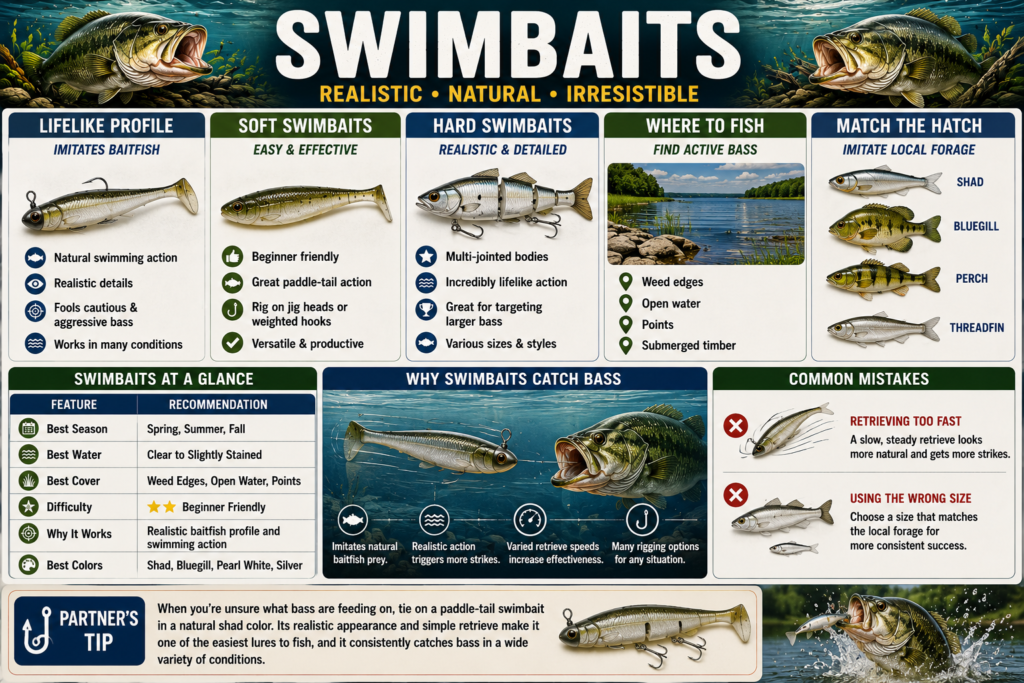
🎣 Swimbaits at a Glance
| Feature | Recommendation |
|---|---|
| Best Season | Spring, Summer, Fall |
| Best Water | Clear to Slightly Stained |
| Best Cover | Weed Edges, Open Water, Points |
| Difficulty | ⭐⭐ Beginner Friendly |
| Why It Works | Realistic baitfish profile and swimming action |
| Best Colors | Shad, Bluegill, Pearl White, Silver |
Why Swimbaits Catch Bass
Bass are opportunistic predators that spend much of their lives feeding on baitfish. Swimbaits closely imitate this natural forage, making them one of the most convincing artificial lures available. A steady retrieve often produces excellent results, but occasional pauses or changes in speed can make the lure appear like a struggling baitfish and trigger aggressive strikes.
Swimbaits are also highly versatile. They can be fished on jig heads, weighted hooks, umbrella rigs, or as trailers on vibrating jigs and spinnerbaits. This flexibility allows anglers to adapt to different depths, cover, and seasonal conditions without changing lure styles.
Common Mistakes
Many anglers retrieve swimbaits too quickly. A slower, steady retrieve usually produces a more natural swimming action and gives bass time to commit to the strike. Another common mistake is choosing a swimbait that is much larger than the available forage. Matching the size of local baitfish often leads to more consistent success.
🎣 Partner’s Tip
When you’re unsure what bass are feeding on, tie on a paddle-tail swimbait in a natural shad color. Its realistic appearance and simple retrieve make it one of the easiest lures to fish, and it consistently catches bass in a wide variety of conditions.
🎣 Jerkbaits
Jerkbaits are one of the most effective lures for fooling bass that are feeding on baitfish, especially during the cooler months of spring, fall, and winter. Their slender profile and darting, erratic action imitate an injured baitfish, making them difficult for even inactive bass to ignore. While many anglers associate jerkbaits with cold-water fishing, they can produce strikes throughout the year when fished with the proper retrieve.
The key to fishing a jerkbait successfully is varying the retrieve. Instead of a steady reel, anglers use a series of rod twitches followed by pauses. This “jerk-jerk-pause” action causes the lure to dart unpredictably before suspending or slowly floating, creating the appearance of a wounded baitfish struggling to escape. Often, bass strike during the pause rather than while the lure is moving.
Jerkbaits are available in floating, suspending, and sinking models. Suspending jerkbaits are the most popular because they remain in the strike zone during pauses, giving bass extra time to attack. Choosing the right model depends on water depth, water temperature, and the behavior of the fish.
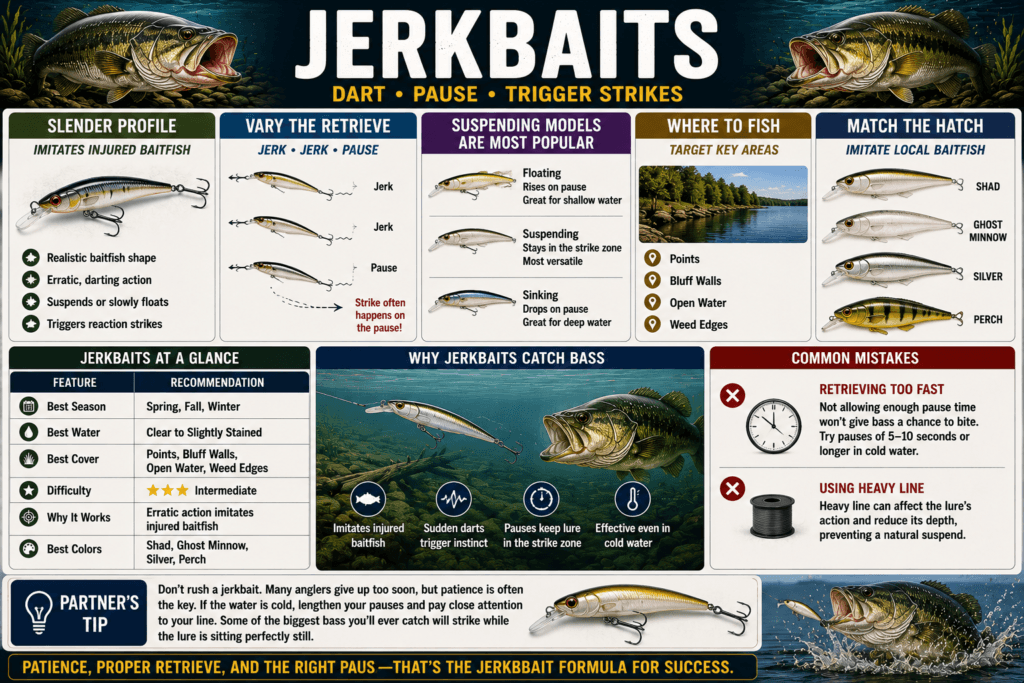
🎣 Jerkbaits at a Glance
| Feature | Recommendation |
|---|---|
| Best Season | Spring, Fall, Winter |
| Best Water | Clear to Slightly Stained |
| Best Cover | Points, Bluff Walls, Open Water, Weed Edges |
| Difficulty | ⭐⭐⭐ Intermediate |
| Why It Works | Erratic action imitates injured baitfish |
| Best Colors | Shad, Ghost Minnow, Silver, Perch |
Why Jerkbaits Catch Bass
Jerkbaits trigger a bass’s instinct to attack injured prey. Their sudden side-to-side movement, followed by a motionless pause, creates an easy target that bass often cannot resist. During colder water temperatures, when fish are less willing to chase fast-moving lures, a suspending jerkbait can remain in the strike zone long enough to provoke a bite from even sluggish bass.
Common Mistakes
One of the biggest mistakes anglers make is retrieving jerkbaits too quickly without allowing enough pause time. In cold water, pauses of five to ten seconds—or even longer—can dramatically increase strikes. Another common mistake is using heavy fishing line, which can reduce the lure’s depth and interfere with its natural suspending action.
🎣 Partner’s Tip
Don’t rush a jerkbait. Many anglers give up too soon, but patience is often the key. If the water is cold, lengthen your pauses and pay close attention to your line. Some of the biggest bass you’ll ever catch will strike while the lure is sitting perfectly still.
🎣 Lipless Crankbaits
Lipless crankbaits are one of the most versatile search lures in bass fishing. Unlike traditional crankbaits, they have no diving bill and sink naturally through the water column, allowing anglers to fish them at almost any depth. Their tight wobble and built-in rattles create vibration and sound that can trigger aggressive reaction strikes from bass throughout the year.
One of the biggest advantages of a lipless crankbait is its ability to cover water quickly. Whether you’re fishing shallow grass flats, rocky points, or open water, these lures allow you to locate active fish in a short amount of time. They can be retrieved steadily, ripped through vegetation, or allowed to sink before beginning the retrieve, making them effective in a wide variety of conditions.
Lipless crankbaits are especially productive during the spring and fall when bass are actively feeding. Their realistic baitfish profiles and vibrating action imitate shad and other forage species, making them a favorite choice for anglers searching for schools of bass.
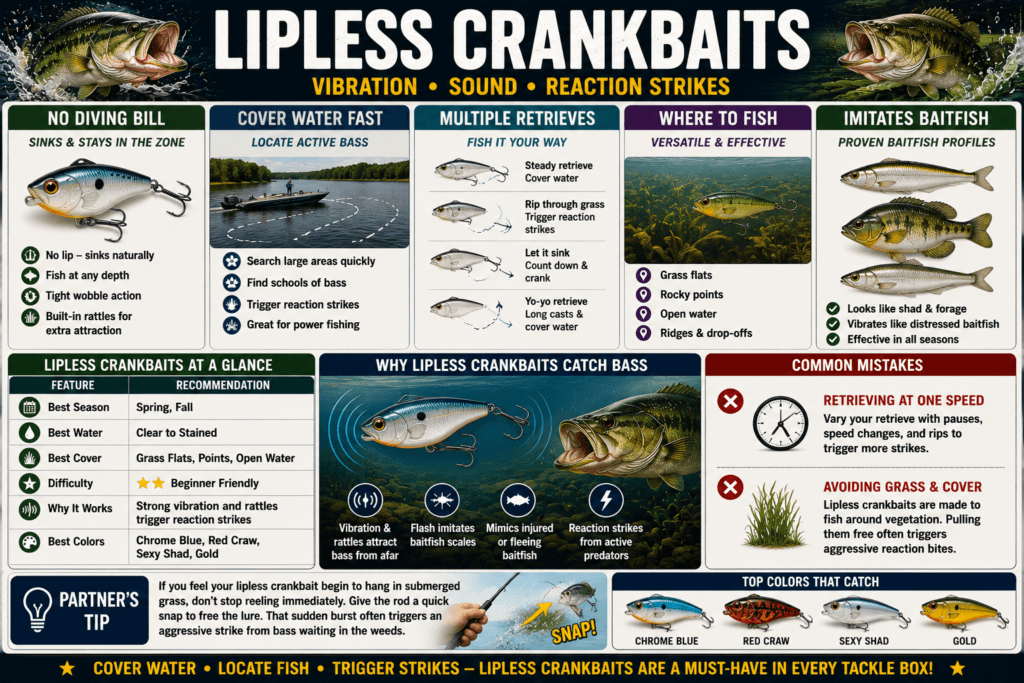
🎣 Lipless Crankbaits at a Glance
| Feature | Recommendation |
|---|---|
| Best Season | Spring, Fall |
| Best Water | Clear to Stained |
| Best Cover | Grass Flats, Points, Open Water |
| Difficulty | ⭐⭐ Beginner Friendly |
| Why It Works | Strong vibration and rattles trigger reaction strikes |
| Best Colors | Chrome Blue, Red Craw, Sexy Shad, Gold |
Why Lipless Crankbaits Catch Bass
The combination of vibration, flash, and sound makes lipless crankbaits extremely effective for locating active bass. Because they sink, anglers can control the depth simply by counting the lure down before beginning the retrieve. Many strikes occur when the lure is ripped free from submerged grass, as the sudden burst of speed imitates a frightened baitfish trying to escape.
Common Mistakes
One common mistake is retrieving the lure at only one speed. Mixing in pauses, speed changes, or ripping the lure through vegetation often produces more strikes. Another mistake is avoiding grassy areas because of fear of snags. Lipless crankbaits are designed to work around vegetation, and pulling them free from grass is one of the best ways to trigger reaction bites.
🎣 Partner’s Tip
If you feel your lipless crankbait begin to hang in submerged grass, don’t stop reeling immediately. Give the rod a quick snap to free the lure. That sudden burst often triggers an aggressive strike from bass waiting in the weeds.
🎣 Topwater Lures
Few experiences in freshwater fishing compare to watching a bass explode on a topwater lure. Whether it’s the splash of a largemouth crushing a frog in heavy cover or the violent strike on a walking bait at sunrise, topwater fishing delivers some of the most exciting moments an angler can experience. While topwater lures may not always produce the highest number of fish, they consistently produce some of the most memorable catches.
Looking for more surface action? Check out our upcoming Complete Guide to Topwater Bass Fishing.
Topwater lures are designed to stay on the water’s surface and imitate injured baitfish, frogs, insects, or other prey. They work by creating surface disturbance that attracts nearby bass. Depending on the lure, this disturbance may come from splashing, popping, walking side to side, or churning the water. Learning how each style moves will help you choose the right presentation for the conditions you’re fishing.
The best times to fish topwater lures are during low-light conditions such as early morning, late evening, or on overcast days. Calm water often provides ideal conditions because bass can easily detect movement on the surface. However, some topwater lures, such as buzzbaits, also excel on windy days by creating enough commotion to draw fish from a distance.
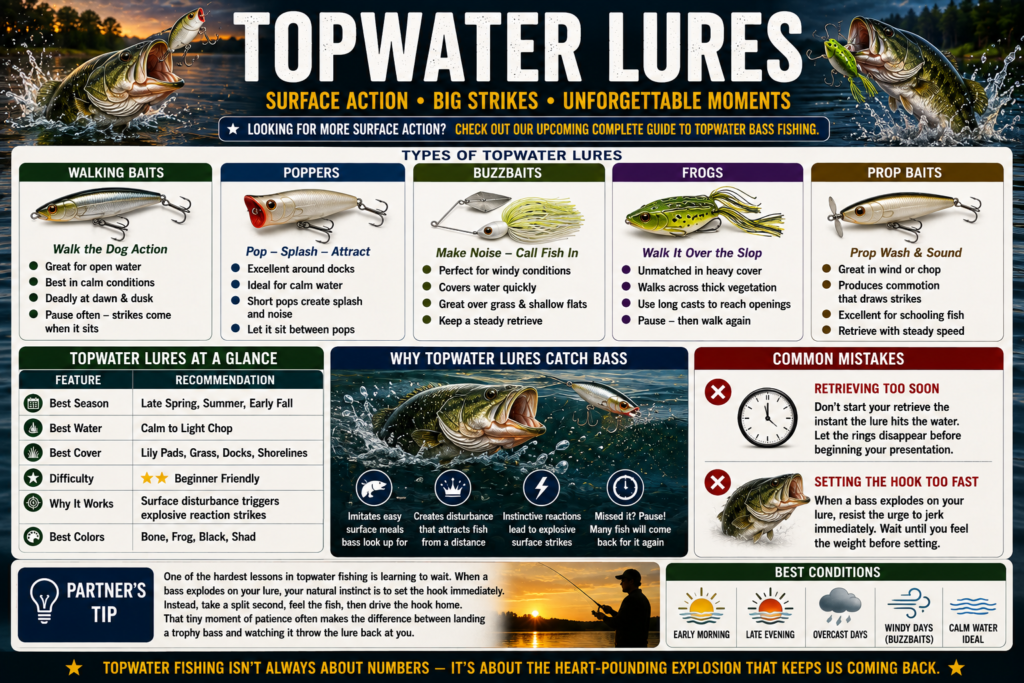
🎣 Topwater Lures at a Glance
| Feature | Recommendation |
|---|---|
| Best Season | Late Spring, Summer, Early Fall |
| Best Water | Calm to Light Chop |
| Best Cover | Lily Pads, Grass, Docks, Shorelines |
| Difficulty | ⭐⭐ Beginner Friendly |
| Why It Works | Surface disturbance triggers explosive reaction strikes |
| Best Colors | Bone, Frog, Black, Shad |
Why Topwater Lures Catch Bass
Bass naturally look upward for easy meals. Frogs, injured baitfish, mice, insects, and other prey often become vulnerable when they break the water’s surface. Topwater lures imitate these opportunities, triggering instinctive reaction strikes. Even when bass miss the lure on the first attempt, it’s often worth pausing briefly before continuing the retrieve, as many fish will come back for a second strike.
Different topwater lures excel in different situations. Walking baits cover open water effectively, poppers shine around calm shorelines and docks, buzzbaits are excellent for covering water quickly, and hollow-body frogs are unmatched for fishing heavy vegetation where other lures would constantly snag.
Common Mistakes
Many anglers begin retrieving a topwater lure the instant it lands. Instead, let the rings on the water disappear before starting your retrieve. Another common mistake is setting the hook too quickly. When a bass explodes on a surface lure, resist the urge to jerk immediately. Wait until you feel the weight of the fish before setting the hook to improve your hookup percentage.
🎣 Partner’s Tip
One of the hardest lessons in topwater fishing is learning to wait. When a bass explodes on your lure, your natural instinct is to set the hook immediately. Instead, take a split second, feel the fish, then drive the hook home. That tiny moment of patience often makes the difference between landing a trophy bass and watching it throw the lure back at you.
❓ Frequently Asked Questions
What is the best bass lure for beginners?
Soft plastic worms are one of the best lures for beginners because they’re affordable, versatile, and catch bass in a wide variety of conditions. A 5-inch stick worm rigged Texas-style or wacky-style is an excellent place to start.
What time of day is best for bass fishing?
Early morning and late evening are often the most productive times, especially during the warmer months. Bass are generally more active during low-light conditions, although they can be caught throughout the day by adjusting your presentation and fishing deeper water when necessary.
How many bass lures do I really need?
You don’t need dozens of lures to catch bass consistently. Start with a few proven choices, such as soft plastics, spinnerbaits, crankbaits, and a topwater lure. As you gain experience, you can gradually expand your tackle selection.
What colors work best in clear water?
Natural colors like green pumpkin, watermelon, shad, and silver tend to work best because they closely resemble the forage bass are accustomed to seeing.
What colors work best in muddy water?
In stained or muddy water, choose colors that create a stronger silhouette or vibration, such as black and blue, chartreuse, white, or bright crawfish patterns.
Can I catch bass year-round?
Yes. Bass can be caught during every season. The key is understanding how seasonal changes affect their location and behavior, then choosing techniques and lures that match those conditions.
Should I use live bait or artificial lures?
Both catch bass, but artificial lures offer greater versatility and help anglers develop techniques that can be used in many different fishing situations. Learning to fish artificial lures also allows you to cover more water and experiment with different presentations.
What’s the biggest mistake new bass anglers make?
Many beginners fish too quickly and change lures too often. Slow down, build confidence with one or two proven lures, and focus on understanding where bass are likely to be before constantly changing your tackle.
⚠️ Common Beginner Mistakes
Even experienced anglers continue learning, but avoiding these common mistakes will help you catch more bass sooner.
Fishing Too Fast
Many anglers retrieve their lures faster than bass are willing to chase them. Slowing down often results in more strikes, especially in cooler water or when fish are less active.
Constantly Changing Lures
Instead of switching lures every few casts, spend time learning how to fish one lure effectively. Confidence comes from understanding your presentation, not from constantly tying on something new.
Ignoring Seasonal Patterns
Bass behavior changes throughout the year. Learning where bass move during each season will improve your success far more than buying additional tackle.
Fishing Where There Is No Cover
Bass relate to structure and cover. Fallen trees, docks, rocks, weed edges, and drop-offs all provide excellent places to find fish.
Buying Too Much Tackle Too Soon
A well-organized tackle box filled with a handful of proven lures is often more effective than owning dozens of lures you haven’t yet learned to fish. Build your collection gradually as your experience grows.
Not Watching the Weather
Cloud cover, wind, water temperature, and seasonal weather patterns all influence bass behavior. Paying attention to changing conditions will help you make better decisions on the water.
🎣 Partner’s Advice
Remember, every experienced angler was once a beginner. Don’t measure your success by the number of fish you catch on a single trip. Measure it by what you learned. Every cast, every missed strike, and every fish landed teaches you something that will make you a better angler the next time you’re on the water.
🎣 Final Thoughts
Bass fishing is more than just catching fish—it’s about learning, growing, and enjoying every moment spent on the water. Every trip teaches something new, whether it’s discovering a productive stretch of shoreline, learning when to slow down your presentation, or finally figuring out why the bass were holding in a particular spot.
If there’s one thing I hope you take away from this guide, it’s that becoming a successful bass angler doesn’t happen overnight. It comes from building confidence one cast at a time. You don’t need the most expensive boat, the latest electronics, or a garage full of tackle to catch bass consistently. What matters most is understanding the fish, paying attention to the conditions, and continuing to learn every time you head out.
I encourage you to start with a few proven lures, practice the techniques we’ve covered, and enjoy the process of becoming a better angler. The more time you spend on the water, the more those lessons will come together, and before long you’ll develop the confidence to adapt to changing conditions and make better decisions on every fishing trip.
Most importantly, remember why you started fishing in the first place.Whether you’re introducing a child or grandchild to the sport, spending a quiet morning on your favorite lake, or chasing the bass of a lifetime, those moments are what make fishing truly special.
Thank you for spending your time with CatchCrafter. I truly appreciate you joining me on this journey to become a better bass angler.
I hope this guide helps you catch more bass, build more confidence, and create memories that last a lifetime.
Remember, no one masters bass fishing overnight. Every trip teaches something new, and every fish—whether you land it or lose it—makes you a better angler.
Most importantly, enjoy your time on the water, respect the resource, and never stop learning.
I’ll see you on the next adventure.
Until next time… Tight Lines!
— Thaddeus 🎣
🎣 Enjoyed This Guide?
If this guide helped you become a more confident bass angler, consider exploring more beginner-friendly fishing guides here on CatchCrafter.
Whether you’re interested in crappie, walleye, or improving your fishing skills, we’re here to help you enjoy more successful days on the water.
Until next time… Tight Lines!
About the Author
Hi, I’m Thaddeus, the creator of CatchCrafter.
I built this website to share practical freshwater fishing knowledge in a way that’s easy for beginners to understand while still offering value to experienced anglers. My goal is simple—to help more people enjoy fishing and spend more successful days on the water.